Learn More
When a media production operation starts to feel chaotic, the causes are usually predictable: a major live event the following day, a client who has unexpectedly doubled their order volume, a key engineer unavailable on a job that was already tight on resource management. These moments get treated as bad luck or exceptional circumstances, but they are neither. They are what happens when complex, interdependent operations run on scheduling infrastructure that was not built for the load it is carrying.
The deeper problem is not that organizations fail to plan. Most plan extensively. The problem is that the planning is distributed across spreadsheets, booking systems, email confirmations, and the working memory of experienced coordinators, which means nobody has a complete, accurate, real-time picture of whether the right people are on the right jobs, whether equipment conflicts are developing, or whether the current slate of work will land within budget. When conditions change, as they always do, the response is improvised rather than informed.
When headcount is not the answer
The instinct when operations feel disorganized is to add coordination capacity: more planners, more schedulers, more people whose job is to hold the complexity together. This helps, up to a point. In organizations where the underlying scheduling infrastructure is fragmented, however, additional headcount mostly means more people working around the same structural problem rather than solving it. The coordination overhead grows with the team, and the fundamental gap persists.
The broadcast organizations and production facilities that run most efficiently are not typically the ones with the largest planning teams. They are the ones whose operational visibility is clearest. Schedulers can see in real time which staff are available for which jobs. Equipment conflicts surface before they affect delivery. When scope changes or a resource drops out, the impact on the rest of the schedule is immediately visible, which means the response can be a considered adjustment rather than a scramble.
That clarity comes from architecture: a single system where personnel planning, equipment, schedules, and costs all live together and update continuously, rather than being distributed across tools that do not talk to each other. This is what resource and production scheduling looks like when it is built correctly.
The cost tracking problem nobody talks about
Production scheduling receives most of the attention in production operations discussions, but the financial layer is where fragmentation creates its most persistent damage.
In organizations where quoting and invoicing and scheduling live in separate systems, the gap between estimated and actual cost on any given job is rarely visible until well after delivery. Overtime is absorbed informally. Equipment usage is not reconciled against bookings. A job that appeared profitable at the quoting stage turns out to be margin-neutral or worse, and the assumption underlying the original quote gets applied to the next five jobs before anyone notices the pattern.
Closing this gap requires treating the financial workflow and the operational workflow as the same workflow. The quote sent to a client should be built from the same resource and rate data that governs scheduling integration. Timecards should feed directly into cost tracking rather than being submitted separately and matched later. Purchase orders and invoices should be generated from the job record rather than assembled from scratch after delivery. When these elements are integrated, the difference between estimated and actual cost narrows materially. When they are not, it compounds over time in ways that are difficult to trace and expensive to correct.
AI-powered scheduling and the Xytech MCP Server
One of the more significant recent developments in production scheduling is the introduction of conversational AI as an operational layer, not as a replacement for scheduling judgment but as a way to remove the friction from the queries that consume a disproportionate share of a scheduler's time.
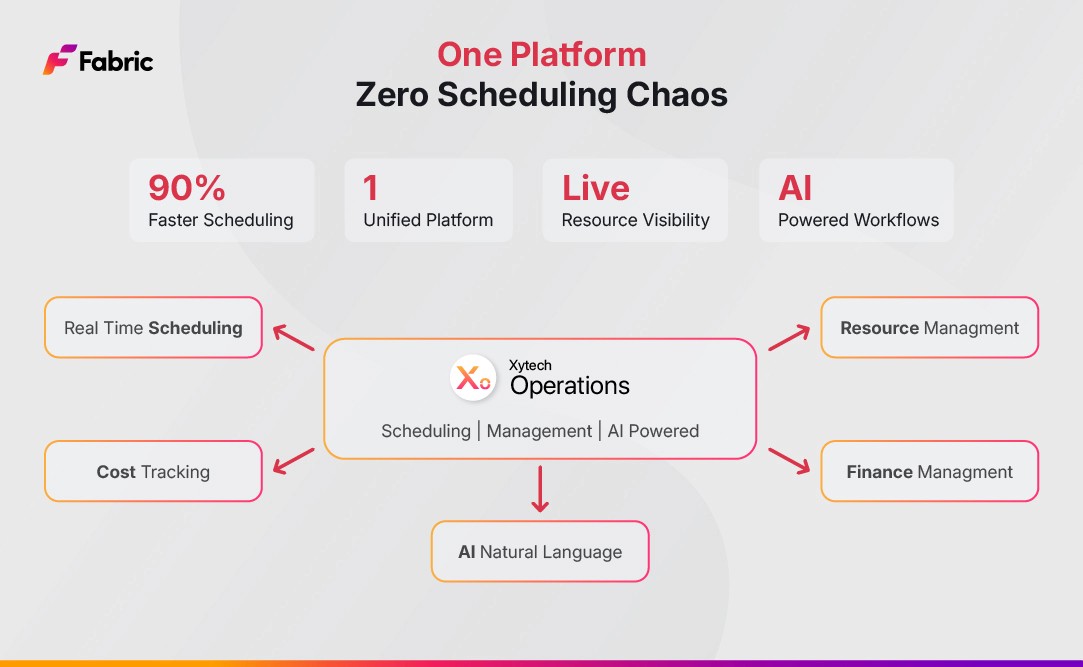
Xytech Operations includes Xytech AI, which adds a natural language interface to scheduling and resource data. A coordinator can ask which engineers are available for a specific shift, or which studios have conflicts on a given afternoon, and receive a structured answer drawn from live operational data in seconds. The impact on the most time-intensive part of the broadcast operations scheduling process is measurable: Fabric's own testing, shared publicly by CEO Rob Delf at DEG's EnTech Fest in 2026, points to a 90% reduction in time spent creating initial resource allocations and schedules. For organizations handling high booking volumes across complex resource pools, that kind of reduction changes what is achievable in a working day.
The Xytech MCP Server extends this capability further, exposing scheduling and resource data through a structured API layer that powers both Xytech AI and broader enterprise AI integrations. For organizations building their own AI-assisted workflows, or connecting Xytech into a wider large-scale operations stack, the MCP Server provides the integration layer without requiring custom development. For a fuller picture of how this connects to media lifecycle management and delivery coordination across the Xytech platform, Fabric's unified media operations overview covers how the three products work together.
How Xytech Operations brings it together
Xytech Operations is built around the principle that production scheduling, resource management, and financial tracking should function as a single integrated system rather than three separate problems handled by three separate tools.
The platform manages equipment scheduling across studios, stages, edit suites, vehicles, and technical gear, with real-time availability visibility and conflict detection before bookings are confirmed. People management covers crews, freelancers, and staff with support for timecards, labor rules, working agreements, and utilization tracking. The financial layer connects quoting and estimates directly to job and resource data, so that purchase orders, invoicing, and cost reconciliation all flow from the same operational record rather than being assembled separately after delivery.
The practical result is that a scheduler building a booking can see resource availability, identify conflicts, generate a cost estimate, and confirm a quote within a single interface, and the actual costs of delivering that job flow back automatically into the financial record without a separate reconciliation exercise.
Xytech Operations connects with Xytech Media for media lifecycle and workflow orchestration, and with Xytech Transmission for contribution and delivery coordination, sharing scheduling, cost tracking, and issue management foundations across the full Xytech platform.
Stay ahead of the curve
We publish regular insights on media operations, production scheduling, and the technology shaping how modern broadcast and production organizations run. Follow Fabric on LinkedIn to stay current.
Fabric is a global media technology company. The Xytech product family, includingXytech Media,Xytech Operations, andXytech Transmission, powers media lifecycle management, resource scheduling, and transmission workflows for media organizations worldwide.
FAQ
Similar Articles
We're constantly pushing the boundaries of what's possible and seeking new ways to improve our services. Search your topic of interest.