Learn More
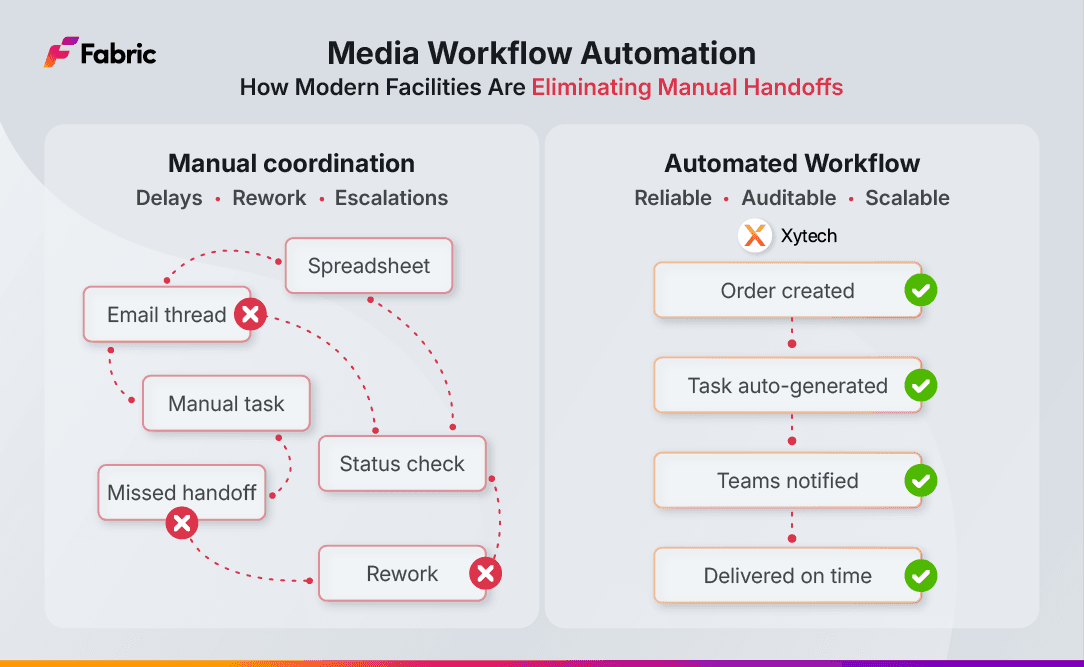
Ask any operations manager at a media facility what eats their team's time, and you will hear some variation of the same answer: chasing. Chasing status on jobs that should have moved forward hours ago. Chasing the team upstream to confirm a handoff that was supposed to happen but wasn't logged anywhere. Chasing the reason a deliverable came back wrong when the brief was clear.
The interesting thing is that most of these facilities are not disorganized. Their people are skilled and experienced. The problem is that the coordination layer connecting those people, the system that routes work, tracks progress, and surfaces problems before they become crises, is held together by email threads, spreadsheets, and institutional memory. That works until volume picks up, turnarounds tighten, or a key person is unavailable. Then the cracks show fast.
What separates high-performing media service operations from the rest is not talent or effort. It is whether the workflows that move media assets through services and teams run on explicit, automated rules, or on people remembering to push things forward.
The hidden cost of manual coordination
There is a version of this problem that is immediately visible: the missed deadline, the duplicated job, the client escalation. Operations managers know these moments well because they generate noise. Urgent calls, post-mortems, apologies.
The more expensive version is invisible. It lives in the cumulative overhead of coordination work that looks productive but produces nothing: the time spent manually creating work orders that a system could generate automatically, the status check-ins that exist because no one has a live view of job progress, the rework triggered by a dependency that got missed because it was tracked in someone's head rather than in the system.
This overhead scales with volume. Every additional job, every additional service type, every additional team member added to the mix creates more coordination surface area. The facilities that grow most efficiently are the ones that have removed this overhead from the equation. A complex multi-step order covering QC, localization, mastering, and platform delivery generates its full downstream task chain automatically the moment it is logged, with dependencies enforced, deadlines set, and the right teams notified without a coordinator touching it.
The gap between jobs that require human pushing and jobs that run on rules is what media workflow automation closes.
What breaks first, and why
In high-volume environments, manual coordination fails in a predictable sequence. Task creation is always the first bottleneck: media work orders sit unactioned not because resources are unavailable but because no one has formally generated the downstream tasks yet. Lag at intake compounds through every subsequent step.
Dependency management breaks next. A complex job has sequencing requirements. Certain steps cannot begin until others complete. When those rules live in people's heads or in informal communication, they get missed. Teams start work before upstream steps are finished and have to redo it. Or they wait unnecessarily because a prior step's completion was never formally communicated.
By the time visibility becomes the presenting problem, with managers unable to give clients accurate status and issues discovered at delivery rather than at the point they occurred, the operational debt has already accumulated across dozens of jobs. The visibility gap is a symptom of the coordination gap, not a separate issue.
How Xytech Media is built for this
Xytech Media is Fabric's media lifecycle management platform, designed specifically for facilities and media service organizations that need structured, automated, and auditable control over how media moves through their operations.
Two capabilities sit at the center of how it works.
Media Library maintains a centralized operational view of media assets as they move through workflows, locations, and services. Every asset has a traceable history: where it came from, what has been done to it, where it is now, and what still needs to happen. This eliminates the visibility gaps that make manual coordination so fragile.
Media Orders is both the order management system and the orchestration engine. When a job is logged, the Media Order defines the services and tasks required to fulfill it, covering QC, processing, delivery, and more, and advances the workflow through each stage automatically as steps are completed. That sequence can span automated processes, manual team tasks, and work fulfilled by external vendors, all tracked within the same order record. Nothing falls through the cracks because the order itself is what holds the workflow together.
What makes this meaningfully different from other media workflow solutions is what sits alongside that orchestration layer: full price and cost tracking built into the same system. Each Media Order carries its associated costs from the moment it is created, including vendor costs for externally supplied work, and flows through to invoicing for external customers without requiring manual reconciliation between operational and financial records. The job, its cost, and its invoice are all part of the same record.
Xytech Media works as part of the broader Xytech platform, connecting media lifecycle management with resource and production scheduling in Xytech Operations and delivery coordination in Xytech Transmission, so that every layer of the operation stays synchronized around shared scheduling, cost tracking, and issue management foundations.
The real measure of a well-run facility
Throughput and on-time delivery are the obvious metrics. But the less visible one, the ratio of coordination work to productive work, is often the more telling indicator of operational health.
In facilities that have automated their core workflows, the coordination layer becomes largely invisible. Jobs move. Exceptions surface. Deadlines are met. The operations team spends its time on the genuinely complex exceptions that require human judgment, not on manually pushing standard jobs through steps that a system should be handling.
That shift does not happen by hiring more coordinators. It happens by building the right infrastructure underneath them. For a broader view of how this fits into a connected media operations platform, the unified media operations approach Fabric takes across Xytech and Origin shows how the workflow, scheduling, and data layers work together.
Get the latest from Fabric
We publish regular insights on media operations, workflow automation, and the technology shaping how modern facilities run. Follow Fabric on LinkedIn to stay current.
Fabric is a global media technology company. The Xytech product family — Xytech Media, Xytech Operations, and Xytech Transmission — powers media lifecycle management, resource scheduling, and transmission workflows for media organizations worldwide.
FAQ
Similar Articles
We're constantly pushing the boundaries of what's possible and seeking new ways to improve our services. Search your topic of interest.