ScheduALL earned its place in broadcast operations the hard way — by being genuinely good at a specific and demanding problem. Transmission scheduling is not a generic workflow. It sits at the intersection of technical infrastructure, operational planning, and real-time pressure in a way that most media operations software either ignores or underserves. SCA did not ignore it.
What transmission scheduling actually requires
The challenge in managing contribution and delivery workflows is that the resources involved are not independent. A satellite uplink, a fiber circuit, an encoding resource, a technical operator — each of these has its own availability constraints, but they are also connected. A booking that works for each individual resource in isolation may still fail if the path between them creates a conflict that point-in-time availability data cannot detect.
ScheduALL understood this. Its transmission scheduling was built around the relationships between resources, not just their individual availability. Operations teams could plan against the full technical chain — not just check whether individual assets were free — which is what made it reliable under pressure.
That relational view is what we’ve now built in Xytech’s X2 Transmission workflow and we can now replicate and extend those workflows even further.
What Xytech’s X2 Transmission delivers now
The core of Xytech X2’s Transmission is contribution resource scheduling — planning and coordinating the technical and operational resources required to move content from source to destination, with full visibility into conflicts and capacity before bookings are confirmed.
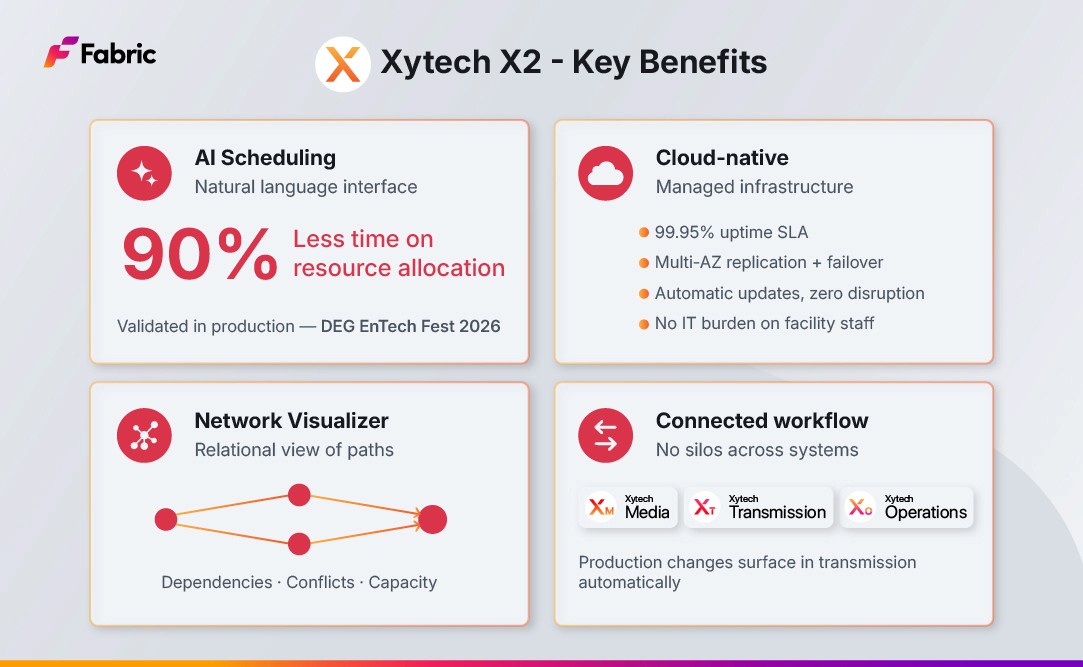
The Network Visualizer is where this becomes operationally concrete. It provides a spatial view of transmission paths, resource dependencies, and utilization across the delivery infrastructure — the kind of picture that makes proactive planning possible at speed. For operations managing multiple simultaneous live events, or coordinating delivery across complex multi-path infrastructure, this is not a marginal improvement over what ScheduALL offered. It is a more capable view of the same problem.
The platform is delivered as a cloud-native hosted application — which matters for transmission operations in ways that go beyond convenience. Software updates arrive automatically, without upgrade projects that risk destabilizing a production environment. Infrastructure reliability is governed by a 99.95% uptime SLA with multi-AZ database replication and automatic failover. The technical foundation that transmission teams depend on is maintained by Fabric's infrastructure team, not by the facility's IT staff.
And Xytech’s X2Transmission does not operate in isolation. It connects directly with X2Operations for upstream production resource planning — so that changes in the production schedule surface in transmission planning automatically — and with X2Media for downstream lifecycle orchestration. The full operational picture is connected rather than siloed across separate systems.
The AI layer that changes what is possible
Beyond the transmission capabilities themselves, the platform now includes something that no on-prem scheduling application can offer: AI-powered scheduling built in partnership with AWS.
Xytech AI, currently live and being rolled out to cloud customers, delivers a 90% reduction in time spent on initial resource allocation and scheduling — a figure validated through Fabric's own testing and shared publicly by CEO Rob Delf at DEG's EnTech Fest in 2026. For transmission operations where the complexity of multi-resource coordination has historically required significant time from experienced schedulers, this is a material change in what is operationally possible in a given day.
The natural language interface means that coordinators can query scheduling data, check availability, and surface conflicts in plain language — without navigating reports or cross-referencing multiple views. The answers are drawn from live operational data, and Xytech is ready for them now.
What has actually changed since earlier in the migration program
If you looked at Xytech a year or two ago and concluded it was not ready, that assessment was reasonable at the time. The transmission capabilities have been built out significantly since then. X2 — the new cloud-native interface launching in Q2 2026 — addresses the UX complexity that was the most consistent point of friction for users migrating from SCA. The AI scheduling layer is live. The cloud infrastructure is stable and proven.
The platform that exists now is not the same platform that was being offered as a ScheduALL replacement in 2024. That distinction matters, and it is the reason this conversation is worth having again if you closed it previously.
Get the latest from Fabric
Follow Fabric on LinkedIn for Xytech product updates, transmission capability announcements, and media operations insights.
Fabric is a global media technology company. The Xytech product family —Xytech Media,Xytech Operations, andXytech Transmission — powers media lifecycle management, resource scheduling, and transmission workflows for media organizations worldwide.
Read More Articles
We're constantly pushing the boundaries of what's possible and seeking new ways to improve our services.