Learn More
The greenlight meeting has always been a high-stakes ritual. A project is pitched, creative instincts are weighed against commercial ones, and a decision is made — often with more confidence than the available evidence warrants. For most of the industry's history, that was simply the nature of the business. Content decisions required judgment, taste, and a reasonable tolerance for uncertainty.
That calculation is changing. Not because instinct and taste have become less valuable — they haven't — but because the data available to inform those instincts has become dramatically richer. The media companies that are making the sharpest content decisions today are not replacing creative judgment with algorithms. They are supplementing judgment with audience demand intelligence that was simply not accessible a decade ago.
This article explores how that intelligence is being used in practice: what audience demand data actually tells you, where it fits into the content decision process, and what it cannot do.
What audience demand data actually measures
The term "audience demand" gets used loosely, so it's worth being precise about what it means in a content intelligence context.
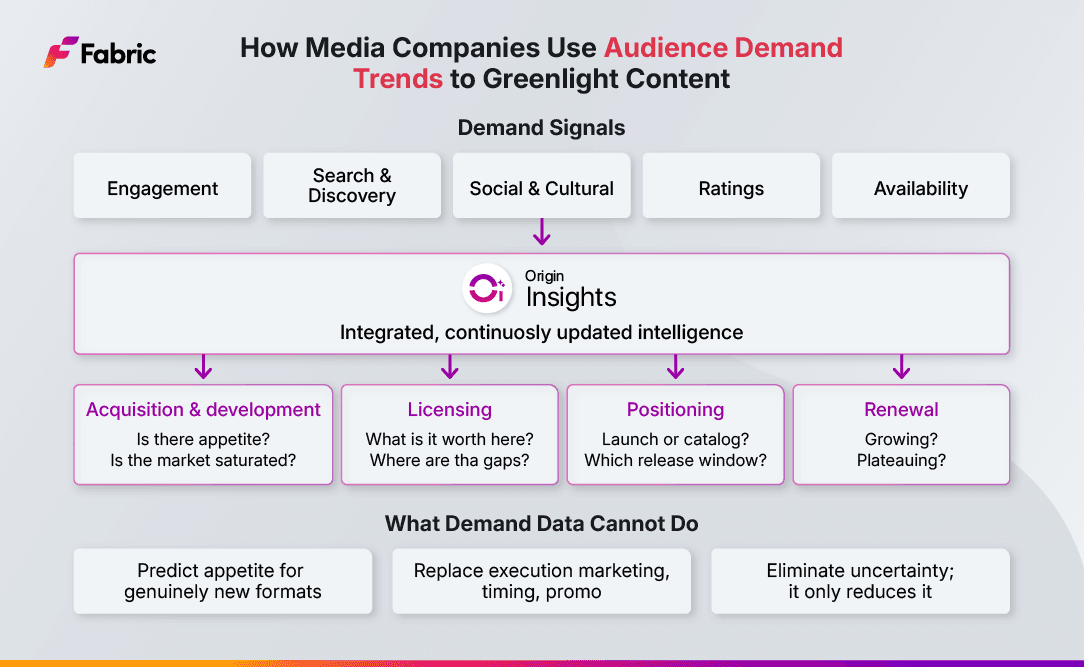
Audience demand data measures the appetite for specific content — titles, genres, formats, talent, franchises — across different platforms, territories, and audience segments. It draws from multiple signal types:
Engagement signals capture how audiences interact with content on streaming platforms: viewing completion rates, rewatch behavior, time-to-start after browse, and drop-off patterns by episode or format. These signals reveal not just what people watch, but how much they value what they're watching — a meaningful distinction.
Search and discovery signals measure what audiences are actively looking for: search query volumes, browse patterns, and the gap between what people seek and what they find. A title that is searched frequently but unavailable in a given territory is a direct acquisition opportunity signal.
Social and cultural signals track conversation volume, sentiment, and velocity around titles, talent, and genres across social platforms. These signals are particularly useful for identifying emerging trends before they peak — the difference between acquiring content at the right moment and arriving after the window has closed.
Ratings and critical signals aggregate audience scores, critic reviews, and award recognition across platforms and territories, providing a normalized view of content performance that is not distorted by any single platform's measurement methodology.
Availability and competitive signals map where content is currently accessible, on which platforms, at what price points, and under what business models. This layer reveals competitive gaps — titles that are in high demand but underserved in specific markets.
No single signal type tells the full story. The value of a proper demand intelligence platform is in the integration: combining these signals into a coherent picture of content performance and market opportunity.
Where demand intelligence fits in the content lifecycle
Audience demand data is not a single-use tool. It applies at multiple points in the content lifecycle, and the questions it answers are different at each stage.
Acquisition and development
At the earliest stage — before content is commissioned or acquired — demand data helps answer questions that used to require expensive custom research or pure intuition: Is there demonstrated audience appetite for this genre in this territory? Is this IP or format already saturated, or is there an underserved gap? Is the talent attached to this project generating growing cultural momentum or fading relevance?
These are not questions that demand data answers definitively. Creative viability, budget, rights availability, and scheduling all factor in. But demand intelligence narrows the uncertainty meaningfully. A project entering the greenlight process with strong demand signals in its target market starts from a better position than one entering without them.
Licensing and rights strategy
For distributors and rights holders, demand data is particularly powerful at the licensing stage. The core question — what is this content worth in this territory right now — has historically been answered through negotiation experience and gut feel. Demand intelligence makes it more systematic.
A title with strong, rising search and social signals in a specific market commands a different conversation than one with flat or declining engagement. Similarly, availability gap analysis — identifying titles that are in high demand but accessible only on competing platforms, or not available at all — creates a map of licensing opportunities ranked by potential audience impact.
Platform positioning and scheduling
Once content is acquired, demand data informs how it is positioned and when it is released. Understanding whether a title is likely to perform better as a catalog anchor or a promotional launch, whether a particular genre is trending in a specific audience segment, or whether a release window conflicts with competing content from other platforms — these are decisions that benefit from demand intelligence at the moment they are made, not in retrospect.
Performance monitoring and renewal
After content is live, demand signals provide an ongoing read on performance that complements platform-native metrics. Tracking whether audience engagement is growing, plateauing, or declining over time — and comparing that trajectory against similar titles — informs renewal decisions, sequel development, and catalog management strategy.
The limits of demand data
Being precise about what demand intelligence cannot do is as important as understanding what it can.
Demand data describes existing appetites. It is less reliable as a predictor of appetite for genuinely new formats or concepts — by definition, there is no existing signal for content that has never existed. The streaming landscape is full of titles that performed well despite modest pre-launch demand signals, and titles that had every demand indicator pointing up and still underperformed. Execution, marketing, timing, and platform promotion matter enormously and are largely outside what demand data can model.
Demand data also reflects the past, not the future. Signals that indicate strong appetite today may shift by the time content is commissioned, produced, and delivered — particularly for fast-moving cultural trends. Demand intelligence is most valuable as an input to decision-making, not as a substitute for it.
The most effective organizations treat demand data the way a good navigator treats instrumentation: as a reliable read of current conditions that informs judgment, not a system that replaces it.
How Origin Insights delivers demand intelligence
Origin Insights is Fabric's market intelligence platform, built specifically for media and entertainment professionals who need a unified, continuously updated view of supply and demand across the global streaming ecosystem.
The scale of the underlying data is what separates it from conventional market research tools. The platform captures over 1.5 billion data points across the global entertainment ecosystem, monitors more than 600 streaming platforms continuously, and scans over 200 million content items every day across 250+ countries and territories— tracked at the granular level of individual episodes, with local pricing and package details captured for each market. When a content team asks where a specific title is available, at what price point, and on which platform tier, the answer is drawn from continuously updated, territory-level data rather than aggregated estimates or periodic survey snapshots.
That data is organized into eight distinct intelligence domains: streaming and VOD availability, demand and popularity signals, pay TV intelligence, pricing and plan tracking, consumer survey data, content metadata, live streaming monitoring, and a content tracker covering distribution and production status across global markets. Each domain addresses a different layer of the decision-making picture; together, they give acquisition, strategy, licensing, and research teams what they need from a single platform rather than from a patchwork of disconnected sources.
For content acquisition teams, Origin Insights provides visibility into audience demand trends by territory and genre, availability gap analysis that surfaces licensing opportunities, and competitive positioning data that maps how similar content is performing across platforms. For strategy and research teams, it delivers the market-level intelligence needed to evaluate territory expansion, pricing optimization, and content portfolio decisions with confidence.
A meaningful recent development is the platform's integration with AI via MCP — the Model Context Protocol — which allows teams to query the full depth of Origin Insights' entertainment market intelligence using natural language, without navigating dashboards or running manual data pulls. A content strategist can ask which platforms carry a specific title in LATAM and receive a structured, real-time answer. A commercial team can query the pricing history for streaming services in a given market and get a compiled view of historical plan and bundle changes. A research team can request demand trends for a title and receive scores and competitive benchmarks automatically compiled into a shareable report. This is what modern media decision-making tools look like when the underlying data infrastructure is genuinely global, continuously updated, and AI-native.
Origin Insights is built on the same metadata foundation as the rest of Fabric's Origin ecosystem — governed in Origin Studio and enriched through Origin Nexus — which means the intelligence it surfaces is grounded in accurate, normalized, continuously updated content data rather than in fragmented or stale inputs.
Join the conversation
The intersection of data and content strategy is one of the most active conversations in the media industry right now. Follow Fabric on LinkedIn to stay connected with the teams and ideas shaping it.
Fabric is a global media data company. The Origin product family — Origin Nexus, Origin Studio, and Origin Insights — powers metadata enrichment, governance, and market intelligence for entertainment companies worldwide.
FAQ
Similar Articles
We're constantly pushing the boundaries of what's possible and seeking new ways to improve our services. Search your topic of interest.