
Learn More
When a streaming platform recommends a film you end up loving, it feels almost personal. Like someone who knows your taste picked it just for you. The reality is less romantic but no less impressive: a recommendation engine processed thousands of signals about that title and matched them against patterns in your behavior. At the center of that process, doing quiet and unglamorous work, is metadata.
Movie and TV metadata is the structured information that describes entertainment content. Titles, genres, cast, crew, themes, ratings, release dates, availability, and dozens of other attributes. It is not the content itself. It is everything that makes the content findable, describable, and recommendable. And for any platform competing on content discovery, it is as strategically important as the content it describes.
What metadata actually is
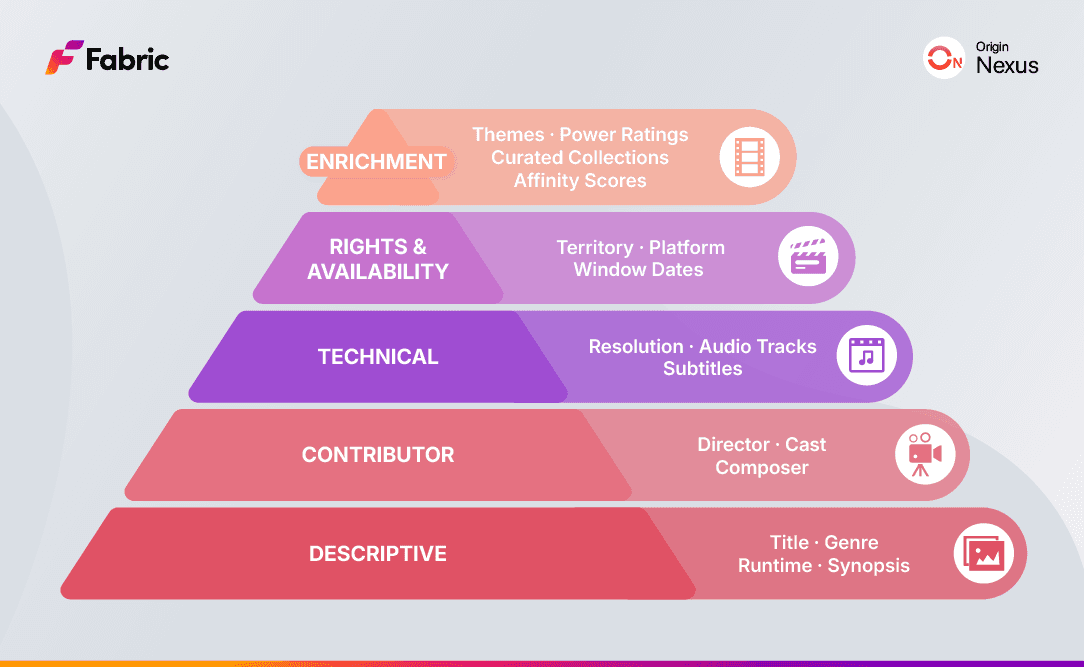
Metadata in the context of film and television describes a title across multiple dimensions. Each layer serves a different purpose and has a different impact on what the platform can do with the content.
Descriptive metadata covers the basic facts: title, original language, country of origin, release year, runtime, format (film, series, miniseries, documentary), genre classifications, synopsis, and tagline. This is the minimum viable set. Enough to list a title in a catalog, but not nearly enough to power discovery.
Contributor metadata covers everyone involved in making the content: directors, writers, producers, cast members, cinematographers, composers. Each contributor is ideally a structured entity with their own record. Not just a name string, but a linked identity with biographical data, filmography, and relationships to other titles and people.
Technical metadata covers format specifications: aspect ratio, audio tracks, subtitle languages, resolution, encoding. This layer matters primarily for delivery and compliance, but it intersects with discovery when platforms surface content by language or format preference.
Rights and availability metadata covers where and when content can be legally accessed: platform availability by territory, subscription tier, rental price, window dates. This is the layer that connects a title in a catalog to a user who can actually watch it right now.
Enrichment metadata is where the real discovery intelligence lives. Thematic tags (revenge narrative, found family, slow burn), mood descriptors, content warnings, audience ratings, critic scores, award history, curated collections, and proprietary signals like popularity indices or affinity scores. This is the layer that makes a recommendation feel intelligent rather than mechanical.
Most platforms have the first two layers. The ones that win on discovery invest seriously in the last one.
Why metadata quality determines discovery quality
The relationship between metadata quality and discovery performance is not theoretical. It is measurable, and the gap between well-structured catalogs and poorly maintained ones shows up directly in engagement metrics.
Consider what happens when a user searches for "something tense and atmospheric, not too long." That query cannot be answered by title, genre, and runtime alone. It requires thematic tags, mood descriptors, pacing signals, and runtime data, all normalized and attached to the right records. A platform with rich enrichment metadata surfaces three or four genuinely relevant titles. A platform without it returns a genre list and hopes for the best.
Or consider the recommendation carousel. The machine learning models that power modern recommendation engines are only as good as the features they are trained on. Sparse metadata, meaning incomplete genre tags, missing cast links, no thematic attributes, produces sparse feature sets, which produce shallow recommendations. The model cannot infer what it was never told.
This is why metadata depth is a competitive variable, not just an operational one. Two platforms with identical content libraries but different metadata quality will deliver meaningfully different discovery experiences. The one with richer, more normalized, more continuously updated metadata will see longer sessions, higher return rates, and lower churn.
The normalization problem
Depth is only part of the challenge. The other is normalization: ensuring that metadata is consistent, structured, and interoperable across titles, sources, and systems.
Entertainment metadata comes from many places. Studios, distributors, aggregators, user contributions, editorial teams, automated pipelines. Each source has its own conventions, taxonomies, and quality standards. One source tags a film as "Thriller / Crime." Another tags the same film as "Crime Drama." A third uses a proprietary genre ontology that maps to neither. None of these are wrong in isolation. Together, they are useless for discovery, because the platform cannot treat them as equivalent.
Normalization is the process of mapping incoming metadata to a consistent internal standard: a controlled vocabulary for genres, a linked entity graph for contributors, a defined schema for availability data. It is painstaking, continuous work. It requires editorial governance, automated validation, and ongoing maintenance as new content arrives and standards evolve.
The platforms that do this well maintain a single, authoritative metadata layer that acts as the source of truth for every downstream system. Recommendation engine, search index, editorial interface, partner feed. Everything downstream trusts the same source. Inconsistencies don't compound.
The platforms that do this poorly end up with metadata that is technically present but practically unreliable. Genre tags that can't be trusted, cast links that are incomplete, and a recommendation engine that has learned to work around the data rather than with it.
The continuous update problem
Metadata is not a one-time investment. It is a living dataset that requires continuous maintenance.
New titles arrive constantly. Existing titles gain new availability windows, lose others, get re-rated, acquire award history, and spawn sequels that create new relationship links. Cast members become more or less prominent in the cultural conversation, changing their editorial weight in discovery algorithms. Platforms launch in new territories, requiring new localization of titles, synopses, and imagery.
For a catalog of any meaningful size, keeping metadata current manually is not feasible. The update velocity is too high and the surface area too large. The practical answer is automated enrichment pipelines that pull from authoritative sources on a defined cadence, validate against a quality schema, and propagate approved updates to downstream systems without human intervention for routine changes.
The operational consequence of falling behind is gradual but compounding. Stale availability data sends users to titles they cannot actually watch. Missing new releases create discovery gaps. Incomplete cast data on newer titles biases recommendations toward older, better-documented content, which is the opposite of what most platforms want.
What this means for platforms evaluating metadata solutions
If your platform competes on content discovery, and most do whether they frame it that way or not, the quality and freshness of your movie and TV metadata is a direct input to that competitive position.
When evaluating metadata providers or enrichment APIs, the questions that matter most are not about volume. Raw title counts are easy to inflate. The questions that matter are about depth, normalization, and currency: How are enrichment attributes sourced and validated? What is the update cadence for availability data? How is the contributor graph maintained as new credits are added? What proprietary discovery signals are available beyond standard attributes? What governance tools exist to maintain quality as the catalog grows?
A provider that answers those questions well is providing infrastructure, not just data. The distinction matters at scale.
How Origin Nexus is built for this
Origin Nexus is Fabric's metadata enrichment and content discovery platform, designed specifically for media companies that need depth, normalization, and continuous currency in their movie and TV metadata.
The platform delivers normalized metadata across titles, contributors, genres, releases, and awards. Maintained editorially and updated continuously, not just seeded once and left to age. Licensed imagery and promotional video are included in the same API, eliminating the operational fragility of sourcing assets separately. Availability data covers streaming platforms by territory with deep links, updated without manual upkeep.
At the discovery intelligence layer, Origin Nexus provides proprietary Power Ratings, thematic collections, and curated signals that go beyond commodity attribute data, giving recommendation engines and editorial teams the features they need to surface content intelligently rather than generically.
For organizations that also need to govern their own catalog records, Origin Nexus integrates directly with Origin Studio, so that enriched data flows from a single, authoritative source into every downstream system.
The platforms that win on discovery in the next five years will not win on content volume alone. They will win on metadata quality. The infrastructure for that starts with how enrichment data is sourced, normalized, and delivered.
Thinking about media data strategy?
The way you structure, enrich, and deliver metadata has a direct impact on how audiences discover and engage with your content. Follow Fabric on LinkedIn for regular insights on metadata strategy, content discovery, and the technology powering modern media operations.
If you're at MPTS on 13–14 May, come see the Fabric team at stand T6. It's the perfect chance to dig into Origin and what it can do for your content strategy. Schedule a 1:1 at meet@fabricdata.com 📅
Fabric is a global media data company. The Origin product family —Origin Nexus,Origin Studio, andOrigin Insights — powers metadata enrichment, governance, and market intelligence for entertainment companies worldwide.
FAQ
Similar Articles
We're constantly pushing the boundaries of what's possible and seeking new ways to improve our services. Search your topic of interest.


