Learn More

We came to NAB 2026 with a lot to show. We left with something we did not expect to be writing about quite this quickly: Origin Studio has been named Product of the Year by the NAB Show in the Media Supply Chain, Automation and Management category.
The award was announced on April 22, 2026, during a ceremony at the Las Vegas Convention Center. Winners were selected by a panel of industry experts across 16 categories. You can read the full list of 2026 Product of the Year winners on the NAB Show website.
We are proud of this recognition — and we think the category it came in is worth talking about, because it reflects exactly the problem Origin Studio was built to solve.
Why the category matters
Media Supply Chain, Automation and Management is not the most glamorous category in the awards program. It does not have the visual impact of camera hardware or the buzz of AI-generated content tools. But for anyone who has spent time inside a studio, a distributor, or a streaming platform trying to get content from production to audience reliably and at scale, it represents something important: the infrastructure layer that everything else depends on.
Content supply chains can fail quietly. A title goes live with the wrong synopsis. A rights window is missed because the metadata in one system did not match the record in another. A platform integration takes three times as long as it should because the internal catalog was never clean enough to deliver from. These are not dramatic failures — they are the persistent, costly friction of operating without a governed metadata foundation.
That friction is what Origin Studio was built to eliminate.
What Origin Studio does
Origin Studio is Fabric's metadata management platform — the system that media organizations use to create, govern, enrich, and deliver their canonical content records across the full supply chain.
At its core, it provides a single authoritative source of truth for title and episode metadata: a hierarchical record structure covering series, seasons, episodes, and compilations, built around the way media workflows actually operate rather than the way a generic database would model them. Every record is governed — with configurable metadata models, role-based permissions, and stage-based governance flows that take content from draft through to publication — so that the question of who changed what, when, and with whose approval always has an answer.
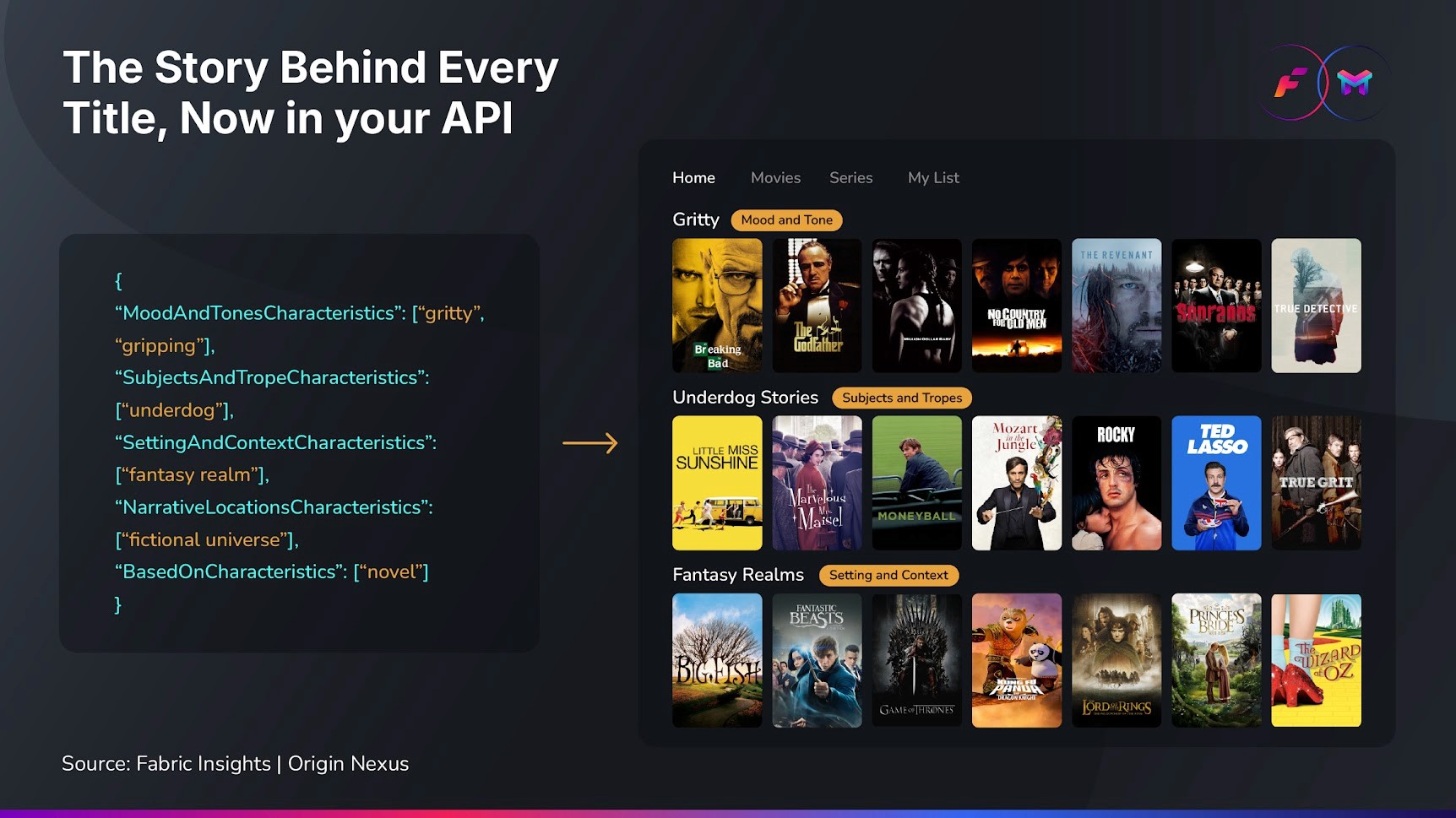
What makes Origin Studio distinct from a content database or a spreadsheet-based catalog is the enrichment layer. Records are created and continuously enriched through direct integration with Origin Nexus, pulling in normalized metadata, licensed imagery, contributor data, and availability information automatically rather than waiting for manual input. The result is a catalog that stays accurate and complete without requiring a team to maintain it field by field.
Delivery is API-first. Downstream systems — MAMs, CMS platforms, scheduling tools, distribution pipelines, partner portals — receive metadata directly via API rather than through manual exports and re-entry. When a record changes, the change propagates. The operational overhead that comes from maintaining metadata separately in each downstream system largely disappears.
For studios and distributors managing global catalogs, Origin Studio also handles the localization, versioning, and territorial complexity that multi-market distribution requires — multiple edits, multiple language versions, multiple platform specifications — without collapsing them into a single undifferentiated record or requiring a separate workflow for each territory.
Part of a connected platform
Origin Studio does not operate in isolation. It sits at the foundation of Fabric's Origin product family — the governance layer that Origin Nexus enriches and Origin Insights transforms into market intelligence.
Together, the three products cover the full metadata lifecycle: Studio governs the source of truth, Nexus activates it for content discovery and distribution, and Insights turns it into strategic intelligence for content acquisition, pricing, and competitive positioning. The connection between them means that the data used to manage content and the data used to make decisions about it come from the same trusted, continuously updated foundation — rather than from separate systems that have to be reconciled after the fact.
This connected architecture is what NAB's panel of industry experts recognized when they selected Origin Studio for the award. Not just a product that solves one problem well, but a platform capability that changes how the media supply chain works.
Join the conversation
If you're heading to MPTS, come find Aurore Gilewicz and Andy Hooper. It's the best way to understand how Origin Studio can enhance your company. Schedule a 1:1 at meet@fabricdata.com
Follow Fabric on LinkedIn for updates on Origin Studio, the rest of the Origin product family, and what we are building next.
Fabric is a global media data company. The Origin product family —Origin Nexus, Origin Studio, and Origin Insights — powers metadata enrichment, governance, and market intelligence for entertainment companies worldwide.
FAQ
Similar Articles
We're constantly pushing the boundaries of what's possible and seeking new ways to improve our services. Search your topic of interest.