
Learn More
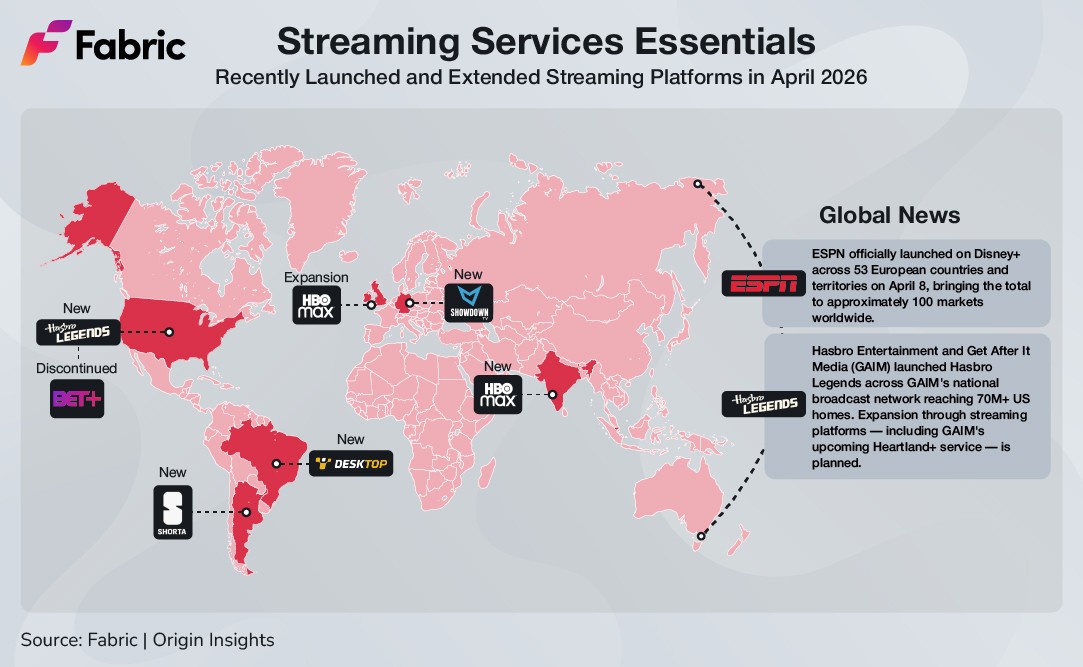
April 2026 was one of those months where threads that have been developing quietly in the streaming market suddenly became visible. HBO Max completed a major phase of its international rollout. The AVOD tier continued its structural consolidation. Sports rights reshaped the competitive map in two separate regions. And a handful of niche platform launches pointed to where the next wave of fragmentation is heading.
For content strategy and distribution teams, these are not isolated news items. They are signals about where audiences are moving, where content windows are opening and closing, and where the competitive dynamics of the next twelve months are being set up right now.
HBO Max finishes what it started
The most significant rights and availability shift of the month was HBO Max completing its European rollout with launches in the UK and Ireland, while simultaneously launching in India through a partnership with JioHotstar. Twenty-two new market launches in 2026 alone.
For distributors and rights holders tracking where premium content lives, this matters in practical terms. In the UK, HBO Max becomes the new home of TNT Sports, replacing discovery+. In India, the service enters as an add-on hub on one of the country's largest streaming platforms, priced accessibly at the equivalent of roughly $0.60 per month at entry tier.
The dual-market timing is deliberate. WBD is establishing a global availability footprint for its premium content in a compressed window, which changes the competitive context for any platform that has been licensing HBO content in these territories or adjacent ones. Availability gaps that existed three months ago no longer exist. For teams making content acquisition and licensing decisions, that is the kind of shift that platform availability intelligence needs to capture in real time rather than in a quarterly report.
AVOD is consolidating, not contracting
April produced three significant AVOD developments that, read together, tell a more interesting story than any of them does individually.
Pluto TV announced a comprehensive overhaul: backend integration with Paramount+, a redesigned app moving away from the channel-grid default toward on-demand-first personalized rows, and new product leadership from a former Meta and Google executive. The target is mid-2026 for a full debut. Tubi, meanwhile, expanded its Canadian library by over 600 titles through deals with five major studios, continuing its 30% year-over-year MAU growth in that market since 2020. And BET+ announced it will shut down as a standalone service in June, with approximately 1,000 hours of content migrating to a dedicated BET Hub on Paramount+.
The pattern here is rationalization, not retreat. The platforms that are thriving in the AVOD tier are investing heavily in product experience and content depth. The ones that are not thriving are being absorbed into larger ecosystems rather than simply closed. For content owners evaluating AVOD distribution strategy, the relevant question is not whether the model works but which platforms within it are building durable audience relationships versus serving as temporary homes for content in transition.
Sports rights are redrawing regional maps
Two separate sports rights developments in April had direct implications for regional streaming competition.
In Central America, Fox completed its acquisition of Tigo Sports from Millicom, gaining sports broadcasting rights, production infrastructure, and a footprint across six markets. A Fox sports network launches in the region in May 2026, with content also available on Tubi and future Fox streaming properties. The rights package includes Premier League, UEFA Europa League, Bundesliga, Liga MX, and Formula E among others. This is a significant reshaping of the sports streaming landscape in a region that has historically been underserved by major sports rights holders.
Globally, ESPN completed its expansion onto Disney+ across 53 European countries and territories in April, bringing the total to approximately 100 markets worldwide. For any platform or distributor operating in European markets with sports audiences, the competitive availability picture for live sports content changed materially in a single month.
Sports rights remain the clearest driver of platform launches, expansions, and subscriber acquisition decisions globally. Tracking where those rights sit, and when they move, is foundational to any distribution or content strategy that involves sports-adjacent audiences. It is also one of the areas where real-time market intelligence has the most direct commercial impact, because the window between a rights move and its effect on audience availability is narrow.
Niche platforms are finding specific audiences
Three platform launches in April pointed in the same direction: specific editorial identities are outperforming generic ones in a crowded market.
Shorta launched in Argentina as Latin America's first platform dedicated to vertical series, with more than 40 original titles in horror, sci-fi, comedy, and thriller formats, operating on a profit-sharing model. ShowdownTV launched in Germany as a dedicated combat sports and live events platform. Hasbro Legends launched in the United States as a linear broadcast channel dedicated to Hasbro's franchise IP library, reaching 70 million homes through a national broadcast network with streaming expansion planned.
These are not scale plays. They are audience-specificity plays. Each one is targeting a defined community with content that general-purpose platforms are not prioritizing. The monetization models differ, but the strategic logic is consistent: in a market where discovery is driven by algorithmic recommendation, owning a specific audience identity is a more durable position than competing for share of a broad one.
For audience demand trend analysis, niche platform launches like these are leading indicators of where underserved appetite exists in the market before it shows up in mainstream platform data. Understanding the metadata layer behind content discovery is what makes the difference between spotting these signals early and arriving after the window has closed.
What April's signals mean for content strategy
Taken together, the month's developments reinforce several dynamics that content strategy and distribution teams should be tracking actively.
Premium content availability is consolidating around fewer, larger platforms in major markets, with HBO Max's rollout being the clearest example. The window for licensing premium content outside those platforms is narrowing in the territories where they are establishing direct relationships with audiences.
The AVOD tier is becoming more competitive at the top and less hospitable at the bottom. Platforms with strong product experience and content depth are pulling further ahead. Content that is currently distributed across mid-tier AVOD platforms may need to be reassessed as those platforms get absorbed or restructured.
Regional sports rights are creating new distribution dynamics in markets that have historically been overlooked. Central America and broader European markets are both experiencing significant shifts in who controls the most valuable live sports rights, with direct implications for platform strategies in those regions.
And the continued emergence of niche platforms suggests that audience demand data at the genre and format level is becoming more actionable, not less, as the market fragments. Understanding where specific audiences are migrating is more valuable than tracking aggregate subscriber numbers.
Acting on these signals requires more than a monthly news digest. It requires governed catalog data, continuous enrichment, and real-time intelligence working together. Origin Studio, which was recognized as a NAB Show 2026 Product of the Year for Media Supply Chain, Automation and Management, provides the catalog governance layer. Origin Nexus keeps that catalog enriched and current across thousands of platforms. And Origin Insights transforms those inputs into the market intelligence that makes decisions like the ones described in this article faster and more grounded. Together, they represent Fabric's connected approach to the media supply chain.
Get the full picture every month
The Streaming Services Essentials report tracks every platform launch, expansion, update, and exit across more than 121,000 streaming services worldwide, with variables including revenue model, content type, ownership, and territory-level availability. Published monthly. To receive it, write to sales@fabricdata.com.
Follow Fabric on LinkedIn for monthly streaming market analysis and updates from the Origin Insights team.
Fabric is a global media data company. Origin Insights, Origin Studio, and Origin Nexus power metadata enrichment, catalog governance, and real-time market intelligence for entertainment companies worldwide.
FAQ
Similar Articles
We're constantly pushing the boundaries of what's possible and seeking new ways to improve our services. Search your topic of interest.


