
Learn More
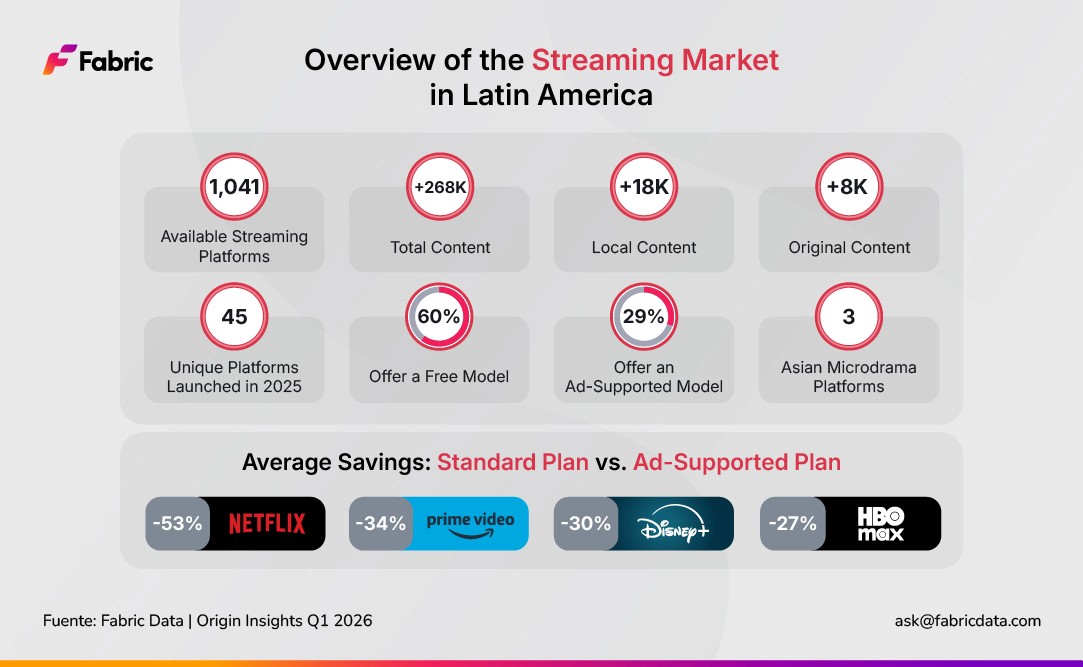
When Netflix launched its ad-supported tier in Brazil, the United States, and Mexico in 2022, it marked a deliberate expansion of the revenue model rather than a retreat from one. The logic was straightforward: reach price-sensitive audiences who had not subscribed at the standard tier, generate advertising revenue as a complementary stream alongside subscription fees, and create a retention mechanism for subscribers considering cancellation by giving them a lower-cost option to step down rather than leave entirely. In hindsight, it was the natural next step for a platform that had extracted most of the available growth from the pure subscription model and needed new commercial levers to continue scaling. Three years later, the data shows that the rest of the industry has drawn the same conclusion. The ad-supported model has moved from a Netflix-specific experiment to a core pillar of how the Latin American streaming market is organized.
At Q1 2024, ad-supported subscription plans represented 13% of all streaming services globally available in Latin America. By Q1 2025, that figure had reached nearly 18%. By Q1 2026, it is approaching 22%. In two years, what was a niche offering has grown to represent nearly one in five plans available across the region. Understanding what is driving that shift, and what it means for the competitive dynamics of the market, requires looking at both the supply side and the demand side simultaneously.
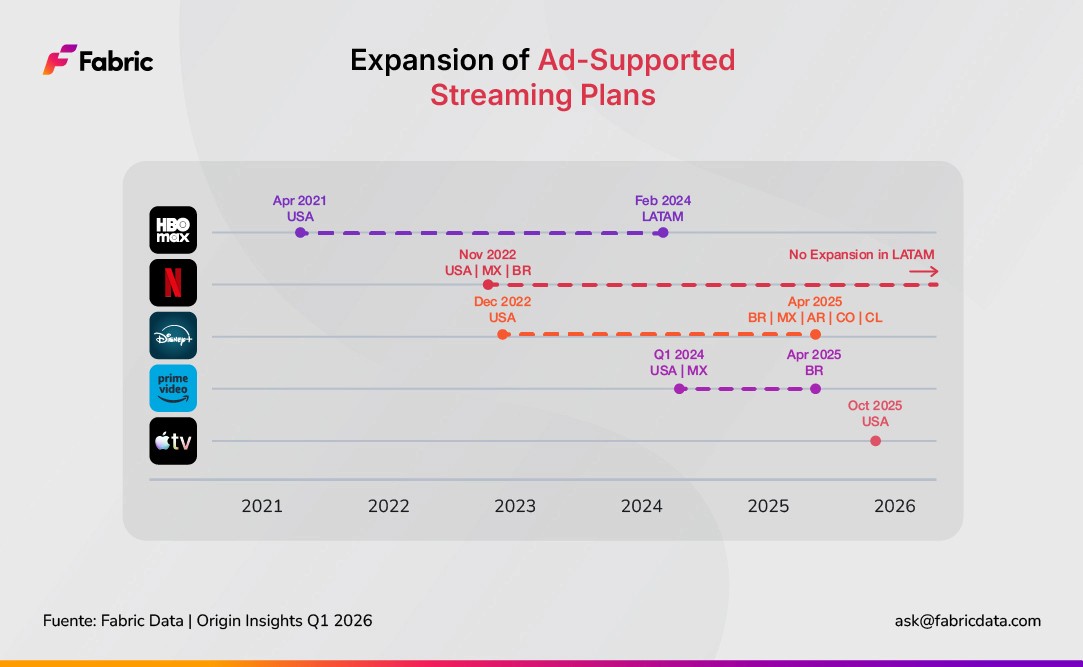
How the major platforms rolled out AVOD across the region
The timeline of ad-supported plan launches in Latin America is not a story of simultaneous industry-wide adoption. It is a story of sequential decisions by individual platforms, each responding to a combination of market conditions, competitive pressure, and internal commercial priorities.
HBO Max was first to move, launching its ad-supported plan in the United States in 2021 and extending it to Latin America in 2024. Netflix followed with its ad tier in Brazil, the United States, and Mexico in 2022, though it has not yet expanded the model to the rest of the region. Disney+ adopted ad-supported plans in the United States before enabling them in Argentina, Brazil, Chile, Colombia, and Mexico in 2025. Prime Video launched its ad-supported tier in the United States and Mexico in 2024, extending it to Brazil in 2025. Apple TV+ was the last of the major platforms to move, introducing an ad-supported plan in the United States in October 2025.
The geographic sequencing matters as much as the chronological one. Most platforms have treated the United States as the test market before rolling out to Latin America, and within Latin America, Brazil and Mexico have consistently been the first markets to receive new commercial models. This reflects both the size of those markets and their relative infrastructure maturity, but it also means that the rest of the region, including Argentina, Chile, Colombia, Peru, and the smaller Central American and Caribbean markets, often lags by one to two years in accessing the full range of streaming subscription prices and plan options.
What audiences actually think of ad-supported plans
The commercial logic of ad-supported tiers rests on an assumption that needs to be tested rather than assumed: that audiences will accept advertising in exchange for a lower price point without feeling that their experience has been degraded. The data from Latin America suggests it holds, with some nuance.
Among subscribers who have opted for ad-supported plans, the majority report that their viewing experience is not meaningfully affected by the presence of advertising. The primary motivator for choosing these plans is straightforward: cost savings relative to the ad-free tier. This is not a surprising finding, but it is an important one because it suggests that the value exchange is working as intended. Audiences are not choosing AVOD as a reluctant compromise; they are choosing it as a rational economic decision.
What this means for platforms is that ad-supported tiers are not cannibalizing premium subscriptions at the rate some feared. They are primarily reaching audiences who would not have subscribed at the higher price point, which makes them an additive revenue stream rather than a substitutional one. Understanding streaming user habits and preferences at this level of granularity is what allows platforms to model the revenue impact of tier expansions before committing to them. For advertisers operating in the region, the implication is a growing inventory of brand-safe, premium streaming environments that did not exist at a meaningful scale three years ago.
The broader platform landscape: 45 new launches and a fragmented model mix
The AVOD growth story does not exist in isolation. It is part of a broader streaming evolution of the Latin American market that has accelerated significantly in the past year. Forty-five new platforms launched in the region in the past twelve months alone. Of those, 60% include a free plan as part of their offering and 29% include an ad-supported option, though most operate across multiple access tiers rather than a single model. This is not consolidation. It is continued fragmentation, with new entrants continuing to find viable niches despite the presence of dominant global players.
Among these new entrants are platforms that represent genuinely novel content formats for the region. Asian short-form and microdrama platforms including FlareFlow, SnackShort, and ShortMax have entered the Latin American market, bringing with them a content format that has generated significant engagement in Asian markets and is beginning to influence how Western platforms think about short-form vertical content. ViX has already launched its own microdrama format under the name "Micros," and the influence of this model is visible in features like Disney+'s "Verts" and Netflix's "Clips," both introduced in the United States with expansion to other markets planned.
The proliferation of new platforms and business model variants creates a navigation challenge for content owners and distributors who need to understand not just which platforms exist but how they are monetized, how streaming market share is distributed across them, and where the genuine growth opportunities lie. At the level of individual titles and catalogs, the question of which platform to prioritize, at what price point, and under which business model is increasingly complex. This is exactly the kind of cross-platform availability data that separates informed tv distribution insights from guesswork.
Subscription still leads, but the gap is narrowing
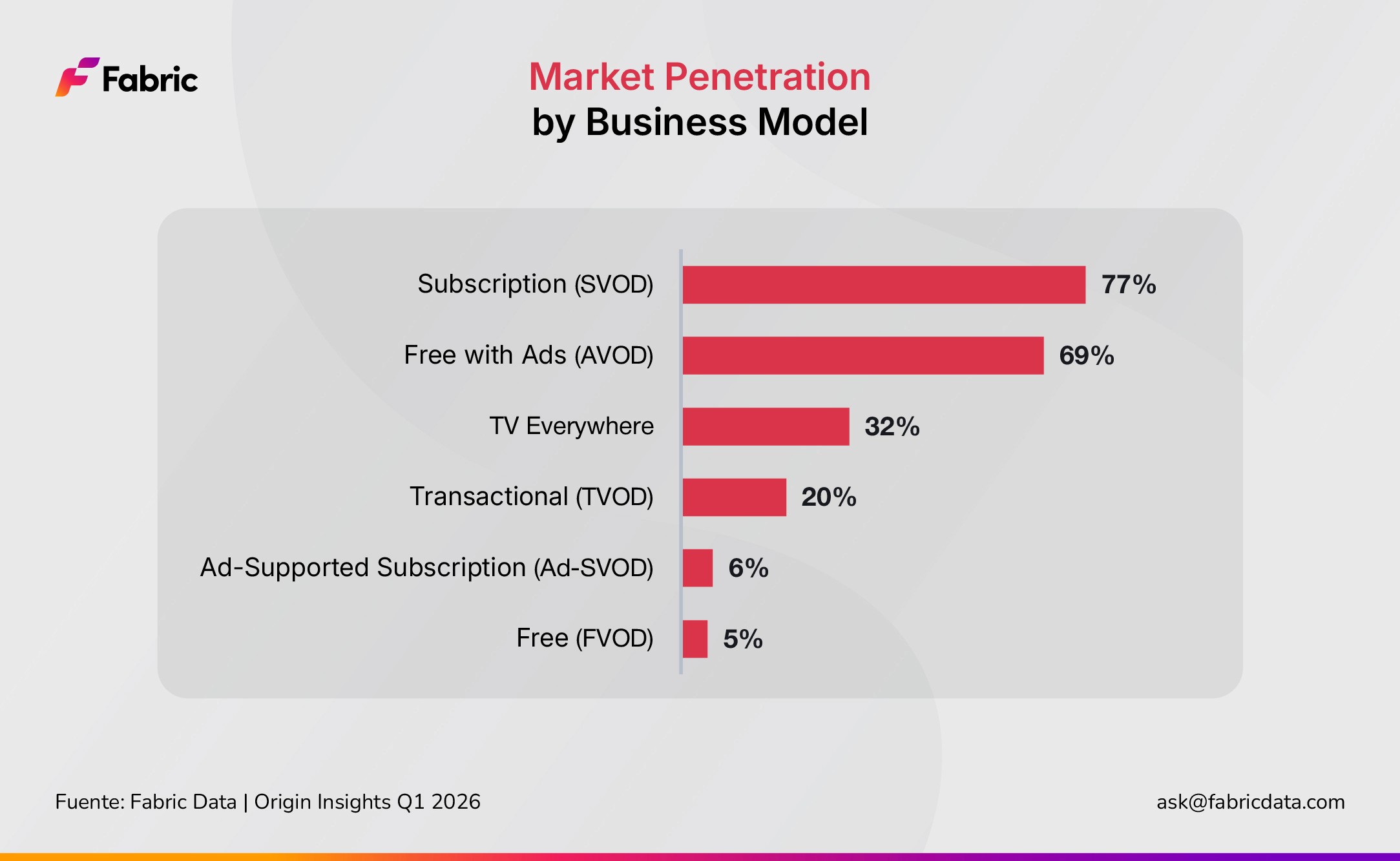
Despite the rapid growth of ad-supported models, subscription plans continue to dominate streaming user habits in Latin America. Among households with internet access in the region, subscription plans maintain a 77% penetration rate, while free ad-supported plans reach 69%. The gap between these two numbers is narrower than it was two years ago, and the trajectory of both figures suggests it will continue to narrow.
This convergence has a specific implication for platform strategy. In markets where subscription penetration is already high, Brazil and Mexico being the clearest examples, incremental subscriber growth is harder to achieve, and the ad-supported tier represents the primary mechanism for revenue growth from audiences who are already engaged. In markets where subscription penetration is lower, ad-supported models may represent not a secondary tier but the primary entry point for new audiences.
The regional variation in this dynamic is substantial. Origin Insights tracks media pricing and plan data across more than 1,000 streaming platforms in 249 countries, updated continuously rather than on a quarterly reporting cycle. For platforms and distributors making commercial decisions about Latin American markets, real-time content insights at the country level, rather than as a regional aggregate, is what separates strategic content insights from assumption.
Beyond platform-level tracking, Fabric also produces ad-hoc advertising intelligence reports for the streaming market. These cover where platforms place commercial breaks within content, what ad formats they use, and which industry sectors and brands appear most frequently across ad-supported tiers. For advertisers evaluating streaming as a channel, and for platforms benchmarking their own ad strategy against competitors, this is the kind of media decision-making tools and AI media analytics that aggregate market data does not surface.
Stay ahead of the curve
We publish regular streaming insights on business model trends, audience demand trends, and platform availability insights across Latin America and global markets. Follow Fabric on LinkedIn for new analysis as soon as it drops.
Fabric is a global media data company. Origin Insights delivers primary-sourced, human-verified entertainment market intelligence covering 1,000+ streaming platforms across 249 countries. Real data. Verified by humans. Trusted by the industry.
FAQ
Similar Articles
We're constantly pushing the boundaries of what's possible and seeking new ways to improve our services. Search your topic of interest.


