Filter Content by Streaming Availability Dates with the Origin Nexus API

Filter Content by Streaming Availability Dates with the Origin Nexus API

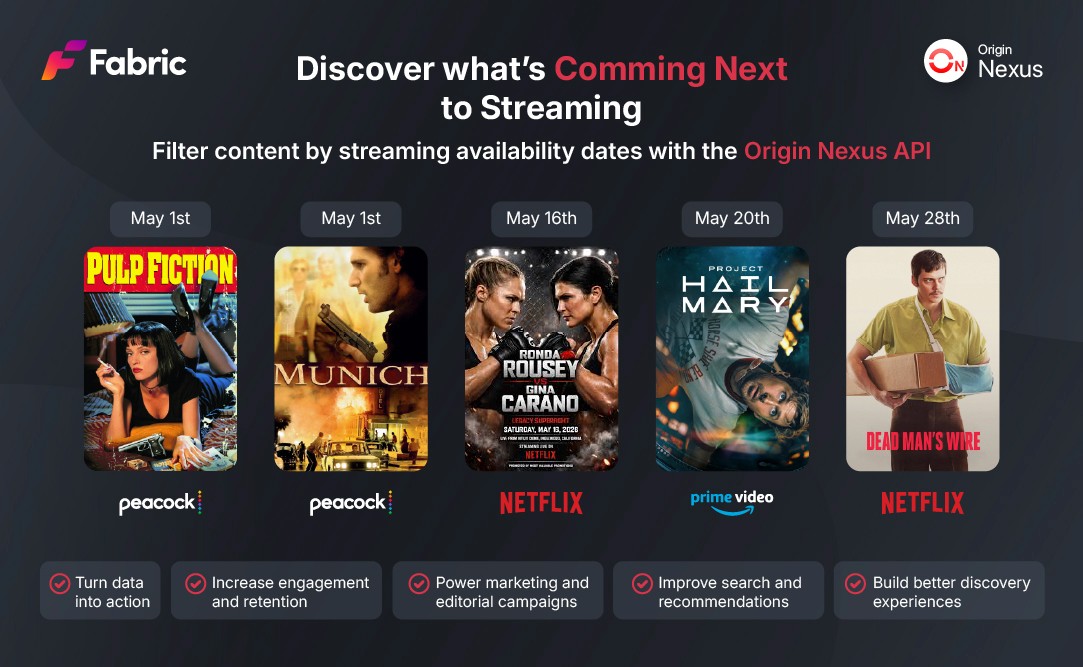
Origin Nexus Entertainment Search API with StartDateStart and StartDateEnd date range filters applied, returning a list of movies and TV titles with upcoming streaming availability dates across major U.S. platforms.

Help your users discover what’s coming next

With our new StartDateStart and StartDateEnd parameters, developers can now filter content based on when a movie or TV title will become available on a major streaming service in the U.S. This gives your products the power to surface upcoming availability windows, not just what’s streaming today. It also helps users discover titles before they begin trending across streaming platforms nationwide.

It’s not just originals but it is also older titles that have found themselves on streaming platforms. Never seen the movie Pulp Fiction from 1994? Stream it this month on Peacock. Looking for other Academy Awards Best Picture nominees? Filter and see Munich is on Peacock too or The Shawshank Redemption is out on Paramount Plus.

Looking for new content? HBOMax is debuting an original new movie with Academy and Emmy Award winner Allison Janney May 29th called Miss You, Love You. Missed that big movie in theaters? See Project Hail Mary coming to Amazon Prime Video on the 20th.

Also, anyone who likes director Gus Van Sant would want to see his latest release Dead Man’s Wire that was just in theaters in January but is now on Netflix on May 28th. Speaking of Netflix, the triple MMA live event with Ronda Rousey vs. Gina Carano as the main event will be airing on May 17th. Your users can be informed about new movies, TV shows, seasons, live events, and even new episodes by using the Fabric Data Origin Nexus APIs.

Why It Matters

Drive Consumer Engagement

Give users a reason to return by highlighting titles arriving soon on their favorite streaming platforms. “Coming This Week” and “Available Next Friday” are high-intent discovery moments that increase repeat visits and session time.

Improve Watchlist & Queue Building

Help audiences plan ahead by allowing them to save upcoming titles before release. Users can add anticipated movies and shows to personal queues, increasing retention and platform stickiness. This kind of forward-looking content availability tracking turns passive browsing into planned viewing.

Power DTC Discovery Pages

Create dynamic "Coming Soon to Streaming" pages for direct-to-consumer experiences, publisher sites, entertainment apps, and streaming guides. Perfect for editorial hubs, recommendation engines, and homepage features. The same cross-platform availability data that powers these pages can feed into broader streaming catalog trends analysis for content and editorial teams.

Support Smarter Notifications

Trigger personalized alerts when a title is about to hit a streaming service. This enables better CRM campaigns, push notifications, and email engagement strategies. Pairing availability date filters with audience demand trends lets you prioritize notifications around the titles users are most likely to act on.

Enhance Editorial & Promotional Campaigns

Surface upcoming releases for newsletters, social campaigns, and seasonal promotions like "What's New This Month on Streaming" with real-time content insights driven by API accuracy. Teams working across media pricing and plan data can use the same availability signals to align promotional timing with platform launch windows.

Better Search & Recommendation Logic

Use availability windows to improve recommendation engines by prioritizing titles users can watch soon, increasing conversion from discovery to viewing. Combined with platform availability insights, this creates a discovery layer that reflects not just what exists in the catalog but what is actually actionable for the user right now.

Built for Developers

In the Origin Nexus Entertainment Search API, using StartDateStart and StartDateEnd, your team can easily query titles becoming available within a specific date range across major U.S. streaming platforms, making integration simple and highly actionable. Combine it with other filters such as genres, streaming platforms, themes, and program type.

Whether you're building content discovery experiences, watchlist tools, editorial features, or engagement campaigns, this new capability helps turn movie and TV metadata into meaningful consumer action. For organizations that also manage their own catalog records, the availability signals surfaced here connect directly with content availability tracking in Origin Studio, so that enriched data flows through a single governed metadata source of truth.

Explore the New Date Filters

Start building with StartDateStart and StartDateEnd today and help your users discover what to watch next, before it arrives. For a broader view of how streaming metadata solutions and entertainment market intelligence work together across the Origin product family, explore what Fabric builds for media companies at every layer of the content supply chain.

Get the latest from Fabric

Follow Fabric on LinkedIn for Xytech product updates, transmission capability announcements, and media operations insights.

Fabric is a global media technology company. The Xytech product family —Xytech Media,Xytech Operations, and Xytech Transmission — powers media lifecycle management, resource scheduling, and transmission workflows for media organizations worldwide.

FAQ

What are the StartDateStart and StartDateEnd parameters in the Origin Nexus API?
What streaming platforms and regions does the availability date filter cover?
Can the streaming availability date filter be combined with other Origin Nexus API filters?

Read More Articles

We're constantly pushing the boundaries of what's possible and seeking new ways to improve our services.

Origin Nexus Entertainment Search API with StartDateStart and StartDateEnd date range filters applied, returning a list of movies and TV titles with upcoming streaming availability dates across major U.S. platforms.

May 11, 2026

Filter Content by Streaming Availability Dates with the Origin Nexus API

Developers can now filter movies and TV titles by the date they become available on streaming platforms, using two new Origin Nexus API parameters. Here is what you can build with them and why availability-date filtering changes how audiences discover content before it starts trending.

Illustration showing three separate department systems, distribution, marketing, and rights management, each holding a different version of the same content record, contrasted with a single unified metadata platform feeding all downstream systems from one authoritative source.

May 7, 2026

Your Metadata Has More Than One Version of the Truth. That's the Problem.

When three departments each maintain their own record for the same title, none of them wrong but none of them the same, the real cost isn't the occasional incident. It's the permanent overhead of a metadata environment nobody fully trusts. Here's what a genuine source of truth looks like and what it takes to build one.

Illustration showing a media operations workflow moving from fragmented manual coordination across email, spreadsheets, and verbal handoffs to a structured, automated system with centralized job tracking and task progression.

May 6, 2026

Media Workflow Automation: How Modern Facilities Are Eliminating Manual Handoffs

Manual handoffs are not just an inconvenience in media operations — they are a structural cost that scales with every job, every team member, and every new client. Here's how modern facilities are replacing coordination overhead with automated workflows, and what that shift looks like in practice.

World map highlighting global streaming platform developments for April 2026, including new launches in Argentina, Brazil, Germany, India, and the United States, HBO Max's European and Indian expansion, AVOD updates across North America, and sports rights shifts in Central America and Europe.

May 5, 2026

The Streaming Moves That Mattered in April 2026

April 2026 reshaped the global streaming map in ways that matter beyond the headlines. HBO Max completed its European rollout, AVOD platforms consolidated around clear winners, sports rights redrew regional competition in Central America and Europe, and niche platforms continued carving out specific audiences. Here's what the month's moves mean for content strategy and distribution planning.

Xytech X2 benefits

May 4, 2026

What ScheduALL Got Right About Transmission — and Where Xytech’s X2 Goes Further

ScheduALL built its reputation in broadcast by solving a genuinely hard problem: transmission scheduling that understands how resources relate, not just whether they are individually available. Xytech's X2 Transmission replicates that relational foundation and goes further, adding a cloud-native architecture, a Network Visualizer, and an AI scheduling layer that changes what experienced transmission teams can accomplish in a day.

A layered pyramid or stacked diagram showing the five metadata types from bottom to top

Apr 30, 2026

Metadata: The Hidden Engine Behind Every Streaming Recommendation

Metadata is the hidden engine behind every streaming recommendation. For platforms competing on content discovery, the quality, depth, and normalization of movie and TV metadata — from genre tags and contributor records to thematic enrichment and availability windows — determines whether recommendation engines surface the right title or settle for a generic list. This post breaks down the layers of entertainment metadata that matter most, why sparse or inconsistent data produces shallow discovery experiences, and how continuous enrichment pipelines are the only scalable answer to keeping a catalog current. If your platform's engagement metrics aren't where they should be, your metadata infrastructure is worth examining.

Ready to take your data to the next level?

Copyright © 2026 Fabric. All Rights Reserved

Powered by AWS

Ready to take your data to the next level?

Copyright © 2026 Fabric. All Rights Reserved

Powered by AWS

Ready to take your data to the next level?

Copyright © 2025 Fabric. All Rights Reserved

Powered by AWS

Ready to take your data to the next level?

Copyright © 2025 Fabric. All Rights Reserved

Powered by AWS