
Learn More
There is a version of the AI conversation happening at every media industry conference right now that is almost entirely theoretical. Executives talk about what AI will do, vendors promise transformations, and panels examine implications, but very little of it is grounded in what AI is actually doing today inside the operational systems that keep studios, broadcasters, and streaming platforms running.
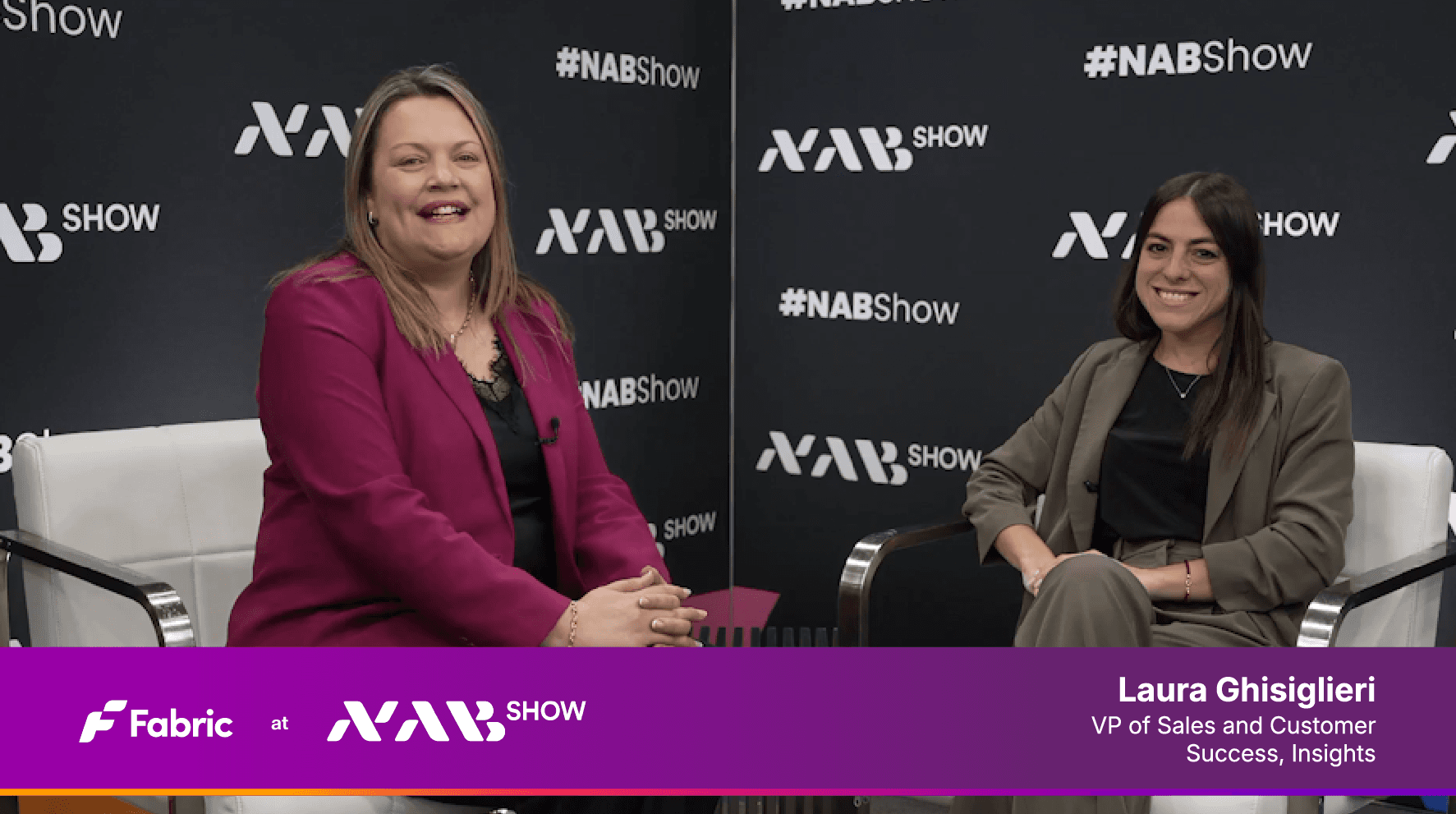
At NAB Show 2026, Laura Ghisiglieri, Fabric's VP of Sales and Customer Success for Insights, offered something rarer: a specific, honest account of where AI is producing real gains for media operations teams and what the preconditions for that actually are. The core argument she kept returning to is that AI works in media workflows when it has access to verified, structured data, and without that layer it becomes a liability rather than an advantage.
Watch the full interview here.
The four problems media companies are actually bringing to Fabric
Ghisiglieri outlined four distinct challenges that customers are arriving at Fabric with right now. These are not abstractions but operational friction points that show up consistently in production and distribution work across the industry.
Fragmented data across global teams
Media organizations operating across multiple countries and time zones routinely have teams working from different, partially synchronized versions of the same information. When a production needs to coordinate globally to ensure a title reaches air on schedule, that coordination depends on tools that let disparate teams communicate in real time from a shared data foundation. Without it, the overhead of alignment becomes the work itself, and the actual creative or commercial task gets buried under the logistics of keeping everyone on the same page. This is the unified data platform problem at its most operationally costly.
The pace of change in the streaming landscape
New platforms launch continuously. Pricing structures shift. What is available on which service in which territory changes faster than any analyst can track manually. For media companies making distribution, licensing, and content investment decisions, the cost of acting on stale or incompletestreaming market intelligence is embedded in every deal that undervalues a title or misses a platform window.
Inconsistent metadata quality
The entertainment industry runs on metadata, including titles, genres, cast, availability, imagery, synopses, and parental ratings, and the quality of that metadata varies enormously across organizations and systems. Fabric helps customers enrich what they already have, filling gaps and standardizing records so that downstream systems including search engines, recommendation engines, and distribution platforms can actually use it reliably. This is precisely where automated metadata enrichment makes the biggest operational difference.
Decentralized asset management
Some customers, particularly smaller distributors, are still managing their content catalogs in spreadsheets, Airtable databases, or PDF documents. Fabric provides centralized metadata management where all relevant information about a title, including images, trailers, synopses, custom genre classifications, and rights and availability data, is stored in one place and integrated with the systems that need to read from it, eliminating the version control problems that come with distributed manual records.
Where AI is actually delivering in media workflows
On the subject of AI, Ghisiglieri was specific in a way that most NAB conversations are not. She described two concrete workflow applications where AI integration is producing measurable results, and both share a common structural feature: the AI is operating on top of verified, Fabric-sourced data rather than on open internet retrieval.
Operations and scheduling with natural language
Through an AI agent embedded in Fabric's media workflow automation tools, powered by Xytech, operations teams can ask natural language questions about their operational state and get immediate, accurate answers. The examples Ghisiglieri gave are worth quoting directly because they illustrate the practical scale of the change: a user can ask how many cameras are available next week for a specific production, or request that an appointment be scheduled for a particular time, and receive an answer or confirmation instantly. Tasks that previously required navigating multiple screens, cross-referencing spreadsheets, or waiting for a colleague's response become single-turn queries resolved in seconds. The resource and production scheduling layer that makes this possible is what turns a natural language query into a reliable operational answer.
Real-time market intelligence through Origin Insights
Through Origin Insights, customers can ask the same kind of natural language questions about streaming market data. Which titles are trending on a given platform in a specific month? Where is audience demand for drama content growing, and on which services? Which platforms are gaining subscribers in which territories? These queries, previously answered by analysts pulling and cleaning reports over hours, now return in seconds. Critically, the answers are validated against real-time content insights rather than generated from unverified sources, which is what makes the speed meaningful rather than dangerous.
AI applications shown live at NAB 2026
Natural language scheduling queries against live operational data covering resource availability, camera booking, and appointment management.
Instant market intelligence queries via Origin Insights on trending titles, platform subscriber trends, and territorial content performance.
AI-generated interactive reports from streaming catalog and platform availability data, produced in seconds rather than hours.
MCP-connected agents that constrain AI responses to verified Fabric data, preventing hallucination in operational contexts.
Why the control layer matters more than the AI itself
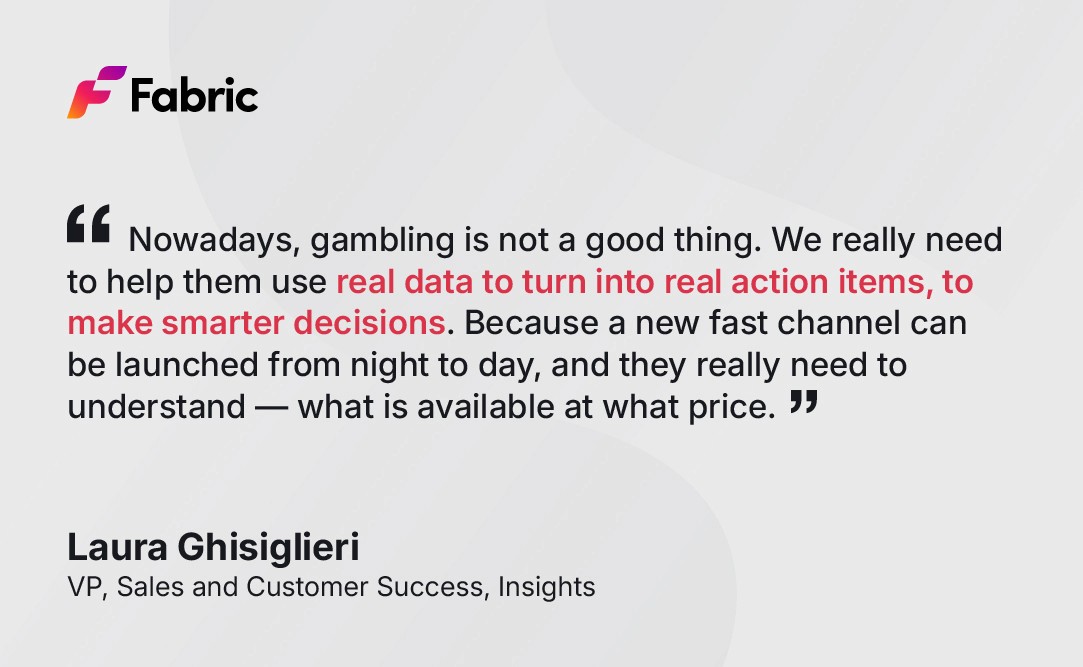
This is the part of the AI conversation that Ghisiglieri returned to with the most emphasis, and it is the part that distinguishes what Fabric is doing from the broader category of AI integrations being announced across the industry. The value of AI in media operations is not that it generates answers quickly. It is that it generates correct answers quickly, verified against proprietary data that the model has been explicitly constrained to use. Without that constraint, speed becomes a liability. Fast wrong answers in production scheduling or distribution planning cause real operational damage, and they erode the trust in AI systems that is required for organizations to build dependence on them.
Fabric's approach, connecting its AI agents to its own verified data via MCP integrations rather than allowing open retrieval, is the design decision that makes the workflow gains Ghisiglieri described possible without the hallucination risks that have made media organizations cautious about AI adoption generally.
NAB 2026 as a delivery milestone
NAB 2026 carried particular significance for Fabric because it marked the point at which announced capabilities became demonstrated ones. The previous year's show had focused on the acquisition of the Daytide Insights division and the AI media analytics infrastructure Fabric was building around it. This year, customers at the booth were able to interact with the AI integrations running on live data for the first time. The transition from roadmap to working product is what changes the commercial relationship between a vendor and its customers, and Ghisiglieri was clear about the significance of that shift.
The next milestone she identified is the one that will matter most for understanding the real-world impact of these tools: the feedback cycle that follows from customers operating them in production over the next twelve months. The capabilities are now live. What comes next is learning what customers actually do with them, which problems they solve in ways Fabric did not anticipate, and which gaps remain.
The data infrastructure argument underneath the AI story
The through-line of everything Ghisiglieri described at NAB is not really about AI. It is about data. The insight she kept returning to is that AI is not a solution to poor data infrastructure but an amplifier of whatever data infrastructure an organization already has. Media companies with fragmented, inconsistent, poorly structured metadata will get fragmented, inconsistent, poorly structured AI outputs. Companies that have invested in clean, centralized, enriched metadata will get AI systems that genuinely accelerate their operations.
This is not a new argument in enterprise software, but the stakes are rising as AI becomes embedded in scheduling systems, distribution decisions, content investment recommendations, and audience targeting. The metadata management decisions that seemed like back-office infrastructure questions are increasingly decisions about how fast and how accurately an organization can operate in an AI-mediated industry.
Fabric's position, connecting metadata management, media service operations, and entertainment market intelligence into a single verified data layer, is precisely the kind of foundation that makes AI integration tractable rather than risky. That is the argument that NAB 2026, and specifically this conversation with Laura Ghisiglieri, makes in concrete operational terms rather than vendor-presentation ones.
Stay ahead of the curve
We publish regular insights on media data, metadata strategy, and the technology powering the entertainment industry. Follow Fabric on LinkedIn to get new articles as soon as they drop.
Fabric is a global media data company. The Origin product family — Origin Nexus, Origin Studio, and Origin Insights — powers metadata enrichment, governance, and market intelligence for entertainment companies worldwide.
FAQ
Similar Articles
We're constantly pushing the boundaries of what's possible and seeking new ways to improve our services. Search your topic of interest.


