
Learn More
The media supply chain has never lacked for systems. What it has lacked is connection. The platforms that manage content research, title catalogs, metadata, ingest workflows, and distribution orders have historically operated as separate domains, each requiring a human to bridge the gap between them: pulling output from one tool, reformatting it for the next, and repeating the process across every step of a production or acquisition cycle.
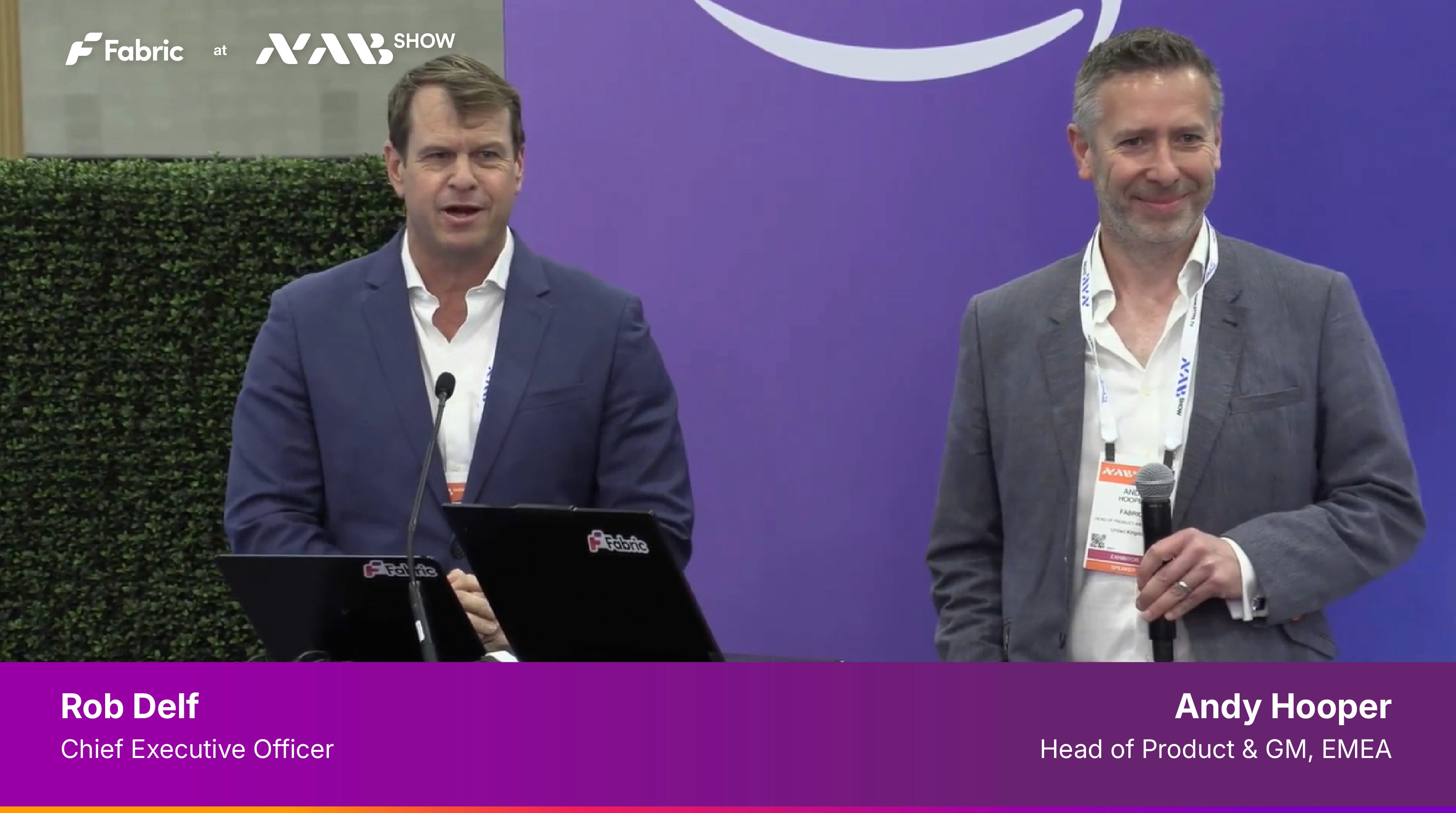
At NAB Show 2026, Fabric CEO Rob Delf and Head of Product Andy Hooper set out to demonstrate what that workflow looks like when the connections are made at the infrastructure level rather than the human level. Using three live MCP integrations across two product families and a single conversational AI session, they took a content acquisition task from initial market research all the way through to a media order ready for distribution, without switching tools, without manual handoffs, and without a single spreadsheet.
The workflow they ran, step by step
The demo was structured around a realistic acquisition scenario. Delf began by submitting a natural language query to Claude, connected via Fabric's MCP server to Origin Insights: find two top movies not currently in the studio catalog that would be strong candidates for Crave, a streaming platform serving a Western Canadian audience, excluding titles exclusive to competing platforms such as Netflix originals, and prioritizing films that are performing well in comparable markets.
That is not a simple query. It requires cross-referencing a live streaming availability dataset, filtering against an existing catalog, understanding platform exclusivity relationships, and applying regional audience context. It is exactly the kind of research task that a distribution analyst might spend half a day on, pulling platform availability insights from multiple sources and comparing them against internal records.
The sequence ran in three stages.
Market research and title recommendation. Claude queried Origin Insights across more than 1,000 streaming platforms to identify trending entertainment data in comparable markets, cross-referenced the studio's existing catalog of 12 movies to eliminate duplicates, and returned two ranked recommendations with demand scores and acquisition rationale.
Title ingest into the studio catalog. Claude pulled normalized metadata for the selected title from Origin Nexus, created a new record in Origin Studio with identifiers, genre data, and imagery, and generated fresh English and French synopses tailored to the platform's editorial tone, all within the same conversational session.
Media order creation and distribution setup. Claude connected to Xytech Media via a third MCP integration, resolved the destination customer record by matching "Bell Canada" to "Crave Bell Media" in the system, created a media work order for physical asset ingest, and set up the transformation and delivery coordination configuration for the target platform.
The entire sequence, from the initial research query to a confirmed media order in Xytech, ran inside a single Claude session. The three systems involved, Origin Insights, Origin Studio, and Xytech, are distinct products with separate databases, separate user interfaces, and separate APIs. What connected them was Fabric's MCP layer, which exposed the relevant capabilities of each system to the AI agent in a standardized, contextualized form.
What Origin Insights is actually doing during the research phase
The market research step is the one that looks most like magic from the outside and is worth examining closely, because the depth of the result depends entirely on the depth of the underlying dataset. Origin Insights is not a web scraper or a third-party aggregator. It is a continuously maintained dataset built by teams of people who monitor streaming platforms on a semi-automated and automated basis, tracking which titles are placed on which services, at what price, and under which subscription packages, across more than 1,000 platforms and 249 countries.
That scale is what makes a query like Delf's answerable in minutes rather than days. When Claude asks Origin Insights to identify trending titles in markets comparable to Western Canada that are not exclusive to competing platforms, it is not synthesizing guesses from public data. It is querying a structured dataset of 1.5 billion data points built specifically to answer that kind of commercial question. The audience demand trends it returns, the platform exclusivity flags, and the regional performance indicators all come from that continuously updated, human-verified source.
There is also a second use case for Origin Insights that Andy Hooper flagged during the session. Once a title has been delivered to a streaming platform, Origin Insights can confirm that it actually arrived, that the content metadata is displaying correctly, that the imagery is right, and that the cast and crew information is accurate in market. For distribution teams managing large catalogs across many platforms and territories, that closed-loop verification is a significant real-time content insights capability that currently requires manual checking at considerable scale.
What MCP actually does in this context
Model Context Protocol is a standard way of exposing system capabilities to AI agents so they can understand not just what an API endpoint does but what it is for and when to use it. Hooper was careful to explain this distinction during the session because it matters for understanding why the demo worked as smoothly as it did.
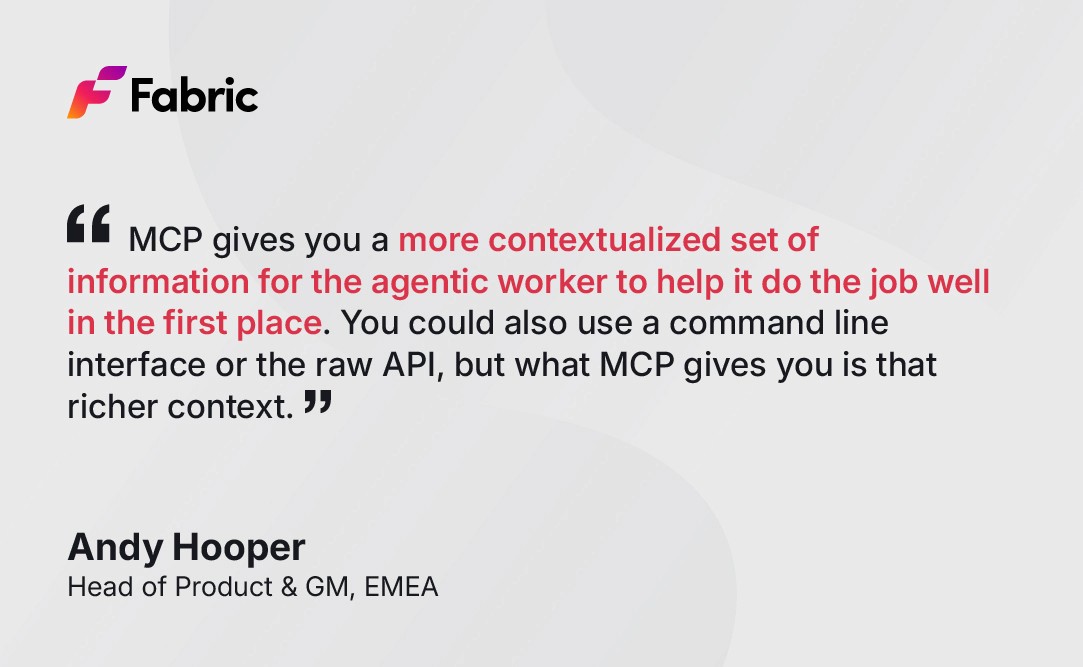
Fabric has built approximately 150 individual tools across its MCP layer, each one wrapping a specific API endpoint and providing the AI agent with enough context to know when it is the right tool to use. The result is that when Claude receives a query like the one Delf submitted, it does not call a generic search function but instead selects from a curated set of purpose-built tools that correspond to specific operations within Origin Insights, Origin Studio, and Xytech Media, calling them in the right sequence based on the logic of the task.
This is also what addresses the hallucination problem that makes AI adoption risky in operational contexts. Because Claude is operating through authenticated, scoped tool calls rather than generating answers from open retrieval, every piece of information it returns is traceable back to a verified data source. The entertainment market intelligence comes from Origin Insights. The catalog metadata solutions come from Origin Nexus. The media work order lives in Xytech. The AI is the orchestrator, but the data is owned and verified by systems the organization already trusts.
Ad hoc queries versus codified workflows
One of the more practically important points in the session came near the end, when Delf noted that the demo used roughly ten to twelve of the 150 available MCP tools and described two distinct modes in which those tools can be deployed.
The first is ad hoc: a user connects Claude or another AI client to the MCP server and submits queries in natural language, as the demo illustrated. This is useful for one-off research tasks, exploratory work, and situations where the exact shape of the workflow is not known in advance.
The second mode is codified automation. The same MCP tools that Claude called interactively during the demo can be wired into workflow automation platforms such as N8n, running defined sequences automatically on a schedule or triggered by an event, without a human prompt initiating each step. An acquisition team doing exploratory research will use the conversational interface. An operations team that needs to run a nightly verification of all distributed titles against Origin Insights, or trigger a media work order automatically when a title clears rights review, will build that as a codified workflow sitting on top of the same MCP layer. Both modes are supported, and neither requires Fabric to build a custom integration for each use case.
The security model that makes enterprise deployment viable
One of the most substantive questions from the NAB audience concerned authorization: how does Fabric handle security and access control when an AI agent is interacting with enterprise systems on behalf of a user?
Hooper's answer addresses a concern that will be on the mind of any IT or security team evaluating agentic workflows for production deployment. The MCP endpoints sit behind OAuth, using the same identity provider and single sign-on configuration as the standard user interfaces. When an agent acts on behalf of a user, it inherits exactly the permissions that user has in the underlying system. If a user is not permitted to edit records in Origin Studio, Claude will not be able to edit records in Origin Studio on their behalf, regardless of what it has been asked to do. The metadata governance model organizations have already built around their media systems extends naturally to the agentic layer without needing to be rebuilt.
What this means for the people doing the work
Hooper offered a candid observation toward the end of the session that reflects a more honest picture of where agentic AI sits in enterprise operations than most vendor presentations allow.
"The conversational and agentic layer is really a force accelerator. It really enables your people to work faster and more efficiently. But I think they're always going to go back to the UI in order to double check things, make sure that the agentic workers have done their job properly. We are very early in this journey."
The workflow demonstrated at NAB compressed what would realistically be two days of analyst and operations work into roughly ten minutes. The research phase alone, cross-referencing streaming market intelligence against an internal catalog across multiple markets, would typically involve several people working across several tools. The metadata enrichment workflows and localization work, generating English and French synopses from source data, represents the kind of labor-intensive task that slows media catalog management teams down consistently. The media work order setup in Xytech, resolving the destination customer record and configuring the ingest and production scheduling parameters, is the kind of work that requires system familiarity and careful attention to get right.
All of it ran through natural language. But Hooper's point is that the people who would have done those tasks manually are not made redundant by this. Their role shifts toward review, validation, and guidance, which is a meaningful change in how media service operations work feels day to day, and an equally meaningful change in how much of it a given team can handle.
The infrastructure investment behind the demo
The live demo at NAB did not emerge from a sprint. Hooper noted that Fabric began the underlying infrastructure work approximately eighteen months ago, migrating its products onto AWS, modernizing legacy deployment methods with managed services and API gateways, and building the foundational components that the MCP layer now sits on top of.
The significance of that timeline is worth understanding for media technology teams thinking about their own AI readiness. The reason Fabric could run a three-system agentic workflow live at NAB is not that MCP is new or that Claude is unusually capable. It is that the underlying systems had been rebuilt with modern API-first records metadata management infrastructure in a way that made them exposable to an agentic layer in the first place. Organizations whose media systems remain on legacy infrastructure without clean API surfaces will find that the AI layer has nothing reliable to connect to, regardless of which AI platform they choose.
The metadata management and media operations decisions that look like back-office infrastructure questions are increasingly the decisions that determine how fast and how intelligently an organization can move as AI becomes embedded in media workflows. What Fabric demonstrated at NAB is what the payoff looks like when those decisions have already been made.
Stay ahead of the curve
We publish regular insights on media data, metadata strategy, and the technology powering the entertainment industry. Follow Fabric on LinkedIn to get new articles as soon as they drop.
Fabric is a global media data company. The Origin product family — Origin Nexus, Origin Studio, and Origin Insights — powers metadata enrichment, governance, and market intelligence for entertainment companies worldwide. The Xytech product family — Xytech Media, Xytech Operations, and Xytech Transmission — powers media lifecycle management, resource scheduling, and transmission workflows for media organizations worldwide.
FAQ
Similar Articles
We're constantly pushing the boundaries of what's possible and seeking new ways to improve our services. Search your topic of interest.


