
Learn More
If you've ever searched for a movie API or TV API, you've probably found two things: a handful of free hobbyist databases, and a much shorter list of enterprise-grade solutions that are harder to evaluate. The gap between them is enormous, and for media companies, choosing the wrong one has real consequences.
This guide cuts through the noise. It explains what a movie or TV API actually is, what it should deliver at scale, what questions to ask before signing a contract, and why the right choice depends on more than just data coverage.
What is a movie and TV API?
An entertainment API (Application Programming Interface) is a service that allows software applications to request and receive structured data about films, TV shows, and other entertainment content. Instead of manually building and maintaining a catalog of titles, cast, crew, genres, synopses, ratings, imagery, and availability, your platform queries the API and receives that data in real time, or syncs it in bulk on a schedule.
At its most basic, a movie and TV API returns information like title, year, runtime, and genre; cast and crew credits; synopsis and taglines; posters; audience and critic ratings; and trailers and promotional clips.
At an enterprise level, a mature movie or TV API goes considerably further, delivering localized metadata by territory, approved imagery, streaming availability by market, curated collections, thematic tags, and proprietary discovery signals that go beyond what any open source database offers.
Movie API vs. TV API: is there a difference?
The terms are often used interchangeably, but the underlying data structures are meaningfully different. Movie metadata is relatively flat: one title, one release, one set of credits. TV metadata is hierarchical and ongoing. A series has seasons, seasons have episodes, episodes have their own credits and synopses, and new content keeps arriving.
That distinction matters when you're evaluating providers. A service that handles movie metadata elegantly may still struggle with long-running series, daily episodic updates, or multi-territory broadcast schedules. Enterprise platforms handle both, with consistent data models across content types.
Why media companies use content APIs
The use cases vary by company type, but the underlying need is the same: rich, accurate, up-to-date entertainment metadata delivered programmatically at scale.
Streaming platforms and VOD services use movie and TV APIs to power their content discovery layers, including the recommendation carousels, search results, genre pages, and title detail pages that drive engagement and time on service. Poor metadata directly translates to lower discovery and higher churn.
Broadcasters and MVPDs not only need data about the programs, but they need to know the channels, dates, and times the programming will be available, usually in a rolling two week window. The channels themselves each have logos too and that needs to be part of the API as well as date and time.
When retailing physical movie and TV content, other data points become important such as box art, format (UK Ultra HD Blu-Ray as an example), special packaging, complete series box set, etc.
B2B data consumers, including analytics firms, production companies, rights management platforms, and media intelligence tools, use entertainment APIs to build foundational layers for analyzing traits of titles, your catalog, or inform your licensing strategies by territory. Here, knowing what titles are trending can guide what gets greenlit in production and how much budget to assign. An entertainment API is not just a nice-to-have. It can lead to creating the next blockbuster.
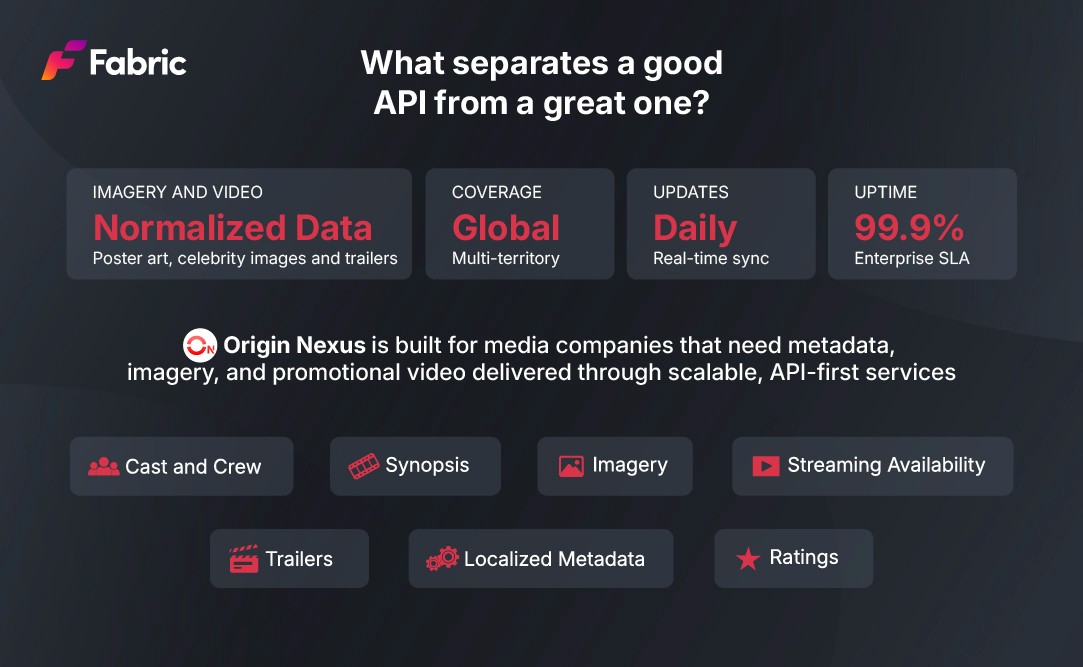
What separates a good movie API from a great one
Not all APIs are created equal. Here is what to look for when evaluating enterprise-grade solutions.
Data depth and normalization
Volume matters, but normalization matters more. A database with 500,000 titles means nothing if the cast credits are incomplete, genres are inconsistently tagged, or release dates vary by territory without explanation. Enterprise APIs maintain a normalized, editorially governed data model with consistent field structures, controlled vocabularies, and regular quality checks.
Ask providers: how is data sourced? How is it validated? What is the update cadence for new releases and changes?
Imagery and video, not just text
Discovery is visual. A fully realized movie API will not only return metadata but also poster art, celebrity images, and trailers. Navigation of a streaming service depends on images and increasingly, we see autoplaying of a trailer on a title page. Streamers have seen the value of trailers in helping with consumer choice and know trailers keep users engaged and arriving on their content choice sooner
Localization and global coverage
If your platform operates across multiple territories, your metadata needs to match. That means localized titles, synopses, and imagery, not just English-language defaults with language codes attached. It also means streaming availability data that reflects where content is actually accessible, not just where it is theoretically licensed.
Ask providers: which languages and territories are supported natively? How frequently is availability data updated?
Reliability and SLA
A metadata enrichment API is production infrastructure. Downtime or degraded performance affects your end users directly. Enterprise providers offer documented SLAs, redundant infrastructure, and transparent status reporting.
Ask providers: what is the uptime commitment? What does the incident response process look like?
Discovery intelligence beyond standard attributes
Standard metadata, including genre, year, and runtime, is a commodity. The platforms that win on discovery layer proprietary signals on top: thematic tags, narrative locations, micor-genres, curated collections, audience affinity scores, and content ratings that go beyond standard classifications. These signals are what make recommendation engines feel intelligent rather than mechanical.
Ask providers: what proprietary data layers do you offer? Can those signals be integrated into our recommendation logic?
Common mistakes when choosing a movie or TV API
Starting with open source databases. are excellent for personal projects and prototyping. They are not suitable for production platforms at scale. The licensing terms, data quality controls, and SLA guarantees simply aren't there. Many companies start with them and migrate later, which is expensive and disruptive.
Evaluating on title count alone. Raw volume is easy to inflate. What matters is the depth and accuracy of the data for the titles your users actually care about, especially newer releases, regional content, and episodic TV.
Ignoring the operational cost of integration. A poorly documented API, a cumbersome data model, or a lack of SDKs and support will cost your engineering team weeks. Evaluate the developer experience as rigorously as you evaluate the data.
Separating metadata from imagery. Sourcing text data from one provider and images from another creates synchronization problems, licensing complexity, and operational fragility. Consolidated metadata solutions are almost always preferable.
How Origin Nexus approaches movie and TV metadata
Origin Nexus, part of Fabric's unified media data platform, is built for media companies that need metadata, imagery, and promotional video delivered through scalable, API-first services.
The platform covers movies and TV series with normalized, continuously updated metadata across titles, contributors, genres, releases, and awards. Licensed images, including posters, box art, tiles, portraits, and set photography, are included with descriptors for smart display across devices and regions. Trailers, clips, and interviews are delivered in multiple formats, with localization, maturity flags, and usage-based delivery.
What distinguishes Origin Nexus at the discovery layer is its proprietary intelligence: Power Ratings, curated thematic collections, and content signals that go beyond standard attribute data to improve how audiences find and engage with content.
For global platforms, Origin Nexus includes country-level streaming availability with deep links to platforms, updated without manual upkeep. And for organizations already managing their own metadata governance, Origin Nexus integrates directly with Origin Studio, Fabric's media records management platform, so that enriched data flows from a single, governed source of truth.
Key questions to ask any movie or TV API provider
Before signing, make sure you have clear answers to the following: What is the data sourcing and validation process? Are images and video included? What territories and languages are supported? How frequently is data updated, including availability? What is the SLA for uptime and response time? What proprietary signals or discovery intelligence are included? How is the API documented, and what integration support is available? What does the pricing model look like at scale?
A movie API or TV API is not a utility decision. It is a strategic one. The data that powers your content discovery platform shapes how audiences experience your platform, how long they stay, and whether they come back. Choosing a provider that delivers depth, reliability, licensed assets, and genuine entertainment market intelligence is not a premium. It is the baseline for building a competitive media product. If you're evaluating options, Origin Nexus is worth a close look.
Stay ahead of the curve
We publish regular insights on media data, metadata strategy, and the technology powering the entertainment industry. Follow Fabric on LinkedIn to get new articles as soon as they drop.
Fabric is a global media data company. The Origin product family — Origin Nexus, Origin Studio, and Origin Insights — powers metadata enrichment, governance, and market intelligence for entertainment companies worldwide.
FAQ
Similar Articles
We're constantly pushing the boundaries of what's possible and seeking new ways to improve our services. Search your topic of interest.


