/

Piracy and Account Sharing in Saudi Arabia: Streaming Trends and Industry Impact

Piracy and Account Sharing in Saudi Arabia: Streaming Trends and Industry Impact

Piracy in Saudi Arabia

Piracy and Account Sharing in Saudi Arabia: Streaming Trends and Industry Impact 

In Saudi Arabia, 84% of connected households watch online content, and there are more than 530 streaming services available in the country. However, this wide range of platforms coexists with high rates of piracy and account sharing—two factors that directly impact the digital ecosystem. 

Piracy in Saudi Arabia  

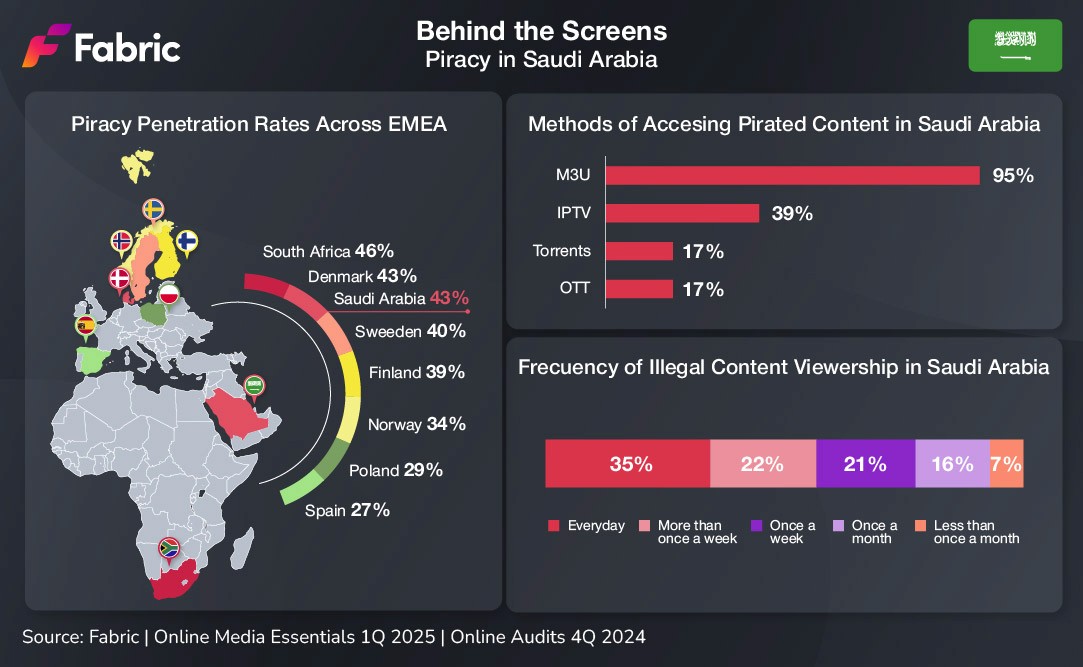
Online piracy in Saudi Arabia has shown a gradual decline. It dropped from 52% in Q2 2024 to 43% in Q4 of the same year. Despite the decrease, it remains one of the highest rates in the EMEA region. It is on par with South Africa (46%) and Denmark (43%). 

The main method is through M3U lists (95%) followed by IPTV with 39%. In addition, 17% of users access pirated content via streaming platforms and torrents. Additionally, usage frequency is high: 35% of users consume online pirated content daily. Meanwhile, 78% do so at least once per week. This reflects a well-established habit among viewers. 


Account Sharing Increases Despite Lower Prices 

Despite offering one of the most affordable streaming ecosystems in the EMEA region—an average monthly subscription cost of USD 12, 16% below the regional average of USD 14—Saudi Arabia records the highest account sharing rate in the region, at 35%. 

This figure has increased by 6% over the past year, indicating a growing trend. The rise suggests that even with relatively low prices, users continue to seek cost-saving alternatives by sharing access. 

While platforms like Netflix and Disney+ have introduced account sharing restrictions in other markets through "extra member" plans, these measures have not yet been enforced in Saudi Arabia. This delay may be contributing to the persistence of account sharing behavior. 

An additional insight: both Netflix and Disney+ report the highest churn rates in Saudi Arabia, with economic reasons cited as the main driver. This indicates that, despite affordability, subscription costs remain a sensitive factor in user retention.  

Among the available services, Eros Now (USD 3.20) and Crunchyroll (USD 4) offer the most affordable monthly plans, while OSN+ (USD 13.06), Disney+ (USD 11.46) and Netflix (USD 9.33) rank as the highest-priced basic options in the market. 


Revenue Pressure from Piracy and Sharing 

The combination of piracy and account sharing creates significant pressure on actual revenue per subscriber. While 71% of households have access to subscription platforms, shared use and illegal access dilute the potential benefits of that penetration. 

This situation raises a key question for the industry: how can platforms achieve effective monetization in an environment where access does not always translate into sustainable income? 

One of the most promising answers lies in diversified monetization models—particularly ad-supported streaming options. The strong presence of free-with-ads users in the market suggests a greater openness to hybrid models that offer lower subscription fees in exchange for advertising. These models not only broaden access but also ensure that each view has a measurable value. 

Addressing this challenge will require comprehensive strategies. These may include usage controls, financial incentives, and digital education to promote more responsible viewership practices. 

Read More Articles

We're constantly pushing the boundaries of what's possible and seeking new ways to improve our services. Search your topic of interest.

Here is what a metadata system designed to scale at enterprise level actually looks like, and the decisions that determine whether it holds up over time.

The Architecture Behind a Metadata System That Actually Scales

Jun 1, 2026

Adopting an API-first metadata platform is a necessary starting point, but it is not what determines whether a metadata system holds up at enterprise scale. The decisions that matter are above the API layer: how the canonical record is structured, how changes to it are governed, how enrichment is handled, and how the integration model is organized. Here is what those decisions look like in practice.

API-First Metadata Management: What It Actually Means (and What It Doesn't)

May 29, 2026

API-first has become a standard claim in media technology marketing, applied to platforms with genuinely different architectural approaches and very different real-world behaviors. Here is a precise account of what API-first metadata management actually means, what it genuinely solves, and why being API-first is a necessary foundation rather than a guarantee of good outcomes.

Andy Hooper Key Takeaways of NAB Show and MPTS London

Key Takeaways on Agility, Data, and the Evolving Media Supply Chain

May 28, 2026

Two of the media industry's most significant spring tradeshows, MPTS in London and NAB in Las Vegas, surfaced the same themes regardless of geography or format: the urgent need for flexible, configurable operations, the growing complexity of metadata and IP management, and the industry's continued commitment to solving these challenges in person.

Content Consumption by Time Slots in LATAM

The Weekend Effect: Latin America Streaming Viewership Patterns

May 27, 2026

Nearly two in five series that appear in Latin America's streaming popularity rankings do so exclusively during weekend periods. They are discovered on Saturday or Sunday, consumed over the following day or two, and never return to the rankings during the week. That pattern has direct implications for how content is programmed, promoted, and prioritized across the region's streaming market.

How Origin Nexus covers the full catalog stack

Games Metadata, Trailers and Imagery: Building a Complete Content Catalog Stack

May 22, 2026

Most metadata discussions focus on movies and TV series. But for platforms competing on content discovery, the catalog stack extends significantly further, into games, trailers, imagery, celebrity data, and promotional assets, each governed by different data requirements and update rhythms. Here's what a complete content catalog actually looks like.

What separates a good API from a great one

What Is a Movie API? A Buyer's Guide for Media Companies

May 21, 2026

This guide explains what a movie or TV API actually is, what it should deliver at scale, what questions to ask before signing a contract, and why the right choice depends on more than just data coverage.

Ready to take your data to the next level?

Copyright © 2026 Fabric. All Rights Reserved

Powered by AWS

Ready to take your data to the next level?

Copyright © 2026 Fabric. All Rights Reserved

Powered by AWS

Ready to take your data to the next level?

Copyright © 2025 Fabric. All Rights Reserved

Powered by AWS

Ready to take your data to the next level?

Copyright © 2025 Fabric. All Rights Reserved

Powered by AWS