
Learn More
Most streaming market research about Latin American streaming audiences focuses on what people watch. The more strategically useful question is when they watch it and what that timing reveals about how content actually travels through the market.
The viewership pattern data from across the region contains a finding that is easy to overlook in a headline summary but significant in its implications for anyone making programming, acquisition, or promotional decisions: nearly two in five series that appear in regional popularity rankings do so exclusively during weekend periods. They surface on Saturday or Sunday, generate enough engagement to register in the data, and then disappear from the rankings entirely for the following week. They are not building audiences over time.
Understanding why this happens, and what it means for the content and platforms involved, is the kind of analysis that separates reactive market observation from genuinely useful strategic content insights.
What the weekend discovery window looks like
The pattern is consistent enough across markets to be structural rather than incidental. When Latin American audiences have unstructured time, primarily on weekends, they actively seek new content to watch. Content discovery platforms play a more prominent role in this process than during the week: YouTube and IMDb show higher relevance in weekend viewership data, indicating that audiences are researching what to watch before they sit down to watch it rather than defaulting to whatever the platform's recommendation engine surfaces first.
This active discovery behavior produces a different kind of engagement than weekday viewership. Weekday viewing tends to be habitual: returning to a series already in progress, continuing a show that was started over the weekend, or defaulting to familiar content during evening prime time. Weekend viewing is more exploratory, which means titles have a genuine window to be found by new audiences who would not have encountered them through the recommendation carousels of their regular viewing sessions.
The titles that appear only in weekend rankings are capturing that exploratory window without converting it into sustained engagement. They are being discovered but not retained, which points to a specific kind of content: interesting enough to start, but not compelling enough to return to during the week when viewing behavior becomes more selective.
What this means for content strategy
The weekend discovery dynamic has several implications that are worth making explicit for teams making programming and acquisition decisions across the region.
For platforms, the data suggests that the recommendation and editorial surfaces shown to users on Saturday and Sunday should be treated as a distinct strategic surface rather than as an extension of the weekday experience. The titles that succeed in the weekend discovery window and then sustain engagement through the week are performing a different function than titles that peak and disappear. Understanding which titles convert weekend discovery into weekday retention, and what they have in common, is a meaningful analytical question that platform data can answer when combined with the right media engagement insights layer.
For content owners and distributors, the weekend pattern creates a specific promotional question: is the marketing investment going into the right window? If a title is positioned for weekend discovery but has the narrative depth and quality to sustain weekday engagement, promotional activity concentrated in the days before and during the weekend could meaningfully affect its trajectory in the rankings. Conversely, a title that is structurally a weekend watch, self-contained, episodically light, or better suited to casual viewing than committed series engagement, may perform exactly as the data would predict regardless of promotional timing. These are the kinds of media decision-making tools that separate instinct-driven scheduling from evidence-based programming.
For acquisition teams evaluating content for regional distribution, the weekend-only pattern is a quality signal worth taking seriously. A title that registers in streaming insights but only during the weekend window is generating initial interest without sustaining it, which is a different commercial proposition than a title that builds its audience week over week.
Prime time is nocturnal, every day
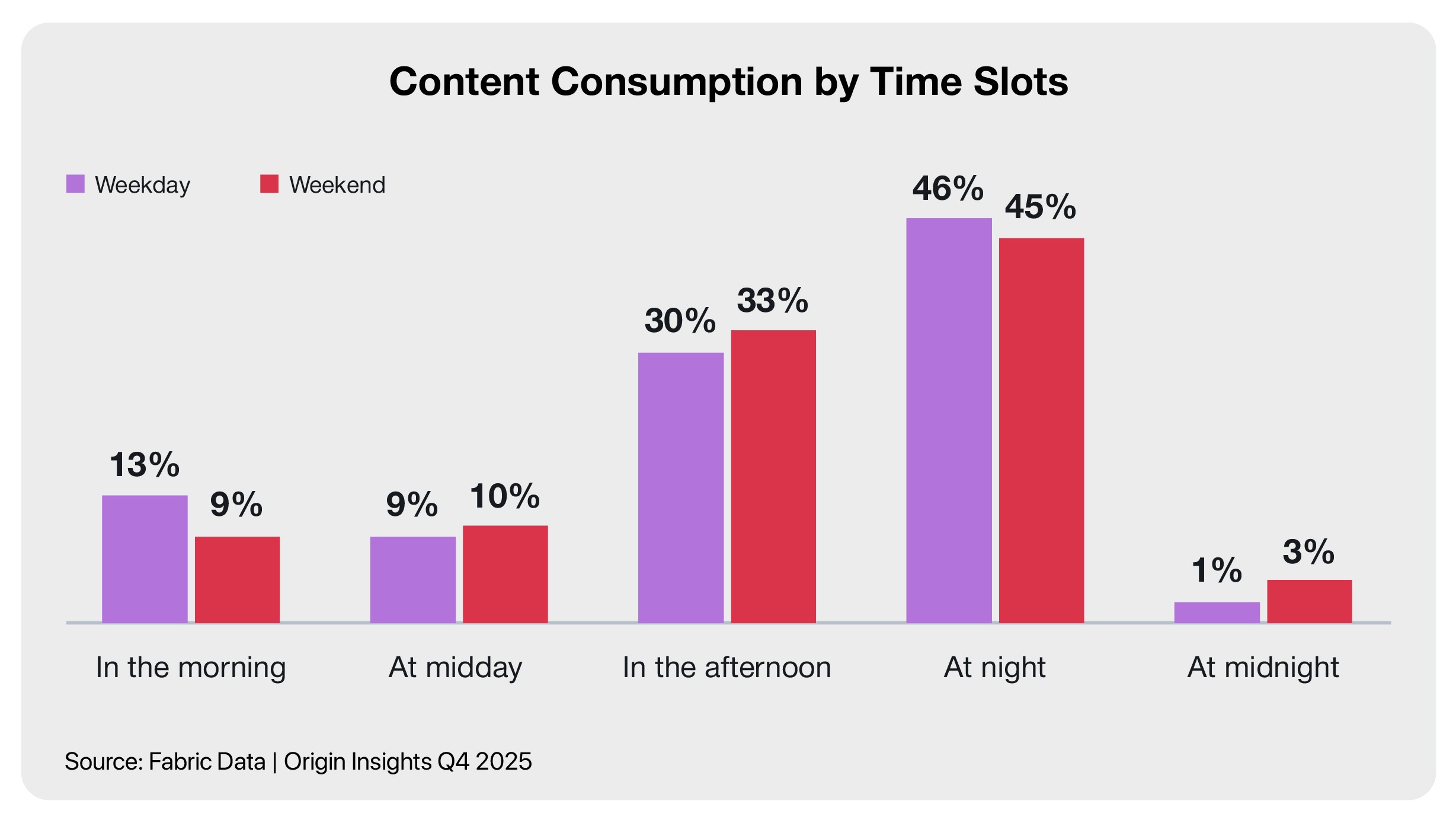
The timing data on when Latin American audiences actually watch adds another layer to the viewership picture. Prime time viewing across the region is consistently nocturnal, regardless of the day of the week. The pattern holds across markets and does not shift meaningfully between weekdays and weekends in terms of when peak evening engagement occurs.
What does shift is morning activity. Weekday mornings show higher streaming engagement than weekend mornings, reflecting the reality that commuting, school routines, and work patterns create viewership opportunities in the morning hours that disappear on weekends when those routines are absent. The afternoon and evening windows show a modest increase during weekends compared to weekdays, but the nocturnal prime time pattern is the dominant and stable feature of the data.
For platform notification and email strategies, this creates a fairly clear framework. Promotional communications sent in the early part of the day on weekdays, when mobile use is higher and audiences are in transit or at work, can serve an awareness function that matures into weekend viewing. Notifications sent during evening hours are competing directly with active viewing and have a shorter conversion window. The platforms that align their communication timing with streaming user habits and preferences are working with the data rather than against it.
The pay TV decline and what it means for streaming
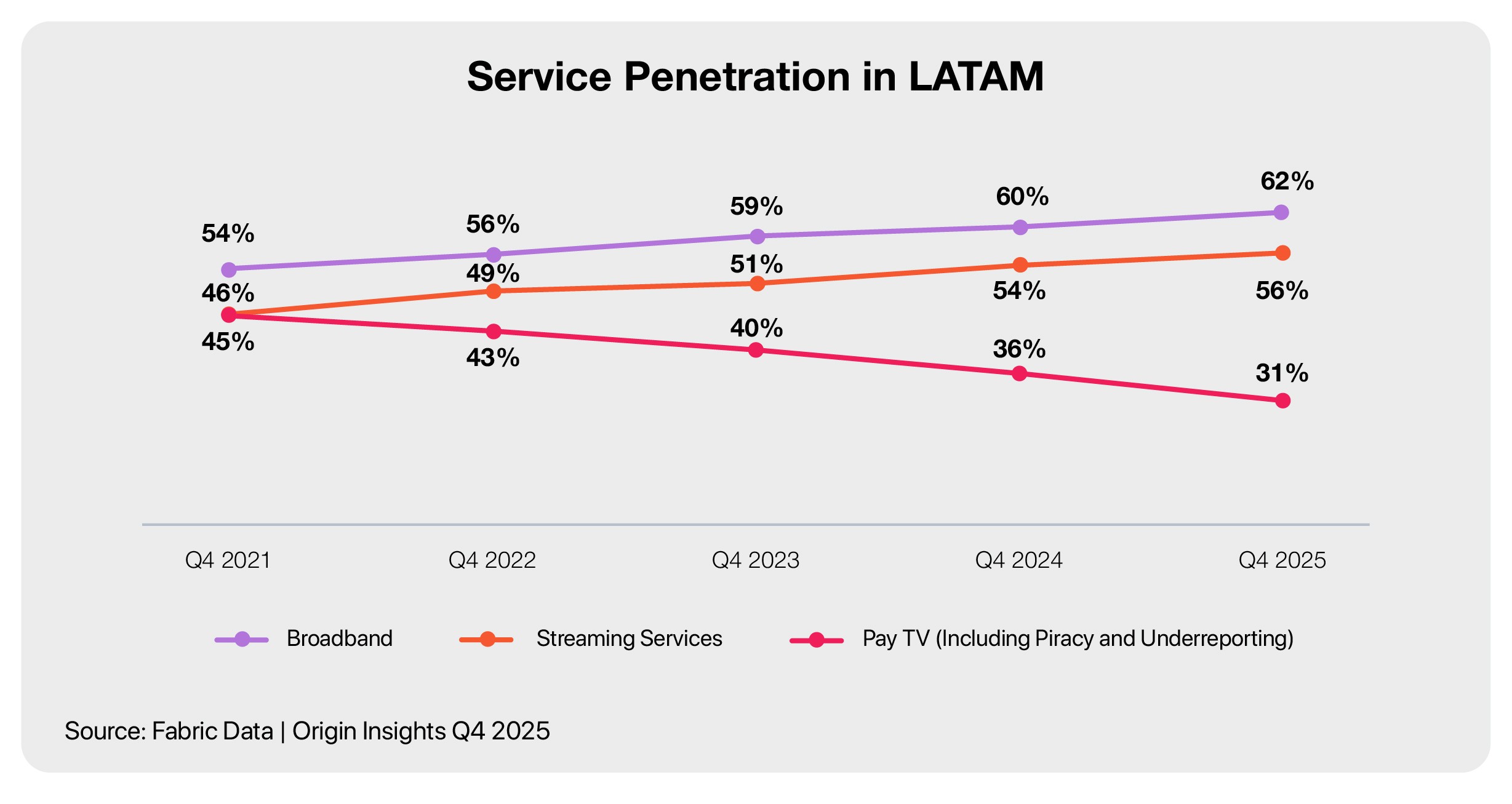
The broader viewership context in Latin America reinforces the strategic importance of understanding these patterns precisely. Pay TV subscription continues to decline across the region, but the relationship between pay TV and streaming is more nuanced than a substitution story.
Among households that still have pay TV, 75% also consume streaming content, and their behavior differs markedly depending on how much time they have available. When time is scarce, 65% of those households reach for traditional TV and 35% for streaming. When time is abundant, the ratio inverts: 83% choose streaming and only 17% opt for pay TV. This is the streaming evolution analysis that explains why streaming dominates weekend engagement. Weekends are the time-abundant window, and streaming is the time-abundant choice.
The content type preferences reinforce this further. News, sports, and telenovelas are the categories that maintain meaningful pay TV preference, while movies, series, and documentaries are consumed primarily through streaming. For content owners in those streaming-dominant categories, the structural shift away from pay TV is not a risk to be managed but a distribution opportunity to be captured, provided the right platforms and the right promotional timing are in place. Understanding cross-platform availability data in each territory is what makes that opportunity actionable rather than theoretical.
What Origin Insights surfaces in this data
The viewership patterns described above are not available from platform-native analytics alone. Streaming services publish selective viewership data, and even the most transparent among them do not provide the cross-platform, cross-territory, time-segmented view that strategic content decisions require.
Origin Insights aggregates audience demand trends, popularity data, and platform availability insights across more than 1,000 streaming services in 249 countries, updated continuously rather than on a quarterly reporting cycle. For teams making acquisition, programming, or distribution decisions in Latin America, the difference between understanding the regional viewership pattern at the aggregate level and understanding how specific titles are performing within that pattern across specific territories and platforms is the difference between market awareness and actionable intelligence.
The weekend discovery dynamic, the nocturnal prime time pattern, and the pay TV to streaming transition are macro signals. The titles and genres that are capturing the weekend window and sustaining engagement through the week are the real-time content insights that Origin Insights is built to surface.
Thinking about media data strategy?
We publish regular insights on streaming market intelligence, audience behavior, and content strategy across Latin America and global markets. Follow Fabric on LinkedIn for new analysis as soon as it drops.
Fabric is a global media data company. Origin Insights delivers primary-sourced, human-verified entertainment market intelligence covering 1,000+ streaming platforms across 249 countries. Real data. Verified by humans. Trusted by the industry.
FAQ
Similar Articles
We're constantly pushing the boundaries of what's possible and seeking new ways to improve our services. Search your topic of interest.


