
Learn More
When media technology teams talk about metadata, the conversation usually defaults to movies and TV series. These are the content types with the most established data standards, the most mature enrichment pipelines, and the most direct connection to the content discovery and recommendation systems that drive platform engagement.
But for platforms building comprehensive discovery experiences, and for the distributors, aggregators, and technology providers that serve them, the catalog stack extends considerably further. Games. Trailers and promotional clips. Licensed imagery across multiple formats and aspect ratios. Celebrity and contributor data that spans entertainment categories. Each of these content types has its own data requirements, its own update rhythms, and its own connection to how audiences find and engage with content.
The platforms that handle this breadth well create discovery experiences that feel complete. The ones that handle only part of it create gaps that audiences notice without being able to articulate why.
Games metadata and the cross-category opportunity
Gaming has become one of the most significant entertainment categories by audience time and engagement, and the intersection between gaming and streaming content has created new metadata requirements that neither the games industry nor the entertainment industry had fully developed data standards for.
For streaming platforms with gaming content, or for platforms that want to surface gaming-adjacent content like gaming documentaries, esports events, or game-related celebrity content, games metadata requires a distinct data model from film and TV. Genres and subgenres in gaming follow different taxonomies. Player counts, platform availability, ESRB and PEGI ratings, multiplayer vs. single-player classifications, and franchise relationships all need structured representation.
The discovery opportunity is significant. A user engaged with a gaming documentary may be highly likely to engage with related gaming content, gaming celebrity profiles, or streaming series based on game IP. Capturing those connections in metadata is what allows a recommendation engine to surface them. Without structured games metadata linked to the same contributor and franchise graph as film and TV content, those connections are invisible to the discovery system.
Trailers and promotional video as first-class metadata
Trailers occupy a specific and important position in the content discovery stack. They are not supplementary assets to be attached to a title record as an afterthought. They are the primary vehicle through which audiences evaluate whether they want to watch something, and their role in conversion from discovery to viewing is substantial.
The metadata requirements for trailers are distinct from those for the titles they promote. A trailer has its own runtime, its own localization requirements, its own age rating, and its own relationship to the promotional calendar of the title it represents. A film may have multiple trailers: teaser, theatrical, international, red-band. Each needs to be correctly linked to the canonical title record, delivered in the right format for the platform displaying it, and updated as new versions are released.
For platforms building editorial features, notification systems, or watchlist tools around upcoming releases, content promotional data is the data layer that makes those features work. A "new trailer dropped" notification system depends on knowing which trailers have been released, for which titles, and whether they have already been surfaced to a given user. Without structured trailers metadata in the same system as title metadata, these features require custom data pipelines that create ongoing maintenance overhead.
Imagery: the metadata layer that audiences actually see
Licensed imagery is the most visible layer of the content metadata stack and the one with the most direct impact on user behavior. Posters, box art, tiles, portraits, and set photography determine how a title appears in search results, recommendation carousels, and content detail pages. Image quality, relevance, and localization all affect click-through rates in ways that are measurable and significant.
The data requirements for imagery go beyond the images themselves. Each image needs format and resolution metadata, localization and usage rights data, aspect ratio variants for different display contexts, and a link to the correct title or contributor record in the canonical catalog.
Managing video and imagery metadata correctly at scale requires that imagery be treated as metadata rather than as a separate asset management problem. When a new international release uses different artwork, the imagery metadata for that territory needs to update independently of the global default. When a platform changes its tile aspect ratio requirements, the delivery layer needs to accommodate the new format without requiring manual re-export of thousands of images.
Celebrity and contributor data across categories
Celebrity metadata connects the dots across entertainment categories in ways that standard title metadata cannot. A performer who appears in both film and television, has a documentary about their career, and is the subject of gaming IP is a single entity in the real world. In a fragmented metadata environment, they may be represented as separate records in each content vertical, with no links between them.
Unified contributor metadata, a single structured entity record for each person that spans their appearances across content types, is what makes cross-category discovery work. The "more from this director" recommendation. The "also available" connection between a streaming series and the film career of its lead. The celebrity profile page that aggregates a performer's full entertainment presence rather than showing only their film credits.
This is the kind of content discovery intelligence that depends on the metadata infrastructure being designed for it, not retrofitted to support it. A contributor graph that has been built to connect a person's credits across film, TV, and gaming is a fundamentally different data structure from a per-title cast list.
How Origin Nexus covers the full catalog stack
Origin Nexus is built to deliver the full catalog metadata stack, not just movies and TV series, but the complete set of content types and asset categories that modern entertainment platforms depend on.
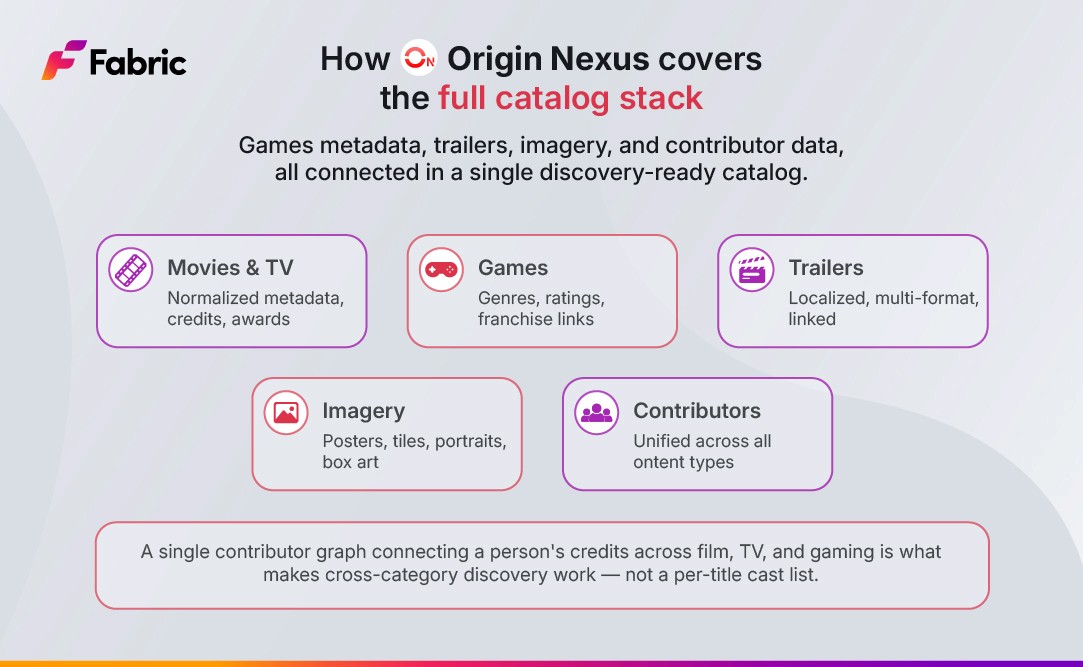
Movie metadata and TV metadata is normalized across titles, contributors, genres, releases, and awards, continuously updated and maintained editorially. Games metadata is structured with gaming-specific taxonomies, franchise relationships, and platform availability data. Movie trailers and promotional clips are delivered across multiple formats, with localization, maturity flags, and usage-based delivery. Licensed imagery covers posters, box art, tiles, portraits, and set photography across formats and aspect ratios, with usage rights included.
The contributor graph in Origin Nexus connects individuals across content types, so that a performer's credits span their full entertainment presence rather than being siloed by category. And at the discovery intelligence layer, proprietary Power Ratings, curated thematic collections, and platform availability insights provide the enrichment signals that turn a complete catalog into a discovery-ready one.
For organizations that also govern their own catalog records, Origin Nexus integrates directly with Origin Studio, so that the full content catalog stack flows from a single metadata source of truth into every downstream system that depends on it.
Join the conversation
Entertainment data is expanding in scope as content categories converge. Follow Fabric on LinkedIn to stay connected with the teams thinking through what the full content catalog stack looks like in practice.
Fabric is a global media data company. The Origin product family, Origin Nexus, Origin Studio, and Origin Insights, powers metadata enrichment, governance, and market intelligence for entertainment companies worldwide.
FAQ
Similar Articles
We're constantly pushing the boundaries of what's possible and seeking new ways to improve our services. Search your topic of interest.


