Learn More
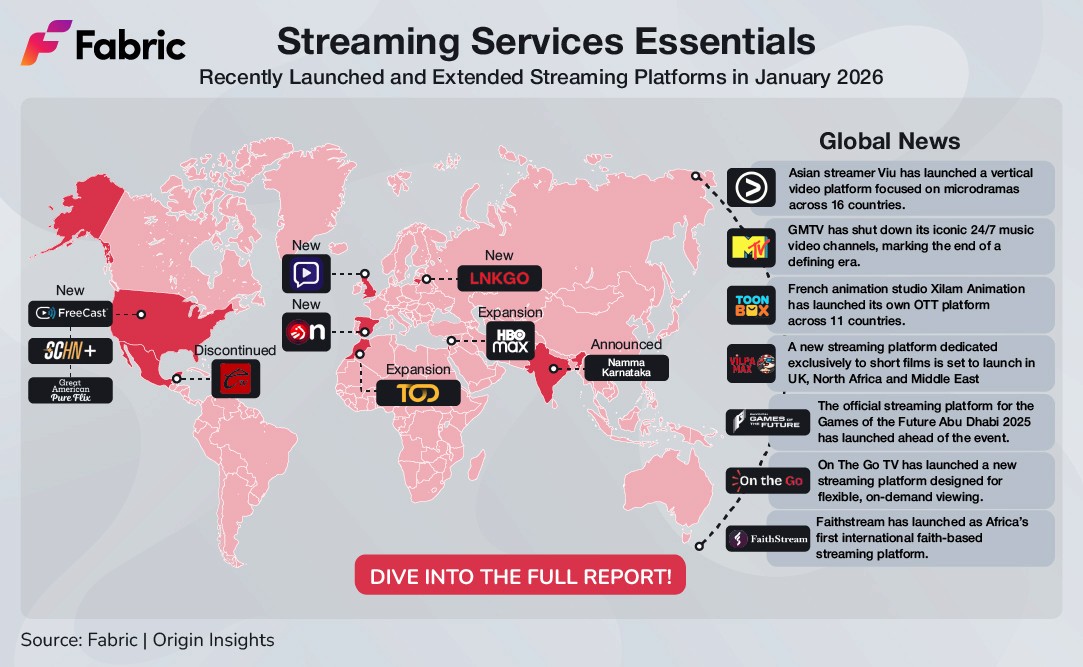
The global streaming ecosystem continues to evolve rapidly in 2026, driven by consolidation, the rise of ad-supported models, mobile-first consumption, and an increasing focus on direct-to-consumer distribution. Across regions, broadcasters, telecom operators, content owners, and new digital players are refining their OTT strategies to better align with changing audience behaviors and monetization models.
Latin America: Consolidation Shapes the OTT Landscape
In Latin America, consolidation remains a defining trend. In Mexico, Caliente TV has been discontinued and fully integrated into Fox One’s OTT platform. The move strengthens Fox One’s market position and reflects a broader regional shift toward fewer, more unified streaming services as operators prioritize scale, operational efficiency, and clearer value propositions.
Europe: Broadcasters and Telecoms Accelerate Digital-First Strategies
Europe saw strong activity in early 2026, particularly from public broadcasters and telecom groups expanding their direct-to-consumer presence.
In Spain, ETB launched ETB ON, a free, ad-supported streaming platform offering live TV and on-demand public service content, reinforcing the broadcaster’s digital-first approach. Orange also completed the consolidation of MasOrange, strengthening its integrated strategy across connectivity, services, and media.
The UK welcomed the launch of Tattle TV, a microdrama streaming app focused on short-form, mobile-first scripted content designed for episodic consumption. In Lithuania, LNK GO entered the market with an ad-supported OTT platform offering live and on-demand programming, further signaling the shift toward direct digital distribution across European markets.
North America: Growth in Free Streaming and DTC Sports
In North America, free streaming and direct-to-consumer sports services continue to gain momentum. FreeCast launched as an ad-supported platform aggregating live TV, on-demand content, and FAST channels, supporting the expansion of free digital TV ecosystems.
SportsNet Houston introduced SCHN+, a DTC streaming service allowing fans to access local NBA and MLB games without a traditional pay-TV subscription. The launch reflects the ongoing transformation of sports rights distribution at the local and regional level. Meanwhile, Great American Media announced plans to launch Pure Flix Familia in the US and Canada, expanding its faith-based offering with Spanish-language content aimed at Hispanic audiences.
Africa: Mobile-First Formats and Sports Drive Expansion
Africa’s streaming growth in 2026 is closely tied to mobile-first consumption and premium sports content. Viu launched Viu Shorts in markets including Egypt and South Africa, focusing on vertical video microdramas optimized for short-form viewing.
In Morocco, beIN Media Group expanded TOD ahead of AFCON 2025, leveraging high-demand sports content to accelerate adoption and subscription growth across the region.
Asia: Short-Form Video and Regional Platforms Gain Ground
Short-form and regional content strategies continue to shape Asia’s OTT landscape. Viu expanded its Viu Shorts service across multiple markets in the Middle East and Southeast Asia, responding to increasing demand for bite-sized, mobile-friendly storytelling.
HBO Max announced its expansion into Israel as part of Warner Bros. Discovery’s international growth strategy, strengthening its regional footprint. In India, the state of Karnataka announced Namma Karnataka, a government-backed streaming platform designed to promote Kannada-language content and support regional creators.
Global: New Niches, Platform Shutdowns, and Industry Shifts
Globally, 2026 brings a mix of new niche platforms, strategic launches, and major industry changes. Faithstream launched as an international faith-based streaming service focused on African and global audiences. New platforms such as GOTF, On The GO TV, and Toon Box highlight continued experimentation with event-driven, mobile-first, and content-owner-led OTT models.
At the same time, MTV shut down its 24/7 music video channels, marking a clear shift away from linear music television toward on-demand and social-first consumption. In a significant industry development, Netflix announced plans to acquire Warner Bros., a move that could dramatically reshape global content ownership, production, and distribution across the OTT ecosystem.
Key Takeaways for Global OTT Trends in 2026
Streaming platforms in 2026 are increasingly defined by consolidation, flexible monetization models, and audience-centric distribution strategies. As the global OTT market matures, success depends on clear positioning, efficient operations, and the ability to adapt content and delivery models to regional and consumer-specific demands.
Similar Articles
We're constantly pushing the boundaries of what's possible and seeking new ways to improve our services. Search your topic of interest.