/

Insights

Exploring APAC's Content Preferences: The Power of Homegrown Stories

Exploring APAC's Content Preferences: The Power of Homegrown Stories

APAC's content preferences

Did you know that in the fourth quarter of 2023, there was a remarkable surge in the consumption of local content across the APAC region? An astonishing 91% of online users in the region reported watching locally produced movies and series. This preference sets APAC apart from other regions, where the inclination for local content was lower: 80% in UCAN and 77% in EMEA.

Among all countries in the region, China demonstrates the strongest preference, with an astonishing 96% favoring local content. This comes as no surprise, especially when considering the regulatory landscape we explored in previous posts regarding the Chinese Streaming Market. With stringent regulations and censorship rules in place, international platforms face significant hurdles in entering the market. Consequently, all major platforms are strictly based in China and feature locally produced contents.

Interestingly, even in countries where foreign platforms have managed to establish themselves in the market, there’s an affinity for local content. Thailand stands out next, with a 91% preference, closely followed by Indonesia and India at 89%.

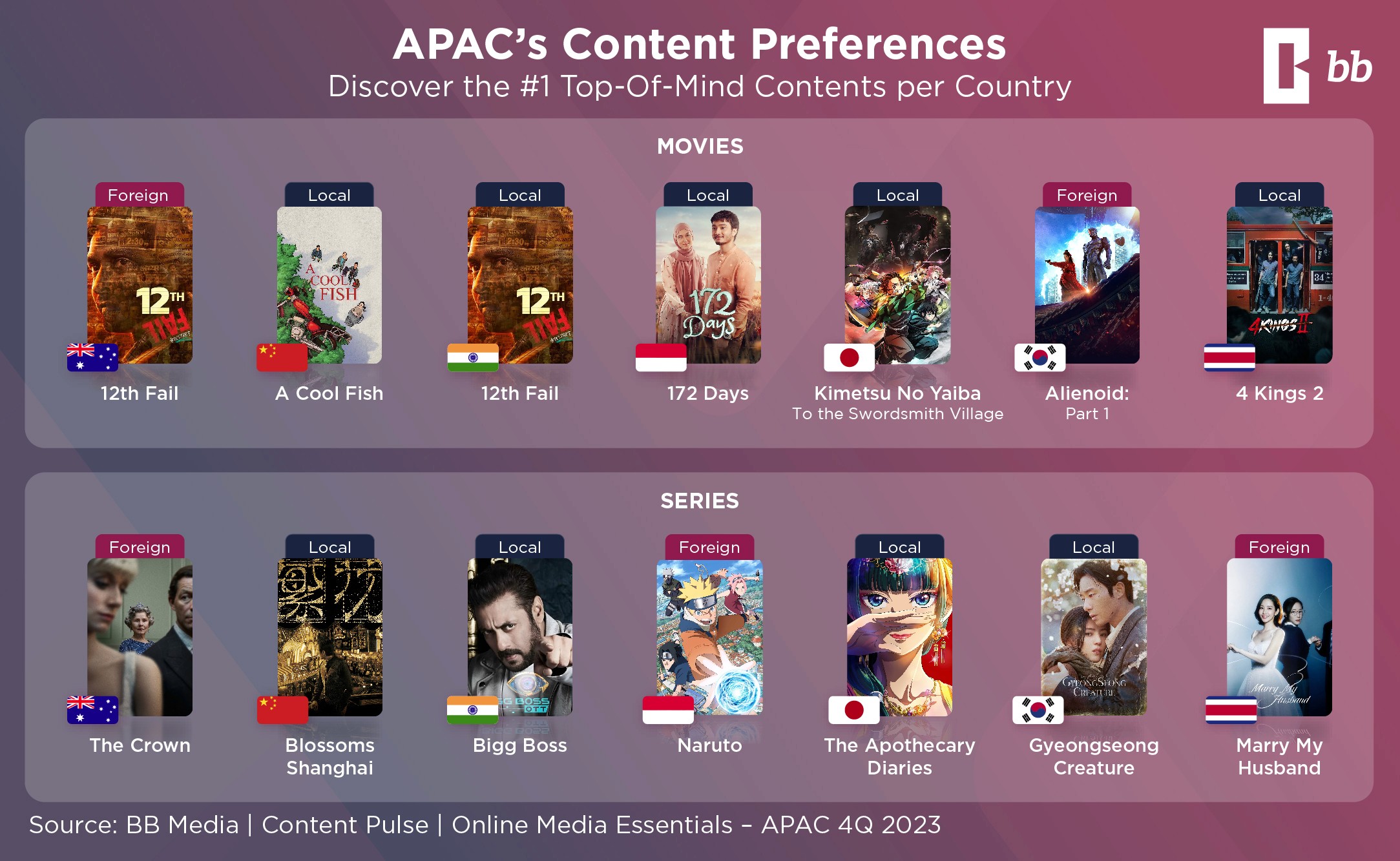
Delving deeper into the preferences, it’s noteworthy that in China, Japan, and South Korea among the top five top-of-mind series, all titles are locally produced. In India, three out of five are local, while in Indonesia and Thailand, the number decreases to two titles. On the movie front, foreign titles dominate, except in China and India, where locally produced films make up 80% and 60% of the top picks, respectively. Overall, the APAC region exhibits a strong inclination towards local series, while maintaining a higher acceptance for foreign content in the realm of movies.

Streaming platforms seeking to expand their presence in the APAC region should consider the strong preference for locally produced content among online users. Incorporating homegrown stories into their catalog or partnering with local production companies could be an effective strategy to attract users in this region.
Powered by BB Media, a Fabric Data company

Read More Articles

We're constantly pushing the boundaries of what's possible and seeking new ways to improve our services.

Origin Nexus Entertainment Search API with StartDateStart and StartDateEnd date range filters applied, returning a list of movies and TV titles with upcoming streaming availability dates across major U.S. platforms.

May 11, 2026

Filter Content by Streaming Availability Dates with the Origin Nexus API

Developers can now filter movies and TV titles by the date they become available on streaming platforms, using two new Origin Nexus API parameters. Here is what you can build with them and why availability-date filtering changes how audiences discover content before it starts trending.

Illustration showing three separate department systems, distribution, marketing, and rights management, each holding a different version of the same content record, contrasted with a single unified metadata platform feeding all downstream systems from one authoritative source.

May 7, 2026

Your Metadata Has More Than One Version of the Truth. That's the Problem.

When three departments each maintain their own record for the same title, none of them wrong but none of them the same, the real cost isn't the occasional incident. It's the permanent overhead of a metadata environment nobody fully trusts. Here's what a genuine source of truth looks like and what it takes to build one.

Illustration showing a media operations workflow moving from fragmented manual coordination across email, spreadsheets, and verbal handoffs to a structured, automated system with centralized job tracking and task progression.

May 6, 2026

Media Workflow Automation: How Modern Facilities Are Eliminating Manual Handoffs

Manual handoffs are not just an inconvenience in media operations — they are a structural cost that scales with every job, every team member, and every new client. Here's how modern facilities are replacing coordination overhead with automated workflows, and what that shift looks like in practice.

World map highlighting global streaming platform developments for April 2026, including new launches in Argentina, Brazil, Germany, India, and the United States, HBO Max's European and Indian expansion, AVOD updates across North America, and sports rights shifts in Central America and Europe.

May 5, 2026

The Streaming Moves That Mattered in April 2026

April 2026 reshaped the global streaming map in ways that matter beyond the headlines. HBO Max completed its European rollout, AVOD platforms consolidated around clear winners, sports rights redrew regional competition in Central America and Europe, and niche platforms continued carving out specific audiences. Here's what the month's moves mean for content strategy and distribution planning.

Xytech X2 benefits

May 4, 2026

What ScheduALL Got Right About Transmission — and Where Xytech’s X2 Goes Further

ScheduALL built its reputation in broadcast by solving a genuinely hard problem: transmission scheduling that understands how resources relate, not just whether they are individually available. Xytech's X2 Transmission replicates that relational foundation and goes further, adding a cloud-native architecture, a Network Visualizer, and an AI scheduling layer that changes what experienced transmission teams can accomplish in a day.

A layered pyramid or stacked diagram showing the five metadata types from bottom to top

Apr 30, 2026

Metadata: The Hidden Engine Behind Every Streaming Recommendation

Metadata is the hidden engine behind every streaming recommendation. For platforms competing on content discovery, the quality, depth, and normalization of movie and TV metadata — from genre tags and contributor records to thematic enrichment and availability windows — determines whether recommendation engines surface the right title or settle for a generic list. This post breaks down the layers of entertainment metadata that matter most, why sparse or inconsistent data produces shallow discovery experiences, and how continuous enrichment pipelines are the only scalable answer to keeping a catalog current. If your platform's engagement metrics aren't where they should be, your metadata infrastructure is worth examining.

Ready to take your data to the next level?

Copyright © 2026 Fabric. All Rights Reserved

Powered by AWS

Ready to take your data to the next level?

Copyright © 2026 Fabric. All Rights Reserved

Powered by AWS

Ready to take your data to the next level?

Copyright © 2025 Fabric. All Rights Reserved

Powered by AWS

Ready to take your data to the next level?

Copyright © 2025 Fabric. All Rights Reserved

Powered by AWS