Learn More
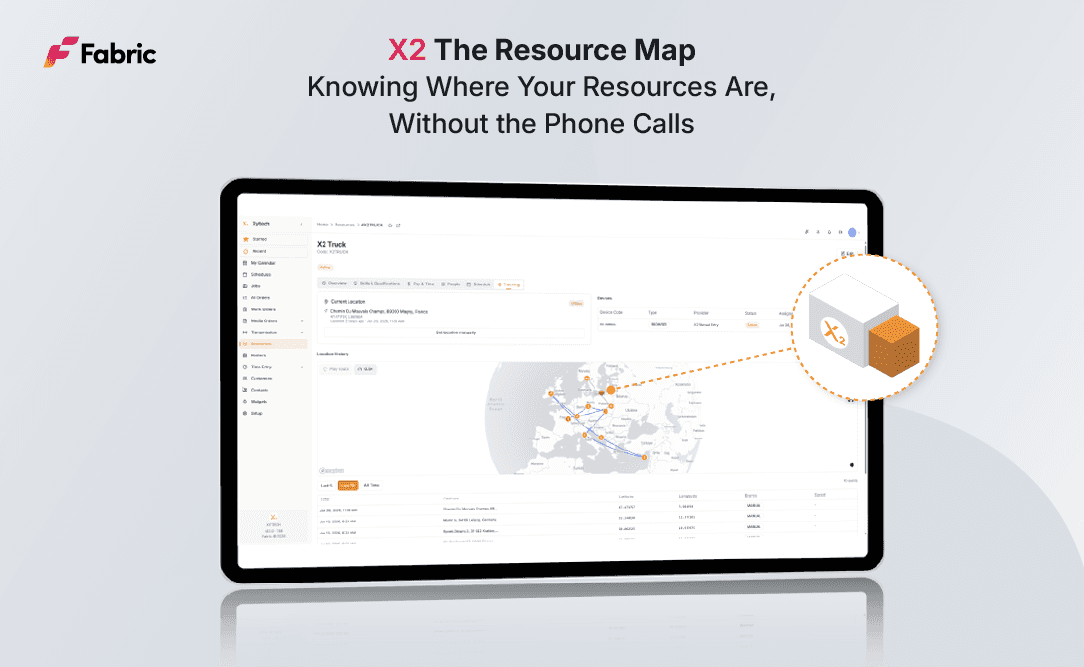
Xytech has been solving the hardest operational problems in media for decades. The workflows it supports, resource and production scheduling, media lifecycle management, transmission coordination, are among the most complex in any industry. What has changed is not the complexity of the problems. It is the expectation of how software should feel while solving them.
X2 is Fabric's answer to that expectation. Built on a completely rearchitected foundation and released in beta at NAB Show 2026, X2 is the next-generation interface for the Xytech platform: faster, fully responsive across all screen sizes including mobile, and designed from the ground up for the way operations teams actually work today, including through natural language conversation with AI.
What X2 actually is
X2 is so much more than just a visual refresh. It is a comprehensive rebuild, delivered on top of the same Xytech data and workflows that customers already depend on, but with a user experience that reflects eighteen months of infrastructure investment, architectural modernization, and direct input from customer conversations and technical deep dives.
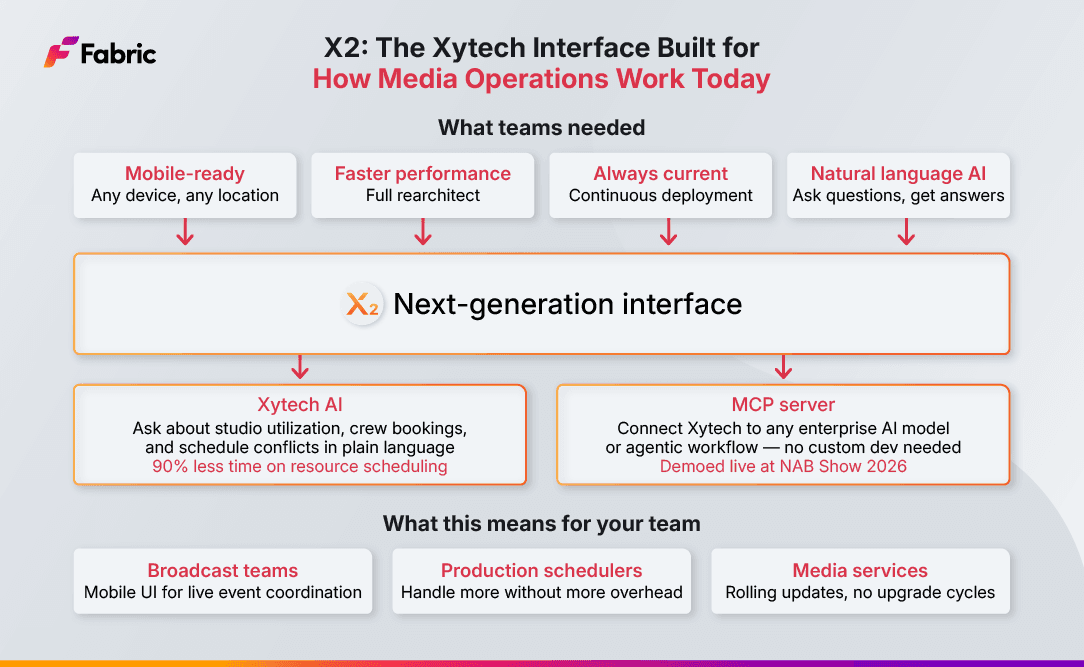
The most immediate difference is responsiveness. The previous Xytech web interface was not built for the range of devices and screen sizes that operations teams now use. X2 works across all screen sizes down to mobile, which matters in broadcast and live event environments where schedulers and coordinators are not always at a desk. The interface is significantly faster than its predecessor, the result of a full architectural rearchitect rather than incremental performance optimization.
Continuous deployment means that new features and enhancements reach customers on the latest platform without the upgrade cycles that have historically created friction between innovation and adoption. Customers using X2 are always on a current, maintained interface rather than managing the gap between installed versions and new capabilities.
The AI layer
The most significant new capability in X2 is Xytech AI, which brings conversational AI interaction directly into the Xytech platform through an embedded chat agent and an MCP server for enterprise AI integration.
The practical value for operations teams is immediate and specific. Rather than navigating complex menus or building manual reports to answer operational questions, teams can ask them directly. Studio utilization across facilities for the quarter. All bookings for a specific crew next month. Schedule conflicts for a particular resource over the next two weeks. These are the kinds of data requests that currently require report-building, system navigation, or asking someone with deeper platform knowledge. Xytech AI surfaces the answer through a natural language question, drawing from live operational data rather than cached reports.
Fabric's own testing, shared publicly by CEO Rob Delf at DEG's EnTech Fest in 2026, points to a 90% reduction in time spent creating initial resource allocations and schedules using Xytech AI. For production scheduling environments handling high volumes of bookings across complex resource pools, the operational implication is significant: the same team can handle substantially more without a proportional increase in coordination overhead.
The MCP server extends this capability beyond the embedded chat interface. Organizations that want to integrate Xytech into a broader agentic enterprise architecture, or bring their own AI models to their operational data, can do so through the MCP layer without requiring custom development. Fabric has already demonstrated this capability publicly: at NAB Show 2026, Fabric's live demo showed an end-to-end content acquisition and media workflow running across Xytech and the Origin product family through a single conversational session, connected via MCP.
The infrastructure underneath it
X2 is the visible output of an infrastructure modernization program that Fabric began in September 2024 and completed in December 2025. The migration to managed cloud resources, proper cloud object use, and improved performance, scalability, monitoring, and redundancy was the prerequisite for everything X2 delivers. Building a next-generation product on the previous infrastructure was not a viable path; the foundation had to be rebuilt first.
The current architecture runs on AWS, with a migration from SQL Server to PostgreSQL on Aurora Serverless V2 in progress and scheduled for completion in Q3 2026. The API layer is being migrated to API Gateway and Lambda, supporting the new natural language interfaces and AI model integrations running on Amazon Bedrock. All infrastructure is managed as code, with changes tested and promoted through a structured software development lifecycle and agile release cycles that increase velocity without sacrificing the stability that media operations environments require.
The three guiding principles Fabric applies to this infrastructure work are stability, performance, and velocity. For customers operating in broadcast, live events, and media services environments where the cost of system instability is immediate and visible, the stability principle is not a marketing claim but an engineering commitment backed by detailed monitoring, tracing, and alerting across the full stack.
What this means for operations teams
The combination of a significantly faster and more flexible interface, AI-powered natural language interaction for data queries and scheduling tasks, MCP-enabled enterprise AI integration, and a continuously deployed feature roadmap represents a meaningful shift in what Xytech customers can expect from the platform going forward.
For teams managing resource and production scheduling across complex facilities, the reduction in friction from natural language queries alone changes how quickly information can be accessed and acted on. For broadcast operations teams coordinating live events and transmission workflows, the mobile-responsive interface and faster performance address practical constraints that the previous UI created in field environments. For media service organizations managing high volumes of work orders across services and vendors, continuous deployment means capability improvements arrive on a rolling basis rather than requiring planned upgrade cycles.
X2 is the interface Xytech customers have been waiting for. It is available in beta now, and reaching general availability in October.
Get the latest from Fabric
We publish regular updates on X2, Xytech AI, and the broader Fabric platform roadmap. Follow Fabric on LinkedIn for new articles as soon as they drop.
Fabric is a global media technology company. The Xytech product family, including Xytech Media, Xytech Operations, and Xytech Transmission, powers media lifecycle management, resource scheduling, and transmission workflows for media organizations worldwide.
FAQ
Similar Articles
We're constantly pushing the boundaries of what's possible and seeking new ways to improve our services. Search your topic of interest.