Learn More
What Is Broadcast Scheduling Software and What Should It Actually Do?
Broadcast scheduling software is the operational infrastructure that keeps broadcast organizations running: the platform that coordinates which people are working on which productions, which studios and technical equipment are booked for which events, which contribution resources are allocated to which deliveries, and whether the financial costs of all of this align with what was quoted and what will be invoiced.
The term covers a range of operational complexity. At one end of the spectrum, a regional broadcaster with a small production team may use broadcast scheduling primarily to manage studio bookings and crew shifts. At the other end, a major broadcast organization or live events company may be coordinating hundreds of bookings per day across dozens of technical resources, freelance pools, multi-venue productions, and simultaneous live events, with real-time visibility requirements and financial tracking integrated across the full operation.
What connects these use cases is the underlying need: the resources involved in broadcast production are interdependent, time-sensitive, and expensive, and coordinating them through informal or disconnected processes creates operational failures that have direct consequences on what reaches audiences.
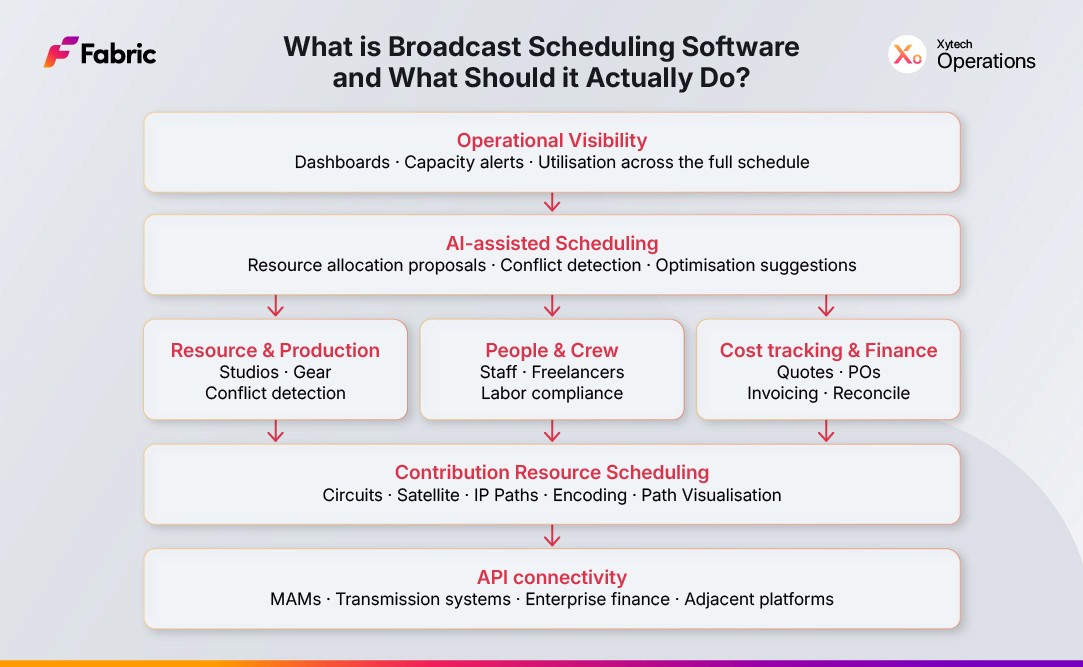
What broadcast scheduling software actually covers
The capabilities that modern broadcast operations software needs to provide fall across several connected operational domains.
Resource and production scheduling is the core function: managing the availability of studios, stages, technical gear, vehicles, and other physical resources, and coordinating them against a production schedule with conflict detection before bookings are confirmed rather than after. The specific challenge in broadcast environments is that resources are often both interdependent and in constrained supply: a studio booking that looks clean in isolation may create a conflict when considered against the technical infrastructure it depends on.
Personnel planning covers the people layer: staff availability, freelance pool management, crew assignments, certification and skill requirements, working time rules, and labor agreement compliance. In broadcast environments with complex labor arrangements covering different categories of talent and technical staff, managing this correctly at scale requires a platform that models these rules rather than relying on coordinators to remember them.
Cost tracking and financial workflow integrates quoting and invoicing, purchase orders, and cost reconciliation with the scheduling layer. The gap between estimated and actual costs in broadcast production, driven by overtime, equipment overruns, scope changes, and rate substitutions, is almost always a consequence of the financial workflow and the operational workflow being managed separately. Closing this gap requires that a quote be built from the same resource and rate data that governs actual bookings.
Contribution resource scheduling manages the technical delivery layer: circuits, satellite capacity, IP pathways, encoding resources, and the personnel who operate them. For broadcasters with live event and contribution operations, this layer needs to be integrated with the production scheduling layer so that changes in the production plan surface immediately in delivery planning and vice versa.
Operational visibility provides the management layer: dashboards and views that give operations managers, schedulers, and senior coordinators a current picture of what is booked, what is at risk, what is running over, and where capacity is approaching its limits.
How broadcast scheduling software has evolved
The tools that broadcast organizations used for scheduling a decade ago were built around the operational requirements of that era: fixed facilities, established workflows, and a relatively predictable production environment. The category has evolved significantly in response to the changes in how broadcast organizations now work.
Cloud-native delivery has replaced on-premises installations for most modern platforms, which means broadcast scheduling software is now accessible from any device and location rather than requiring specific hardware at a specific location. This matters particularly for live event environments where schedulers and coordinators need access to operational data outside of fixed office environments.
AI-powered scheduling has emerged as a meaningful capability in the most recent generation of platforms. Rather than requiring schedulers to manually build and optimize resource allocation across complex event slates, AI assistance can propose initial resource allocations and identify optimization opportunities, with schedulers reviewing and adjusting rather than building from scratch. Fabric's own testing, shared publicly by CEO Rob Delf at DEG's EnTech Fest in 2026, found a 90% reduction in time spent creating initial resource allocations and schedules using AI-assisted scheduling in Xytech Operations.
Integration with adjacent systems has become more important as broadcast operations have become more complex. The most useful broadcast scheduling software today exposes data through API layers that connect to transmission workflows, financial systems, and broader media lifecycle management infrastructure, rather than operating as isolated scheduling databases.
What to evaluate when choosing broadcast scheduling software
Coverage of the full operational stack. Broadcast scheduling software that covers only studio bookings without integrating crew scheduling, financial tracking, and contribution resource scheduling creates the same fragmentation problem that informal coordination creates, just with different tools. The most effective implementations are ones where the full operational visibility picture lives in a single system.
AI and automation capabilities. Manual scheduling in high-volume environments is a bottleneck that limits how much work a team can handle without proportionally scaling headcount. Platforms that provide automated task generation and AI-assisted scheduling reduce this bottleneck. Evaluate what specifically the AI assists with, whether it is initial resource allocation, conflict detection, optimization suggestions, or natural language querying of scheduling data, and how much manual review is required to validate its outputs.
Financial integration. The gap between what broadcast operations cost and what was quoted for them is one of the most persistent operational challenges in the industry. Evaluate whether the platform integrates quoting and invoicing, booking confirmation, timecards and planning, and invoice generation in the same workflow rather than requiring manual reconciliation between separate financial and operational records.
API connectivity. Broadcast scheduling software that cannot expose its data to adjacent systems, whether transmission platforms, MAMs, or enterprise financial systems, will eventually create integration problems as the operational stack around it evolves. Evaluate the quality and completeness of the API layer as rigorously as the features themselves. For a broader view of how scheduling, transmission, and media workflow automation connect across a single platform, Fabric's unified media operations overview covers how the three Xytech products work together.
How Xytech Operations addresses broadcast scheduling requirements
Xytech Operations is Fabric's resource and production scheduling platform, built specifically for the operational requirements of broadcast organizations, production companies, and live events operations.
The platform manages equipment scheduling across studios, edit suites, vehicles, and technical gear with real-time availability tracking and conflict detection. People management covers crews, freelancers, and staff with support for timecards, labor rules, working agreements, and utilization tracking. The financial layer connects quoting and estimates directly to job and resource data, with purchase orders, invoicing, and cost reconciliation flowing from the same operational record.
Xytech AI adds a conversational AI interface for natural language queries against live scheduling and resource data, with the 90% reduction in initial resource allocation time noted above. The Xytech MCP Server exposes scheduling data for enterprise AI integration and workflow automation.
Xytech Operations connects with Xytech Transmission for contribution resource scheduling and delivery coordination, and with Xytech Media for media lifecycle and workflow management, through shared scheduling, cost tracking, and issue management foundations.
Get the latest from Fabric
We publish regular insights on broadcast operations, resource scheduling, and the technology shaping how modern broadcast and production organizations run. Follow Fabric on LinkedIn for new articles as soon as they drop.
Fabric is a global media technology company. The Xytech product family, including Xytech Media, Xytech Operations, and Xytech Transmission, powers media lifecycle management, resource scheduling, and transmission workflows for media organizations worldwide.
FAQ
Similar Articles
We're constantly pushing the boundaries of what's possible and seeking new ways to improve our services. Search your topic of interest.