Learn More
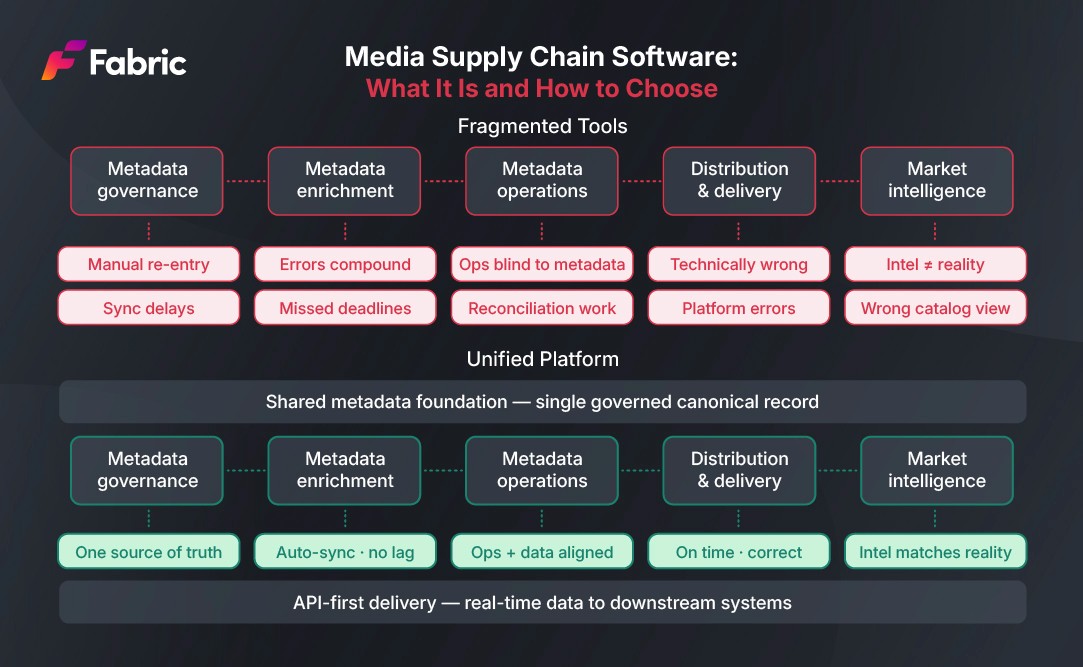
Media supply chain is a term borrowed from manufacturing that has found a genuine home in the media industry. Like a physical supply chain, the media supply chain describes the sequence of processes that transform raw material, in this case content and associated material, into a finished product delivered to the end customer. Unlike a physical supply chain, the product is intangible, the distribution channels are numerous and technically complex, and the metadata that describes the product is as operationally important as the content itself.
Media supply chain software is the infrastructure that coordinates and connects these processes: the tools that govern how content is identified, described, enriched, processed, scheduled, distributed, and monitored across the full journey from production to audience. The challenge that most media organizations face is not a shortage of tools. It is a shortage of connection between them.
What the media supply chain actually involves
The media supply chain spans several distinct operational layers, each with its own requirements, systems, and teams.
Content metadata governance is the foundation. Before content can be distributed, described, or discovered, it needs accurate, consistent, and governed metadata: title and episode metadata that correctly describes the content, carries the right identifiers, reflects the correct rights and territorial configurations, and is maintained as a single authoritative source rather than replicated inconsistently across multiple systems. Without a governed metadata source of truth, every downstream layer in the supply chain operates on unreliable data.
Metadata enrichment augments the governed canonical record with data from authoritative external sources: normalized metadata, licensed imagery, thematic attributes, availability information, and content discovery data. Enrichment determines how well content can be found and recommended across distribution platforms. A title with complete, automated metadata enrichment performs in discovery; a title with skeletal metadata does not, regardless of its quality.
Media operations covers the operational layer: the production scheduling, media workflow automation, and delivery coordination that governs how content moves through production and post-production facilities, how resources are allocated and tracked, and how financial workflows are connected to operational data. This is the layer that determines whether content moves efficiently from production to delivery or whether it accumulates in queues, misses deadlines, and arrives at distribution platforms with errors.
Distribution and delivery manages the movement of content and its associated metadata to the platforms and partners that will make it available to audiences: transcoding, packaging, delivery planning, technical specification compliance, and confirmation that deliveries have been received and ingested correctly.
Market intelligence provides the strategic layer: understanding how content is performing across the platforms it has been distributed to, where audience demand trends exist in markets it has not yet reached, and how the competitive landscape is evolving across media pricing and plan data, catalog, and streaming user habits dimensions.
Where media supply chains typically break down
The most common failure in media supply chain infrastructure is not that any individual layer is absent. It is that the layers do not connect, and the connections between them are managed through manual processes that cannot scale.
A metadata source of truth that is governed correctly in one system but has to be manually re-entered in a distribution system creates an opportunity for error and a maintenance burden that grows with every new distribution partner. An operational workflow that manages resource and production scheduling efficiently but has no visibility into metadata quality creates deliveries that are operationally on time but technically incorrect. A market intelligence function that operates on data sourced separately from the distribution and metadata infrastructure may be working from a different version of the catalog than the one that is actually being distributed.
Each of these gaps is manageable at small scale. At enterprise scale, they produce the persistent operational overhead that media organizations describe as the cost of doing business. For example, the reconciliation work before every major delivery, the error correction after every platform launch, or the manual tracking that absorbs coordinator capacity that should be focused on higher-value work.
The infrastructure answer is a unified media operations approach: tools that are designed to share data foundations rather than requiring manual synchronization between them.
What to look for in media supply chain software
Metadata as the connective tissue. Evaluate whether the platform treats metadata as a shared foundation that all other layers draw from, or as a separate concern managed independently by each layer. The most effective media supply chain software is organized around a governed, enriched, API-first records metadata management canonical record that flows from governance through enrichment through distribution rather than being reconstructed at each stage.
Operational and data layer integration. Evaluate whether the platform connects the metadata governance layer with the operational layer, so that the data used to manage content and the data used to operate on it come from the same source. A platform that handles media catalog management and media lifecycle management separately, requiring manual synchronization between them, creates the same fragmentation that informal coordination creates.
API-first delivery architecture. Evaluate whether the platform is designed to deliver data to downstream systems in real time through structured APIs, or whether it requires periodic bulk exports that create sync delays and divergent copies. The distribution layer of the media supply chain cannot be reliable if the metadata it is distributing is not current at the moment of delivery. Achieving metadata scalability looks like this when it is built into the architecture rather than bolted on afterward.
Market intelligence integration. Evaluate whether the platform connects operational and distribution data with entertainment market intelligence, so that performance monitoring and competitive analysis draw from the same data foundation as content management. A market intelligence layer that operates on different data than the operational layer provides a picture of the market that does not always match the operational reality.
Where Fabric sits in the media supply chain
Fabric is built around a connected platform approach to the media supply chain, spanning the metadata governance, enrichment, operations, and intelligence layers with shared data foundations rather than requiring manual synchronization between them.
Origin Studio governs the canonical content record: the metadata source of truth that every other layer draws from. Origin Nexus enriches those records with normalized metadata, licensed imagery, contributor data, and availability information at the point of creation. Origin Insights transforms the governed, enriched canonical record into the market intelligence that informs what goes into the supply chain in the first place.
The Xytech product family connects the metadata foundation to the operational layer. Xytech Media manages media lifecycle and workflow orchestration. Xytech Operations handles resource and production scheduling with integrated financial tracking. Xytech Transmission coordinates contribution resource scheduling and delivery.
The connection between these layers is what distinguishes a connected media supply chain platform from a collection of point solutions that each handle one layer well.
Thinking about media data strategy?
We publish regular insights on media supply chain infrastructure, platform integration, and the decisions that determine how well media organizations manage content at scale. Follow Fabric on LinkedIn for new articles as soon as they drop.
Fabric is a global media data company. The Origin product family, including Origin Nexus, Origin Studio, and Origin Insights, and the Xytech product family, including Xytech Media, Xytech Operations, and Xytech Transmission, power metadata enrichment, governance, market intelligence, and media operations for entertainment companies worldwide.
FAQ
Similar Articles
We're constantly pushing the boundaries of what's possible and seeking new ways to improve our services. Search your topic of interest.