Learn More
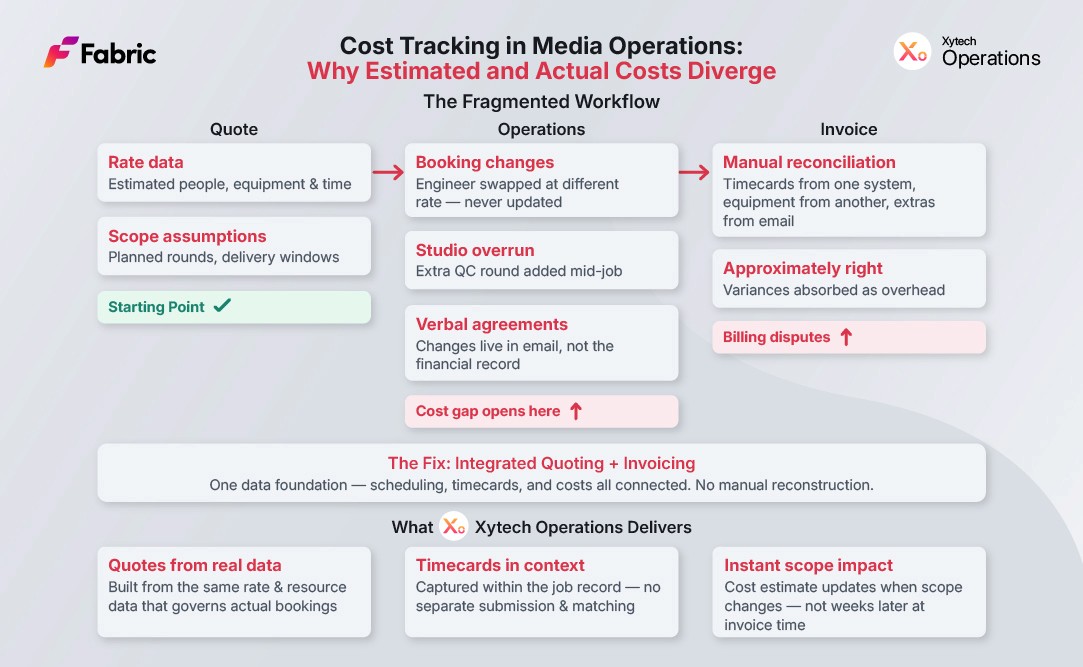
Cost Tracking in Media Operations: Why Estimated and Actual Costs Diverge
Most media service organizations have a version of this problem they have learned to live with. Jobs come in, get quoted, get delivered, and somewhere in the reconciliation process the actual cost turns out to be higher than the estimate. Not dramatically higher, usually. Just consistently higher, in ways that are hard to attribute precisely and therefore hard to fix.
The standard response is to build contingency into quotes, tighten timecard submission, and ask teams to flag scope changes earlier. These are reasonable measures and they help at the margins. They do not fix the underlying issue, which is structural: in most media service operations, the system used to quote a job and the system used to execute it are not the same system. The connection between what was planned and what actually happened has to be reconstructed manually, after the fact, by people whose time would be better spent elsewhere.
Where the cost tracking gap opens: quoting, scheduling, and invoicing in separate systems
Quoting and invoicing in media services is a forecasting exercise. It estimates the people, equipment, and time a job will require before any of it has been confirmed or scheduled. Done carefully with accurate rate data and realistic time estimates, the quote is a reasonable starting point. The problem is not the quote. It is everything that happens between the quote and the invoice.
Resource bookings change. A scheduled engineer becomes unavailable and a replacement is brought in at a different rate, without anyone updating the cost estimate. A studio runs over its booked time. A job requires an additional round of QC that was never part of the original scope. Each of these situations is reasonable and often unavoidable, but they all share the same problem: they happen inside the operational layer, in scheduling tools, booking confirmations, and verbal agreements, without ever flowing back to the financial record built at the quoting stage.
By the time an invoice is being prepared, a coordinator is working backwards: pulling timecard data from one system, equipment usage from another, additional services from email confirmations, and trying to assemble a coherent cost picture from sources that were never designed to exchange data with each other. The result is an invoice that is approximately right, with variances absorbed as rounding or attributed to operational visibility gaps rather than tracked to their source.
What integrated quoting and invoicing looks like in practice
The alternative to manual reconciliation is building the financial workflow and the operational workflow on the same data foundation, so that cost tracking becomes automatic rather than a periodic reconstruction exercise.
In practice, this means a quote is built from the same resource and rate data that governs production scheduling, so when a booking is confirmed the cost estimate already reflects actual committed resources rather than planning assumptions. Timecards and planning data is captured within the same system as the job record it belongs to rather than submitted separately and matched later. When scope changes, the cost impact is visible immediately rather than discovered when the invoice is being prepared weeks after delivery.
Purchase orders and invoices generated from job data rather than assembled from scratch are faster to produce and more accurate. The coordinator is confirming a cost picture that the system has assembled from the operational record rather than reconstructing one from scattered sources. For organizations running high volumes of jobs across multiple clients, the compounding effect of tighter cost tracking produces better margin transparency, faster invoicing cycles, and fewer billing disputes.
How Xytech Operations connects production scheduling and financial tracking
Xytech Operations is built around the principle that resource and production scheduling and financial tracking are the same operation rather than two separate workflows that need to be reconciled after the fact.
The platform's financial layer, covering quoting and invoicing, purchase orders, and cost reconciliation, is directly connected to the scheduling and resource layer. Quotes are built from the rate and resource data that governs actual bookings. Timecards and planning are captured within the job context and feed directly into cost records. Equipment usage is tracked against the booking rather than separately logged. When a job's scope changes, the cost estimate updates with it.
Personnel planning in Xytech Operations supports the full crew lifecycle: availability, assignments, timecards, labor rules, and working agreements, all within the same operational record. For organizations with complex labor agreements or large freelance pools, having this data in the same system as the scheduling integration and cost data is what makes accurate planning and accurate invoicing simultaneously achievable rather than a trade-off between the two.
The platform connects with Xytech Media for media lifecycle management and media work orders, and with Xytech Transmission for contribution resource scheduling and delivery coordination, through shared scheduling, cost tracking, and issue management foundations. For operations managers who need operational visibility across the full job lifecycle from initial quote through delivery and invoice, that connection is what makes the picture complete.
Join the conversation
Production operations, cost visibility, and the decisions that separate high-margin facilities from perpetually tight ones are among the most important operational questions in media services. Follow Fabric on LinkedIn for regular insights on what works.
Fabric is a global media technology company. The Xytech product family, including Xytech Media, Xytech Operations, and Xytech Transmission, powers media lifecycle management, resource scheduling, and transmission workflows for media organizations worldwide.
Similar Articles
We're constantly pushing the boundaries of what's possible and seeking new ways to improve our services. Search your topic of interest.