Halloween and UX Adaptation in Streaming Platforms

Halloween and UX Adaptation in Streaming Platforms

Horror Content Viewership in USA - Streaming Analysis for Halloween Season

October has firmly established itself as a strategic month for the entertainment industry. Halloween has transcended its cultural roots to become a key seasonal event for audiovisual viewing — especially on streaming platforms. 

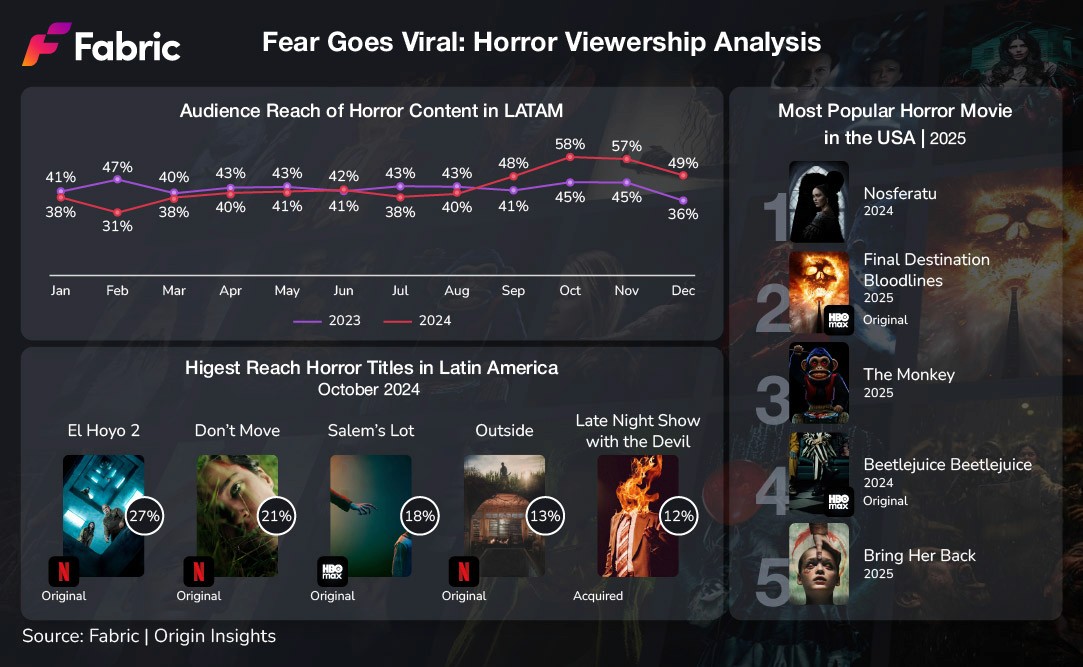
During this period, audiences show a stronger preference for horror content. In Latin America, viewership begins to rise in September and peaks between October and November. In 2024, reach grew by 19% from September to October, while the year-on-year comparison (October 2023 vs. October 2024) shows a 27% increase — with Mexico leading the region, reaching 64% in 2024. 

To leverage this opportunity, streaming services rethink their user experience (UX) to boost the visibility and engagement of Halloween-related titles. Fabric conducted an analysis on how major streaming platforms in the USA and the key LATAM markets adapted their UX during Halloween 2025. 

These features include thematic collections, prominent banners, seasonal filters, and specific sub-categories — such as “Classic Horror,” “Family-Friendly,” or “Based on Stephen King”. These strategies strengthen emotional connection with audiences and encourage content discovery during the season. 

Disney+: Integrating “Huluween” as a Thematic Axis

In Argentina, Brazil and Mexico, following the integration of Hulu into its interface, Disney+ replicates the “Huluween” experience, featuring a special section on its home screen with Hulu’s Halloween titles. 
In contrast, in the United States — where Disney+ has not yet integrated with Hulu — the platform added a “Halloween Collection” category on the home screen — only four scrolls from the start. Even though Disney+ maintains global consistency in branding and visual storytelling, visibility levels vary by market. In LATAM, the same section appears further down (between 12 and 22 scrolls), showing lower visual priority outside the USA. 

Netflix: “Netflix & Chills” — A Fully Integrated Halloween Experience 

Netflix presents the most cohesive design strategy for the Halloween season. Across the four markets analyzed, the platform features the “Netflix & Chills” collection, bringing together sub-categories like “Thirst for Blood,” “Horror without the Gore,” and “Family Fright Night.” This section was first introduced in the platform’s interface in 2024 and has been reintroduced again this year. 

Netflix is also the only platform that allows users to filter directly by “Halloween” in the movies section, simplifying the themed browsing experience. 

Regarding the horror genre category: 

  • Argentina: “Modern Horror Classics” and “Horror Movies” appear on both the home page and movies section. 

  • Brazil and the USA: “Modern Horror Classics” is available directly on the home page. 

  • Mexico: The category appears on both the home page and movies section. 

In terms of visibility, access is easier in Brazil and the USA, where the category appears after only 6 scrolls. In Mexico and Argentina, it requires more navigation (7 and 10 scrolls, respectively). 
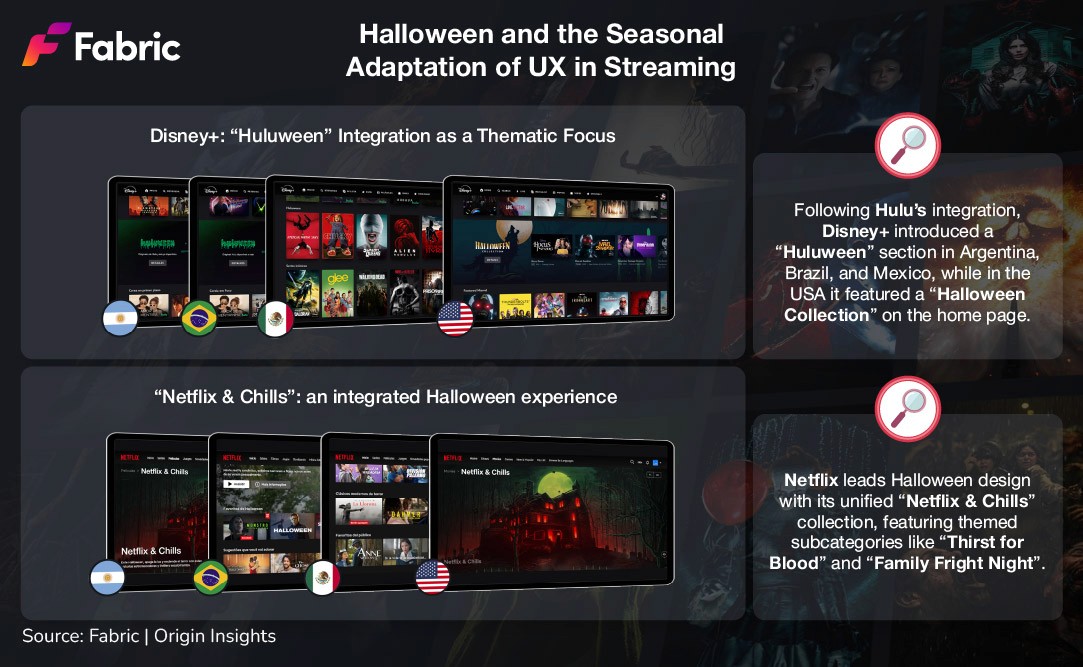
Netflix and Disney+'s UX strategies for Halloween Season 2025

Prime Video: Limited Regional Halloween Integration 

In Argentina, Brazil and Mexico, Prime Video does not feature Halloween-themed sections or filters, maintaining a standard interface. In the USA, however, the platform adds a dedicated Halloween section and filter, accessible from the main menu — reflecting a localized strategy where customization depends on the market.  

The “Horror Movies” and “Horror TV” categories remain active across all regions, though their placement on the home page varies. In LATAM, they appear after 3–8 scrolls, while in the USA they are positioned beyond 20. 

HBO Max: Visual Consistency and Market-Specific Personalization 

HBO Max maintains a cohesive Halloween design across markets, centered on the collection “Face Your Demons”. In all countries, this section includes sub-categories like “Elevated Horror”, “Stephen King”, and “Home, Creepy Home”. However, the platform tailors its UX presentation to each market: 

  • Argentina and Brazil: “Face Your Demons” appears on the home page with the mentioned sub-categories. 

  • Mexico: The collection is placed in the movies section, accessible after four scrolls. 

  • United States: The collection features prominently on the home page with categories such as “Must-Scream Horror,” “A Killer Movie Marathon,” and “Vintage Horrors.” 

In the USA, this category appears near the top of the home page, while in Latin America it requires more scrolling (between 4 and 14), though it remains prominent in the movies section. 
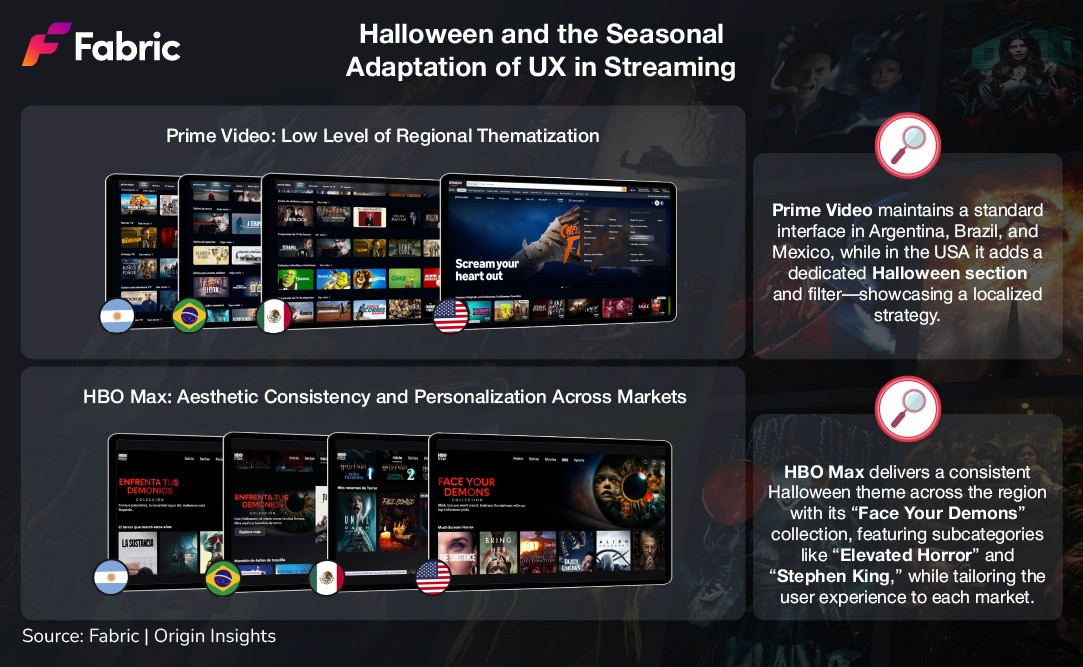
Prime Video and HBO Max's UX strategies for Halloween Season 2025

The Strategy Behind the Design

Beyond personalization, Halloween serves as a testing ground for temporary UX strategies. Platforms experiment with navigation formats, content hierarchy, and engagement models that can later be applied to other seasons — such as Christmas, summer, or major premieres. 

The strongest Halloween UX strategies combine high visibility (collections positioned at the top of the home page), dedicated filters, and segmented personalization

By adapting their interfaces during Halloween, streaming platforms not only respond to a global cultural trend but also leverage a commercial opportunity to enhance visibility, engagement, and audience retention within the streaming ecosystem. 

FAQ

How do major streaming services adapt their interfaces for Halloween?
Which platform showed the most integrated Halloween UX strategy in 2025?
What insights does the report reveal about regional UX differences?

Read More Articles

We're constantly pushing the boundaries of what's possible and seeking new ways to improve our services.

Origin Nexus Entertainment Search API with StartDateStart and StartDateEnd date range filters applied, returning a list of movies and TV titles with upcoming streaming availability dates across major U.S. platforms.

May 11, 2026

Filter Content by Streaming Availability Dates with the Origin Nexus API

Developers can now filter movies and TV titles by the date they become available on streaming platforms, using two new Origin Nexus API parameters. Here is what you can build with them and why availability-date filtering changes how audiences discover content before it starts trending.

Illustration showing three separate department systems, distribution, marketing, and rights management, each holding a different version of the same content record, contrasted with a single unified metadata platform feeding all downstream systems from one authoritative source.

May 7, 2026

Your Metadata Has More Than One Version of the Truth. That's the Problem.

When three departments each maintain their own record for the same title, none of them wrong but none of them the same, the real cost isn't the occasional incident. It's the permanent overhead of a metadata environment nobody fully trusts. Here's what a genuine source of truth looks like and what it takes to build one.

Illustration showing a media operations workflow moving from fragmented manual coordination across email, spreadsheets, and verbal handoffs to a structured, automated system with centralized job tracking and task progression.

May 6, 2026

Media Workflow Automation: How Modern Facilities Are Eliminating Manual Handoffs

Manual handoffs are not just an inconvenience in media operations — they are a structural cost that scales with every job, every team member, and every new client. Here's how modern facilities are replacing coordination overhead with automated workflows, and what that shift looks like in practice.

World map highlighting global streaming platform developments for April 2026, including new launches in Argentina, Brazil, Germany, India, and the United States, HBO Max's European and Indian expansion, AVOD updates across North America, and sports rights shifts in Central America and Europe.

May 5, 2026

The Streaming Moves That Mattered in April 2026

April 2026 reshaped the global streaming map in ways that matter beyond the headlines. HBO Max completed its European rollout, AVOD platforms consolidated around clear winners, sports rights redrew regional competition in Central America and Europe, and niche platforms continued carving out specific audiences. Here's what the month's moves mean for content strategy and distribution planning.

Xytech X2 benefits

May 4, 2026

What ScheduALL Got Right About Transmission — and Where Xytech’s X2 Goes Further

ScheduALL built its reputation in broadcast by solving a genuinely hard problem: transmission scheduling that understands how resources relate, not just whether they are individually available. Xytech's X2 Transmission replicates that relational foundation and goes further, adding a cloud-native architecture, a Network Visualizer, and an AI scheduling layer that changes what experienced transmission teams can accomplish in a day.

A layered pyramid or stacked diagram showing the five metadata types from bottom to top

Apr 30, 2026

Metadata: The Hidden Engine Behind Every Streaming Recommendation

Metadata is the hidden engine behind every streaming recommendation. For platforms competing on content discovery, the quality, depth, and normalization of movie and TV metadata — from genre tags and contributor records to thematic enrichment and availability windows — determines whether recommendation engines surface the right title or settle for a generic list. This post breaks down the layers of entertainment metadata that matter most, why sparse or inconsistent data produces shallow discovery experiences, and how continuous enrichment pipelines are the only scalable answer to keeping a catalog current. If your platform's engagement metrics aren't where they should be, your metadata infrastructure is worth examining.

Ready to take your data to the next level?

Copyright © 2026 Fabric. All Rights Reserved

Powered by AWS

Ready to take your data to the next level?

Copyright © 2026 Fabric. All Rights Reserved

Powered by AWS

Ready to take your data to the next level?

Copyright © 2025 Fabric. All Rights Reserved

Powered by AWS

Ready to take your data to the next level?

Copyright © 2025 Fabric. All Rights Reserved

Powered by AWS