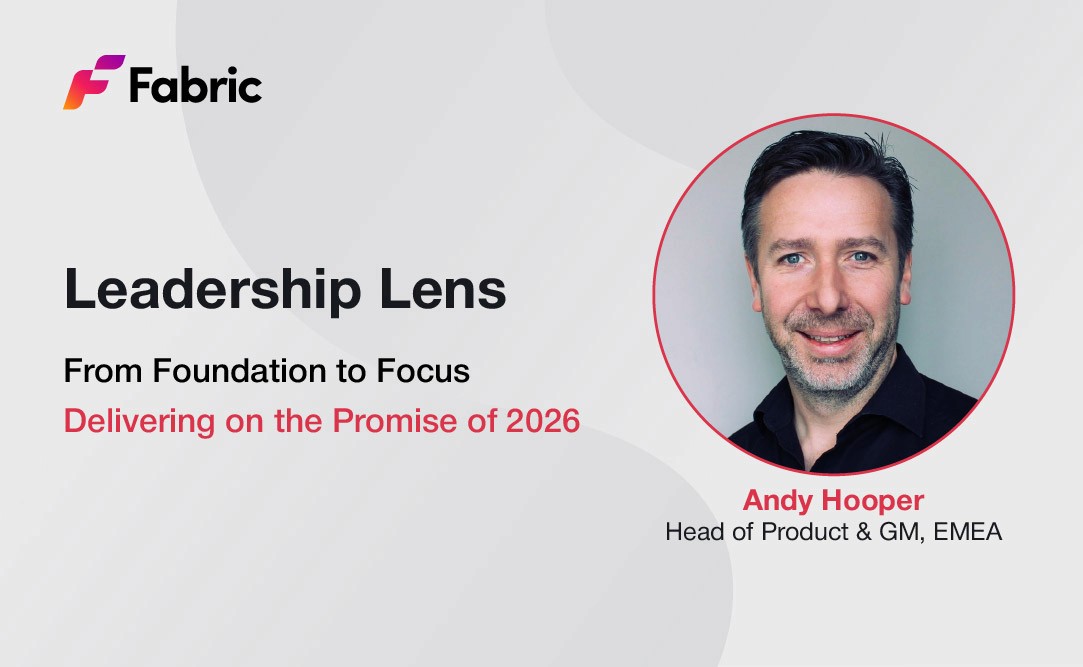
From Foundation to Focus: Delivering on the Promise of 2026

From Foundation to Focus: Delivering on the Promise of 2026

In his recent reflection on 2025, our CEO, Rob, described last year as a year of "building the foundation." As the leader of our Product team, I see 2026 as the year we put that foundation to work.

The "building" phase wasn't just about code or acquisitions; it was about listening. Recently, at events like the DPP Leaders’ Briefing, I had the chance to hear directly from senior leaders across the media and entertainment supply chain. Their message to vendors was clear: Be focused, and be honest about what you are truly great at.

In 2026, we are leaning into that challenge. Here is how our product strategy is evolving to meet that standard:

1. Speed Through Modern Infrastructure

To deliver value faster, we are doubling down on multi-tenant SaaS platforms. This is the engine behind our "North Star" vision. By moving away from fragmented environments, we ensure that every customer gains access to our newest functional value—including the agentic workflows and intelligent scheduling Rob mentioned—the moment it’s ready. We’ve already begun to see this pay off with an accelerated feature development cadence across our core product lines, and we are just getting started.

2. The Power of "No"

One of the most important parts of being a focused partner is being honest about where we don't fit. You may hear us say "no" more regularly in 2026. This isn't a sign of slowing down; it’s a commitment to excellence.

When we say "no" to requests that fall outside our core strengths, it is always grounded in the product strategy Rob outlined. By saying "no" to the distractions, we protect our ability to say "yes" to the things that deliver the most transformative value to your supply chain. We want to be the best in the world at what we do, rather than "just okay" at everything.

The "Proof in the Pudding": Coming Later in Q1

I know that strategy only matters if it results in better tools for your team. To that end, we are preparing a series of product releases for the end of Q1 that serve as the first major proof points of this focused approach.

While I can’t share every detail just yet, look out for significant updates that directly address the "north star" of data flow and workflow automation Rob highlighted. These releases will showcase the increased velocity of our multi-tenant platform and our commitment to deepening the features that matter most to your daily operations.

Turning Feedback into Momentum

The integration of our global teams—from London to Argentina—has given us a uniquely powerful toolkit. We are now in a position where we can finally bridge the gap between Fabric Xytech and Fabric Origin with the "Insights" and "Studio" enhancements you’ve been asking for.

We are still on a journey, and there is a long way to go. But the steps we are taking today—prioritizing SaaS-first development and radical focus—are designed to make your creative and operational workflows smoother than they’ve ever been.

Thank you for being part of this evolution. We aren't just building more features; we are building a more focused, more honest, and more capable Fabric for you.


Read More Articles

We're constantly pushing the boundaries of what's possible and seeking new ways to improve our services.

Origin Nexus Entertainment Search API with StartDateStart and StartDateEnd date range filters applied, returning a list of movies and TV titles with upcoming streaming availability dates across major U.S. platforms.

May 11, 2026

Filter Content by Streaming Availability Dates with the Origin Nexus API

Developers can now filter movies and TV titles by the date they become available on streaming platforms, using two new Origin Nexus API parameters. Here is what you can build with them and why availability-date filtering changes how audiences discover content before it starts trending.

Illustration showing three separate department systems, distribution, marketing, and rights management, each holding a different version of the same content record, contrasted with a single unified metadata platform feeding all downstream systems from one authoritative source.

May 7, 2026

Your Metadata Has More Than One Version of the Truth. That's the Problem.

When three departments each maintain their own record for the same title, none of them wrong but none of them the same, the real cost isn't the occasional incident. It's the permanent overhead of a metadata environment nobody fully trusts. Here's what a genuine source of truth looks like and what it takes to build one.

Illustration showing a media operations workflow moving from fragmented manual coordination across email, spreadsheets, and verbal handoffs to a structured, automated system with centralized job tracking and task progression.

May 6, 2026

Media Workflow Automation: How Modern Facilities Are Eliminating Manual Handoffs

Manual handoffs are not just an inconvenience in media operations — they are a structural cost that scales with every job, every team member, and every new client. Here's how modern facilities are replacing coordination overhead with automated workflows, and what that shift looks like in practice.

World map highlighting global streaming platform developments for April 2026, including new launches in Argentina, Brazil, Germany, India, and the United States, HBO Max's European and Indian expansion, AVOD updates across North America, and sports rights shifts in Central America and Europe.

May 5, 2026

The Streaming Moves That Mattered in April 2026

April 2026 reshaped the global streaming map in ways that matter beyond the headlines. HBO Max completed its European rollout, AVOD platforms consolidated around clear winners, sports rights redrew regional competition in Central America and Europe, and niche platforms continued carving out specific audiences. Here's what the month's moves mean for content strategy and distribution planning.

Xytech X2 benefits

May 4, 2026

What ScheduALL Got Right About Transmission — and Where Xytech’s X2 Goes Further

ScheduALL built its reputation in broadcast by solving a genuinely hard problem: transmission scheduling that understands how resources relate, not just whether they are individually available. Xytech's X2 Transmission replicates that relational foundation and goes further, adding a cloud-native architecture, a Network Visualizer, and an AI scheduling layer that changes what experienced transmission teams can accomplish in a day.

A layered pyramid or stacked diagram showing the five metadata types from bottom to top

Apr 30, 2026

Metadata: The Hidden Engine Behind Every Streaming Recommendation

Metadata is the hidden engine behind every streaming recommendation. For platforms competing on content discovery, the quality, depth, and normalization of movie and TV metadata — from genre tags and contributor records to thematic enrichment and availability windows — determines whether recommendation engines surface the right title or settle for a generic list. This post breaks down the layers of entertainment metadata that matter most, why sparse or inconsistent data produces shallow discovery experiences, and how continuous enrichment pipelines are the only scalable answer to keeping a catalog current. If your platform's engagement metrics aren't where they should be, your metadata infrastructure is worth examining.

Ready to take your data to the next level?

Copyright © 2026 Fabric. All Rights Reserved

Powered by AWS

Ready to take your data to the next level?

Copyright © 2026 Fabric. All Rights Reserved

Powered by AWS

Ready to take your data to the next level?

Copyright © 2025 Fabric. All Rights Reserved

Powered by AWS

Ready to take your data to the next level?

Copyright © 2025 Fabric. All Rights Reserved

Powered by AWS