Learn More
/
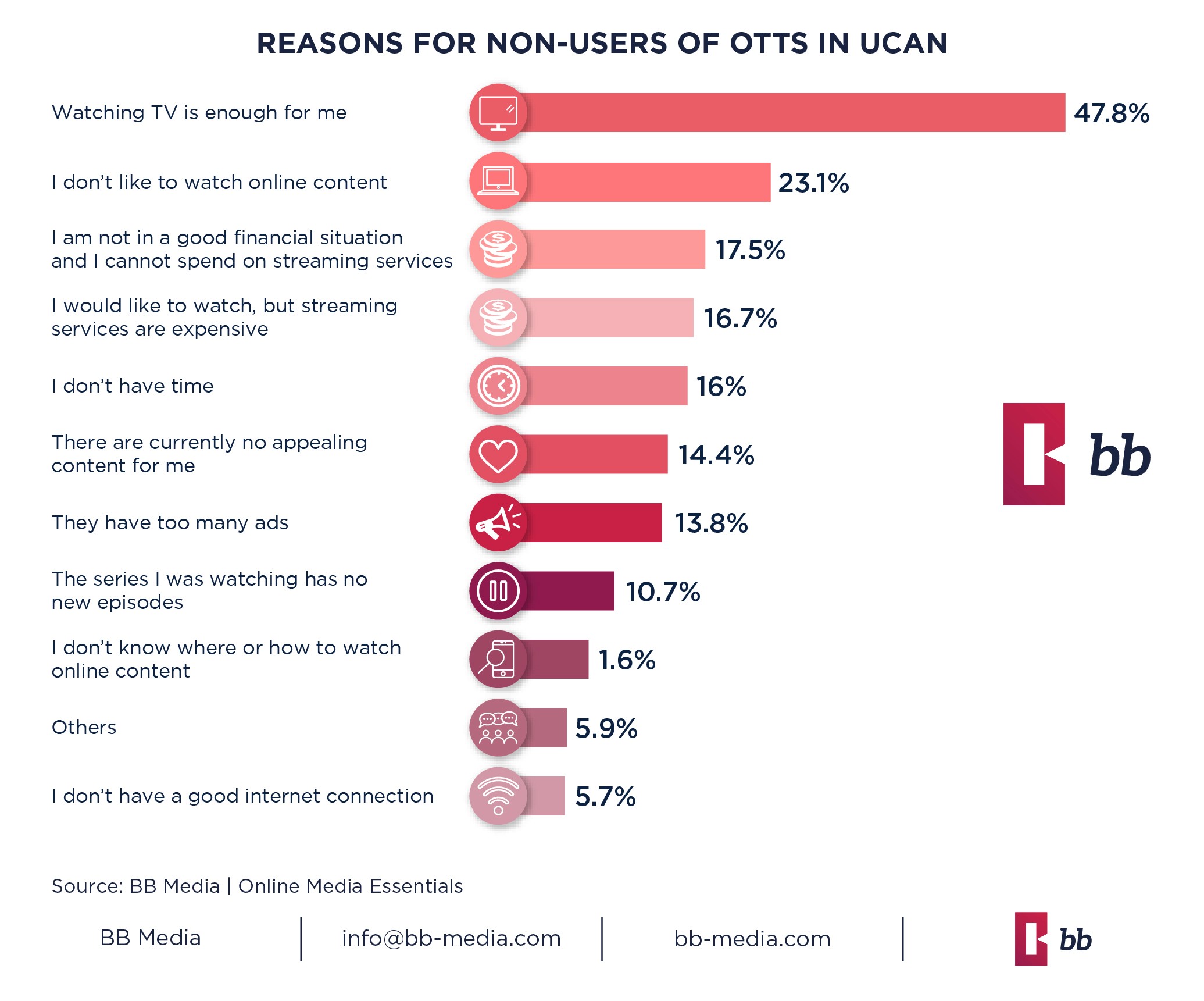
In recent years, the streaming platform market has become highly competitive. With many platforms and thousands of content options, the major players in the industry are exploring how to attract new consumers or lure users from other platforms. For a market as competitive as UCAN (United States & Canada), the challenge is even greater. According to BB Media data, in the 4Q of 2023, 86% of households consume online content, while 9% have never done so, and 5% haven’t in the last three months. So, what are the reasons for not watching online content?
Non-Users are those individuals who haven’t consumed movies, series, or events online for more than three months, or never have, regardless of the content or business model. BB Media analyzed the reasons for these individuals in UCAN. The main reason, by a wide margin, is that they consider watching paid TV to be sufficient (48%). This reason is especially predominant among older individuals, particularly those over 55. However, personal preference for not watching online content also plays a significant role (23%), as well as economic reasons, divided into “I would like to, but it’s too expensive” (18%) and “I am in a difficult financial situation” (17%).
When analyzing users who do consume online content but canceled subscriptions to certain platforms, BB Media identified that economic reasons are also a considerable factor. In fact, the main reason for users who canceled their Max subscription in the United States is that they consider the platform to be expensive (51%). This issue is not limited to this streaming service but is also observed with Disney+ (29%), Netflix (45%), and Prime Video (33%), among others. Other reasons for unsubscribing include switching to another platform, cutting expenses due to financial situations, and a perceived decline in the quality of the offered movies and series.
How do platforms respond to this scenario? Regarding the economic factor, major streaming platforms have started to introduce ASVOD (Ad-Supported Video on Demand) plans. In the United States, multiple platforms have adopted the scheme of including commercials, thus offering a cheaper package to avoid losing users. This decision aligns with consumer opinions. According to BB Media, in the United States, 66% of users prefer a more economically accessible plan, even with advertisements, compared to 34% who are willing to subscribe to a more expensive plan with ad-free content.

Moreover, given that the main reason non-users find consuming TV sufficient, the inclusion of live-streaming channels is becoming a popular strategy among platforms to attract this audience and maintain their market share. Among the multiple platforms that have launched a variety of linear channels, Plex, The Roku Channel, Samsung TV Plus, Amazon Freevee, Fubo TV, and Pluto TV stand out for their wide offerings. This is a widespread practice with significant participation, as 63% of online consumers claim to watch live-streaming in the United States.
In conclusion, the streaming industry continues to evolve to adapt to the changing needs and preferences of consumers. Analyzing the reasons behind not consuming online content is essential to understand the preferences and behaviors of potential users and design effective market penetration strategies.
Powered by BB Media, a Fabric Data company
Similar Articles
We're constantly pushing the boundaries of what's possible and seeking new ways to improve our services. Search your topic of interest.