Learn More
The streaming services market is a highly dynamic space, shaped by a wide range of players on both the supply and demand sides. This report explores key insights into the transactional streaming landscape, with a focus on the discontinuation of Microsoft Movies & TV, a platform that had been part of the entertainment industry since 2012.
Shifting Dynamics in the USA Transactional Landscape
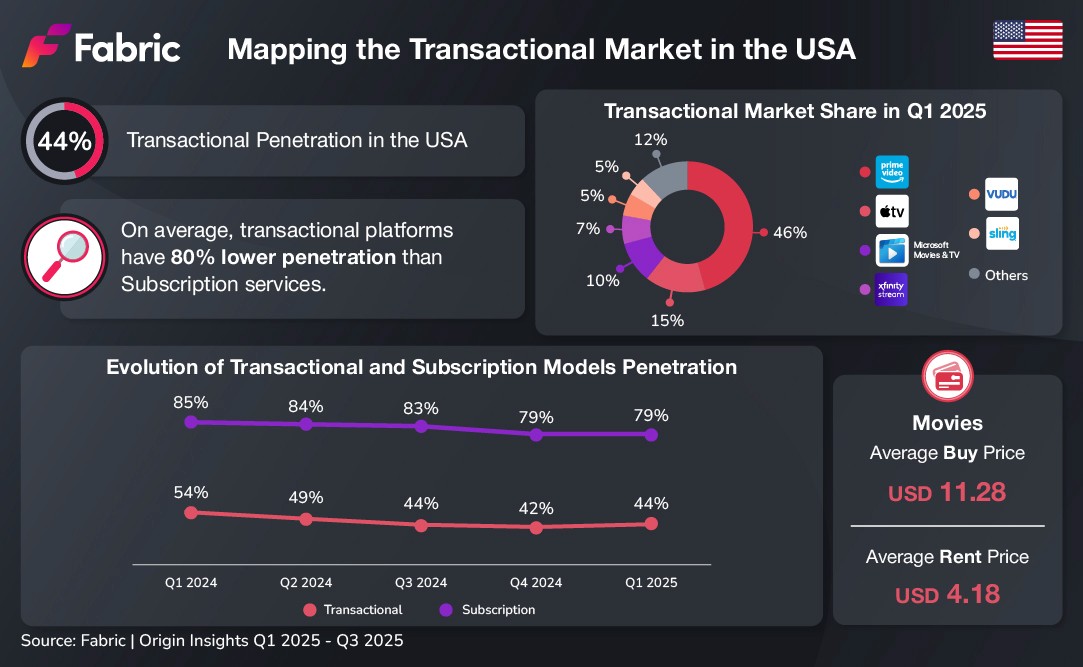
Among all USA households, 44% engage with transactional platforms, favoring on-demand content for purchase or rental. However, this is significantly lower than the penetration of Subscription (79%) services, a model firmly established in the country’s vast streaming ecosystem.
Compared to last year, transactional models in the USA have experienced a 19% decline in penetration, signaling a downward trend despite a brief growth at the beginning of 2025. The subscription model has also experienced a decline in penetration over the past year but just dropping by 7%. However, the year-over-year decrease in transactional penetration has been the steepest among all business models in the industry, highlighting the need for platforms to remain attentive to market trends and evolving consumer demands.
A Vibrant and Dominant Market
When looking at market share among transactional platforms in the USA, the top streaming services in Q1 2025 were:
Amazon Prime Video: 46%
Apple TV: 15%
The transactional market in the United States is highly concentrated, with Amazon Prime Video leading the sector and Apple TV also holding a significant share. In this context, Microsoft Movies and TV emerged as the third-largest platform, capturing 10% of the market. This suggests that while its presence is modest, it maintained a foothold in a market largely dominated by major players.
Regarding the platform’s catalogs, an analysis of the USA services shows the following:
Amazon Prime Video: +101,000 titles
Apple TV: +61,000 titles
This demonstrates that the dominance of Amazon Prime Video and Apple TV is not only reflected in their market share but also in the breadth of their content libraries, offering users a wide variety of choices.
Global Discontinuation of Microsoft Movies & TV
In July 2025, Microsoft Movies and TV announced the global discontinuation of its transactional content. Since its closure, users can no longer purchase or rent new titles, although previously purchased or rented ones remain accessible.
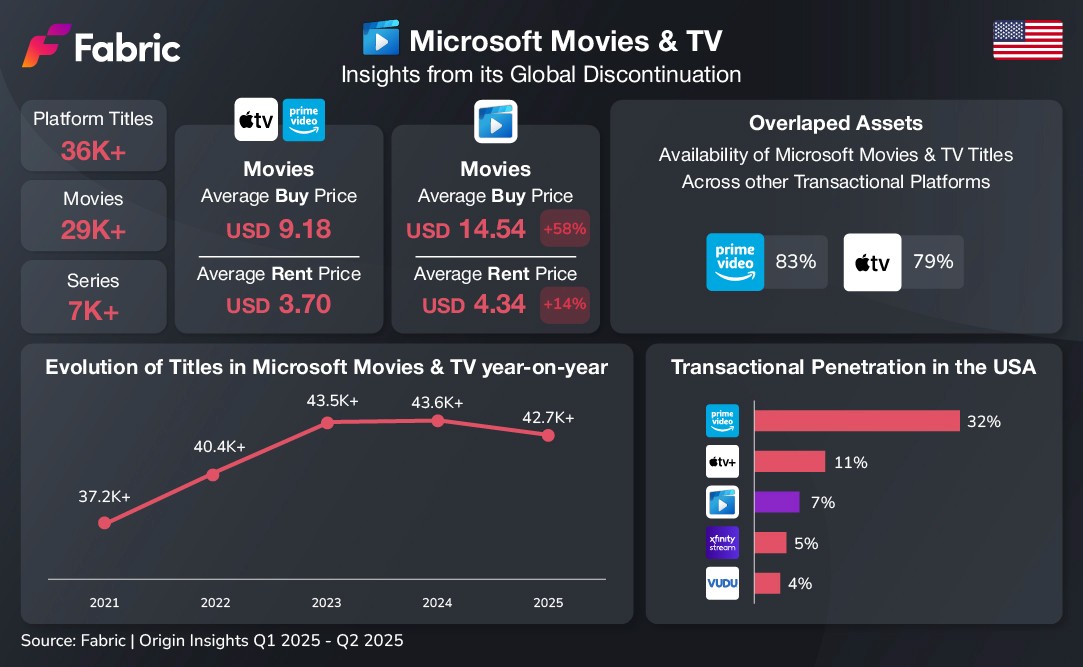
Throughout 2025, its catalog had included over 42,700 titles until its closure. However, at the time of its discontinuation, the platform offered over 36K titles in the USA, including more than 29K movies and 7K series available for transactional purchase or rental.
A year-by-year analysis of available titles shows that while the platform experienced significant growth between 2021 and 2023, 2024 saw an increase of only around 100 assets. By the time of its closure in 2025, the catalog had decreased by nearly 1,000 titles, reflecting a trend of limited content additions in the platform’s final years.
Regarding transactional penetration in the US, Microsoft Movies & TV ranks third with 7%, meaning that 7 out of 100 users carried out a transaction on the platform during the first quarter of the year. This figure is relatively low compared to Apple TV (11%) and Amazon Prime Video (32%), highlighting the strong dominance of these two platforms in the transactional space.
Content Overlap with Leading Platforms
Comparing Microsoft Movies & TV with the two leading platforms in the USA, the content overlap is as follows:
Amazon Prime Video: 83%
Apple TV: 79%
Eight out of ten titles available on the two largest platforms were also present in Microsoft Movies & TV’s USA catalog, showcasing that the vast majority of Microsoft’s catalog is already available on the platforms with the highest penetration and market share. It therefore suggests that the titles offered by Microsoft Movies & TV are most likely already being consumed through those services. But what’s the key factor that might have driven users to view content on Prime Video and Apple TV rather than Microsoft Movies and TV?
Pricing Comparison across the USA
Pricing plays a central role in understanding the dynamics of transactional platforms. Comparing the average purchase and rental movies prices on Microsoft Movies & TV, Amazon Prime Video, and Apple TV during the second quarter of the year, Fabric’s Origin Insights data show the following:
Microsoft Movies and TV:
Average Movies Buy Price: USD $14.54
Average Movies Rent Price: USD $4.34
Amazon Prime Video + Apple TV:
Average Movies Buy Price: USD $9.18
Average Movies Rent Price: USD $3.70
When comparing platforms, Microsoft Movies & TV stood out as being 58% more expensive for purchases and 17% for rentals. In a market with over 90 active transactional platforms in the United States, pricing can play a decisive role in shaping consumer choices when it comes to content transactions.
This price difference, combined with broader content availability on competing platforms, likely encouraged consumers to favor more affordable options for their online content purchases and rentals.
Looking Ahead: Strategies in a Dynamic Streaming Market
When considering the transactional streaming market in the USA and globally, the question remains: what strategies will platforms adopt in such a dynamic and ever-changing landscape? As consumer preferences evolve and competition intensifies, platforms will need to balance pricing and content differentiation.
The closure of Microsoft Movies and TV highlights how critical these factors are, signaling that only platforms capable of offering both value and unique content will thrive in the transactional space moving forward.
FAQ
Similar Articles
We're constantly pushing the boundaries of what's possible and seeking new ways to improve our services. Search your topic of interest.