Learn More
In today’s entertainment industry, it’s impossible to ignore the central role of digital distribution. Yet, this very shift has also opened the door to a growing challenge: the rise of online piracy and the spread of illegal content. In Latin America, the scale of this issue offers some particularly revealing insights that deserve closer attention.
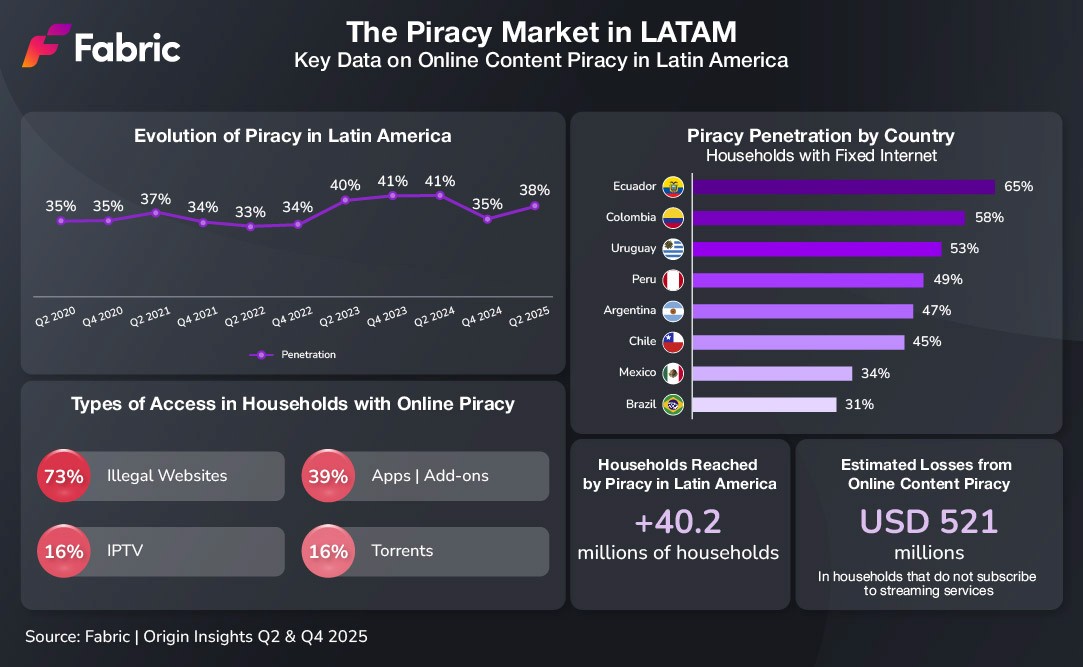
According to the latest data from Origin, online piracy reached 38% of households with fixed internet in the second quarter of the year — equivalent to more than 40 million homes across Latin America.
From an evolutionary standpoint, this represents an 11% increase compared to the January–March period. Still, the region remains below the five-year peak, recorded in Q2 2024, when piracy affected 41% of connected households.
Looking at country-level data, Ecuador shows the highest incidence, with 65% of connected households engaging in piracy, while Brazil stands out as the market with the lowest penetration, at just 31%.
Piracy remains a complex issue to tackle — not only because of the risks users face when consuming illegal content, but also due to its significant economic impact on the entire entertainment value chain. It is estimated that, each year, content piracy on subscription platforms leads to losses exceeding USD 521 million in Latin America, accounting for households that forgo paid subscriptions but still access content through illegal channels.
Piracy Access Behaviors
In Latin America, online content piracy takes shape through several access points, the most prominent being:
Illegal websites: 73%
Apps and add-ons: 39%
IPTV: 16%
Torrents: 16%
According to data from Origin, nearly three out of four households with fixed internet in the region consume pirated content through illegal websites, making this the main access channel.
Apps and add-ons rank as the second most common method, and also the fastest-growing segment over the past two years — rising from 32% to 39%, a 21% increase. This trend reflects a diversification in illegal consumption habits, driven by easy access and the proliferation of connected devices.
Brazil, a Success Story
Brazil stands out as the country with the lowest level of online content piracy in Latin America. However, the country still records a notable volume of access to unofficial sites, even though its incidence and usage frequency remain the lowest in the region.
When it comes to the type of content viewed in households that access illicit platforms, 84% of users watch movies and 79% watch series.
Among the main live streaming channel providers in the country, the most pirated genres are Domestic Free-to-Air Signals (53%) and Sports (28%).
According to Origin, this sustained decline in illegal content consumption is linked to several structural factors within the Brazilian market that encourage the adoption of legal alternatives — reinforcing Brazil’s position as the country with the lowest online piracy rates in the region.
Spending and Accessibility: The Drivers of Legal Consumption in Brazil
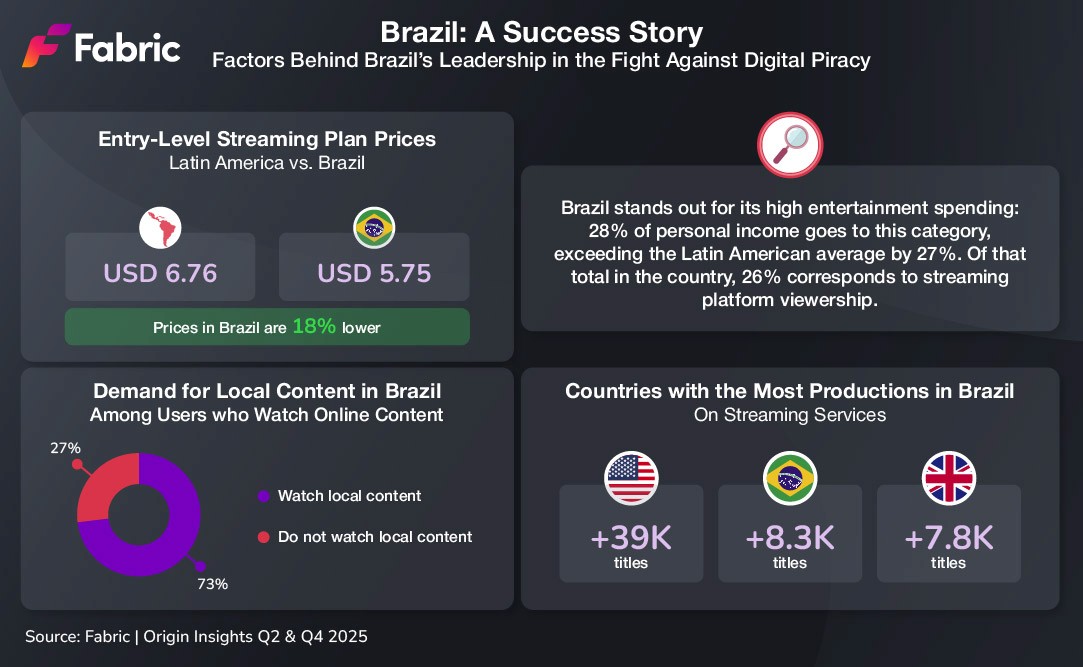
Among the major markets in Latin America, Brazil stands out as the country with the highest spending on entertainment, allocating on average 28% of personal income to this category — 27% above the regional average.
Within this spending distribution, the most significant categories are streaming platforms (26%), dining out (14%), and movie theater attendance (9%). Combined, more than one-third of entertainment spending in Brazil goes toward audiovisual content consumption.
This consumer behavior is supported by a broad and accessible streaming offer. According to a dataset compiled by Origin (based on the main platforms available in the country), Brazil leads the region with over 480 active plans, well ahead of Mexico (360+) and Chile (320+).
In addition, the average monthly entry cost for a streaming service in Brazil is USD 5.75, which is 18% lower than the regional average (USD 6.76).
The combination of competitive pricing, diverse plan options, and a strong willingness to invest in leisure reinforces the legal entertainment ecosystem in Brazil. As a result, Brazilian consumers find appealing and affordable options within the formal market, reducing the incentive to turn to illegal platforms and contributing to the country’s relatively low levels of digital piracy.
Penetration of Illegal Platforms
When focusing exclusively on illegal streaming platforms, the data is particularly revealing. In Latin America, these platforms reach 30% of households with fixed internet, while in Brazil that figure drops to just 22% — 36% lower than the regional average.
This gap is also reflected in consumption time: Brazilian households spend an average of 5 hours per week on illegal platforms, compared to 6.5 hours across Latin America. This difference further reinforces the downward trend in the use of pirated platforms within the Brazilian market.
Extensive Content Offering
The breadth of available catalogs in Brazil also plays a key role in reducing piracy. When streaming platforms provide a diverse, updated, and accessible legal offering, users have fewer incentives to turn to unofficial sources.
Brazil ranks as the second country in Latin America with the largest number of unique titles available on streaming platforms, with over 184K pieces of content, just behind Mexico, which offers more than 186K.
Brazilian consumers show a strong preference for local content: during the second quarter of the year, three out of four households with fixed internet watched locally produced content. As for the origin of unique titles available on streaming platforms in Brazil, the top three producing countries are:
United States: +39,900 titles
Brazil: +8,300 titles
United Kingdom: +7,800 titles
Even with the dominance of Hollywood productions, the strong presence of local content ensures that Brazilian audiences find relevant and appealing options that match their preferences within the legal streaming offering.
An Industry That Never Sleeps
Online content piracy continues to leave a significant mark across Latin America, reflecting a complex and persistent challenge. However, cases like Brazil’s offer valuable lessons for designing effective reduction strategies.
The wide range of services and plans, competitive pricing, and diverse content offerings aligned with local preferences emerge as key factors in discouraging illegal consumption and strengthening the legal digital entertainment ecosystem throughout the region.
Similar Articles
We're constantly pushing the boundaries of what's possible and seeking new ways to improve our services. Search your topic of interest.