
Learn More
Piracy data is almost always discussed in the media industry as a problem to be managed: a compliance challenge, an enforcement priority, a drag on revenue that requires legal and technical countermeasures. That framing is not wrong, but it is incomplete. Piracy data also contains entertainment market intelligence that viewership reports, subscriber counts, and platform analytics cannot provide: a direct signal of where audience demand exists that legitimate distribution is currently failing to satisfy.
In Latin America, that signal is substantial. Piracy affects 28% of households across the region, meaning more than one in four connected households is accessing content through illegal channels. The organizations that treat this figure as strategic content insights rather than purely a legal problem gain a clearer and more actionable picture of unmet audience demand than most commercial research provides.
How piracy actually works in the region
The access methods through which Latin American audiences consume pirated content reveal something important about the nature of the demand. Websites remain the primary access point at 64% of illegal consumption, followed by M3U lists at 57%, torrent downloads at 12%, and IPTV at 9%. Social platforms also play a role: movies are the most searched pirated content type on Facebook (52%), Twitter (59%), and YouTube (70%), and on YouTube specifically, illegal live sports broadcasts account for 44% of piracy activity.
These are not the access patterns of a technically sophisticated fringe. They reflect a mainstream audience using relatively accessible tools to reach content that is either unavailable through legitimate channels or available at a price point they are unwilling to pay. The distinction between those two motivations matters significantly for what the appropriate strategic response looks like.

Among the stated reasons for illegal consumption, the cost of subscription is the primary driver. But the second most cited reason is availability: audiences are actively seeking content that has not yet been added to the catalogs of legitimate platforms in their markets. Films still in theatrical release account for 31% of the most-searched pirated movie content. Recently premiered series account for 37% of the most-searched pirated series content. These are not audiences who have given up on legitimate streaming. They are audiences who want to watch something specific and cannot find it through the channels they would prefer to use. This is precisely what content discovery data can surface before piracy behavior makes the gap visible.
The geography of piracy is a distribution map
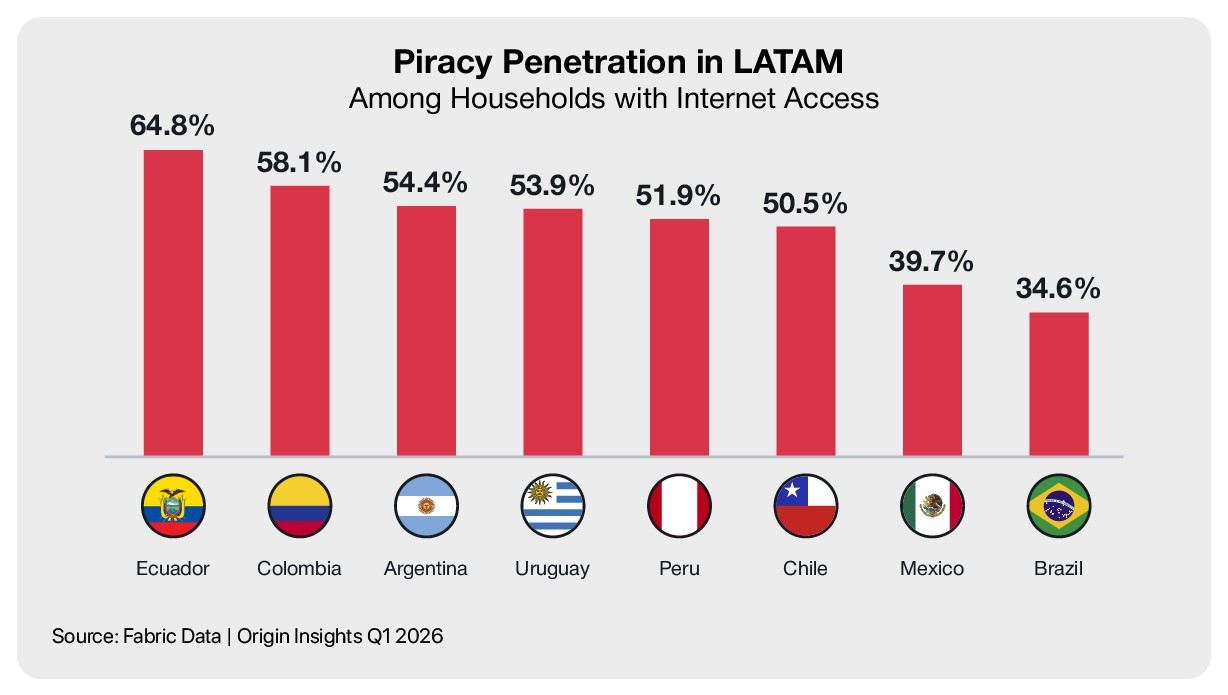
The country-level distribution of piracy rates across Latin America reads less like a map of audience attitudes toward intellectual property and more like a map of legitimate distribution quality and streaming subscription prices accessibility. Ecuador and Colombia consistently record the highest piracy rates in the region. Chile experienced the sharpest single-year increase, adding 11 percentage points between 2024 and 2025.
These variations are worth examining against what is known about streaming market share development in each territory. Markets where major platforms have invested more heavily in local content, competitive pricing, and ad-supported tiers tend to show lower piracy rates. Markets where the combination of high subscription costs relative to local purchasing power and limited local content availability leaves audiences underserved by legitimate options tend to show higher rates.
Chile's sharp single-year increase is particularly instructive. An 11-point jump in a single year does not reflect a sudden change in audience values. It reflects a change in market conditions: whether that is a pricing increase by a major platform, the removal of content from a popular service, or a gap between what audiences want and what legitimate distribution currently provides. Understanding which of those factors is driving the increase requires real-time content insights at the territory level that aggregate regional figures cannot provide.
The account sharing dimension
Alongside outright piracy, account sharing remains present in 27% of subscription plan accesses across the region. This figure sits between the two extremes of illegal consumption and fully paid individual subscription, and it represents a different kind of market signal.
The combination of 28% piracy and 27% account sharing suggests that somewhere between a quarter and a half of the connected household audience in Latin America is currently accessing content through channels other than fully paid individual subscriptions. For platforms evaluating media pricing and plan data, tier design, and the potential audience size available for conversion, that combined figure is the relevant denominator, not the current subscriber base alone.
What piracy data tells you that viewership data cannot
Platform analytics tell you who is watching what through your service. They say nothing about the audience that is watching the same content through other channels, or about the audience that is actively seeking content you do not carry. Piracy data fills both of those gaps.
The 37% of pirated series searches that target recently premiered content is a direct audience demand trends signal for titles that legitimate platforms have not yet acquired or have acquired for some markets but not others. When a title is being actively searched and illegally accessed at meaningful scale in a specific territory, that is the market's answer to the question of whether there is an audience for that content in that place. It is also, implicitly, a measure of the licensing opportunity cost of not having acquired it for legitimate distribution.
Origin Insights combines platform availability insights across more than 1,000 streaming services with demand and popularity data, making it possible to identify titles that are generating significant audience interest in specific territories where they are not currently available through legitimate channels. That gap analysis is the commercial application of the insight that piracy data contains: where demand exists that distribution has not yet reached.
The organizations that use this intelligence effectively are not simply trying to suppress piracy. They are using the trending entertainment data that piracy behavior surfaces to make faster, better-informed acquisition and distribution decisions that close the availability gap before competitors do.
The 42% who did not know they were doing anything wrong
One figure in the regional data deserves specific attention because it complicates the enforcement-first framing: 42% of users accessing pirated content did not know, or were uncertain, whether they were consuming content illegally.
This is not an insignificant edge case. Nearly half of the piracy audience is not making a deliberate choice to circumvent intellectual property rights. They are using tools and platforms that their social network uses, often without clear signals that what they are accessing is illegal. This has implications for how the issue is addressed. Enforcement and legal countermeasures are appropriate responses to deliberate circumvention. They are less effective and potentially counterproductive when applied to an audience that is confused about legality rather than indifferent to it.
The more effective response for that segment of the piracy audience is making legitimate access easier and more visible, which is a streaming user habits and preferences question as much as a legal one. If the content they are seeking is available through a legitimate channel at a price point they can access, and if that channel is sufficiently easy to find and use, a meaningful proportion of that audience can be converted without enforcement. Understanding where those legitimate gaps exist, at the title level and the territory level, is exactly what media decision-making tools like Origin Insights are built to surface.
Join the conversation
We publish regular insights on streaming market intelligence, audience behavior, and content strategy across Latin America and global markets. Follow Fabric on LinkedIn for new analysis as soon as it drops.
Fabric is a global media data company. Origin Insights delivers primary-sourced, human-verified entertainment market intelligence covering 1,000+ streaming platforms across 249 countries. Real data. Verified by humans. Trusted by the industry.
FAQ
Similar Articles
We're constantly pushing the boundaries of what's possible and seeking new ways to improve our services. Search your topic of interest.


