/

South Africa Gets Connected

South Africa Gets Connected

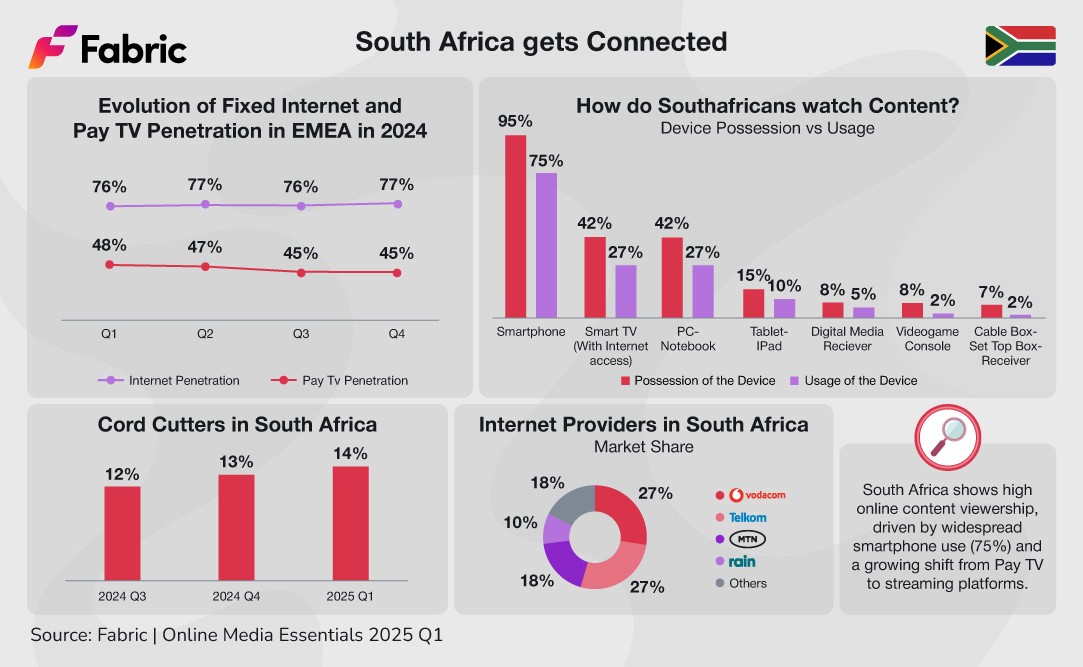
Graphics showing the connectivity trends in South Africa, exploring its regional evolution, content viewership, the rise of cord cutters, and the competitive landscape of internet provider market shares

A common pattern observed in most nations is the progressive growth of the already all-encompassing presence of fixed internet connections in households and the slow decline of Pay TV penetration. South Africa is no exception to this rule, but it is an immense outlier when you look at the numbers as a snapshot.  

Fixed Internet Penetration Lags Behind in South Africa 

While all other countries in the EMEA region surveyed by Fabric Data are above 90% fixed internet penetration, only 14% of households in South Africa have an internet connection as of Q1 2025; more than half of these being provided by market leaders Vodacom and Telkom, each holding 27% of the market share, followed by MTN with 18%, Rain with 10% and the remaining 18% distributed among smaller companies. 

Mobile-First: Smartphone Usage Dominates 

One of the reasons for this anomaly is most likely a preference for mobile internet connections. In fact, South Africa displays the largest percentage of smartphone possession in the region with 95%, which is 4% more than the average of all other countries. On the other hand, Cable Boxes or Receivers only hold 7% possession in comparison to Smart TVs with 42%. 

Device Preferences for Content Viewership 

Looking at device usage for watching content, there is a similar landscape: only 2% of the population use their Cable Box while 27% choose their Smart TV, the same percentage choose their PC or Notebook. Smartphones remain the main source of content with 75%, growing half a percentage point from the previous quarter and 4% in comparison to the same quarter last year. 

This is reflective of the low penetration of the Pay TV model (39%) as compared to the penetration of online content (69%). This trend is also stronger in younger generations, as the 16 to 24 years old age group has the lowest possession of Cable box with 1% while 45 to 54 and the 55+ age groups hold the highest with 9% each. 

Older Generations Also Turning Away from Pay TV 

While the older generations of South Africans are the ones who still hold on to TV, they they’re also contributing to its decline with 24% of the 55+ age group being Cord-Cutters, meaning they have cancelled their Pay TV subscription in the past (as of Q1 2025). Cord cutters in general have consistently increased, from 12% in Q3 of 2024, to 13% in Q4 and finally 14% in the first quarter of 2025. 

Price Gaps Between Streaming and Pay TV Services 

When a South African household looks at their options, they see that the streaming platform Showmax costs $99 ZAR per month ($5.65 USD) while a Pay TV alternative like Openview charges $799 ZAR ($45.59 USD) for a single Cable Box. DStv, the most popular TV service, has a basic plan that is only $33 ZAR ($1.88 USD) but only includes one Cable Box with 33 channels while all other plans they offer include access to their streaming service and a discount or free access to Showmax and even more plans that are stream only without Pay TV. 

Considering all this, the market for streaming platforms and online content in South Africa is ripe for expansion as traditional media seems to only be shrinking and internet connections expanding. Even older generations show indications of being ready to make the switch provided a better offer is shown to them. As South Africa becomes more connected, the thirst for content will only grow. 

Read More Articles

We're constantly pushing the boundaries of what's possible and seeking new ways to improve our services. Search your topic of interest.

Here is what a metadata system designed to scale at enterprise level actually looks like, and the decisions that determine whether it holds up over time.

The Architecture Behind a Metadata System That Actually Scales

Jun 1, 2026

Adopting an API-first metadata platform is a necessary starting point, but it is not what determines whether a metadata system holds up at enterprise scale. The decisions that matter are above the API layer: how the canonical record is structured, how changes to it are governed, how enrichment is handled, and how the integration model is organized. Here is what those decisions look like in practice.

API-First Metadata Management: What It Actually Means (and What It Doesn't)

May 29, 2026

API-first has become a standard claim in media technology marketing, applied to platforms with genuinely different architectural approaches and very different real-world behaviors. Here is a precise account of what API-first metadata management actually means, what it genuinely solves, and why being API-first is a necessary foundation rather than a guarantee of good outcomes.

Andy Hooper Key Takeaways of NAB Show and MPTS London

Key Takeaways on Agility, Data, and the Evolving Media Supply Chain

May 28, 2026

Two of the media industry's most significant spring tradeshows, MPTS in London and NAB in Las Vegas, surfaced the same themes regardless of geography or format: the urgent need for flexible, configurable operations, the growing complexity of metadata and IP management, and the industry's continued commitment to solving these challenges in person.

Content Consumption by Time Slots in LATAM

The Weekend Effect: Latin America Streaming Viewership Patterns

May 27, 2026

Nearly two in five series that appear in Latin America's streaming popularity rankings do so exclusively during weekend periods. They are discovered on Saturday or Sunday, consumed over the following day or two, and never return to the rankings during the week. That pattern has direct implications for how content is programmed, promoted, and prioritized across the region's streaming market.

How Origin Nexus covers the full catalog stack

Games Metadata, Trailers and Imagery: Building a Complete Content Catalog Stack

May 22, 2026

Most metadata discussions focus on movies and TV series. But for platforms competing on content discovery, the catalog stack extends significantly further, into games, trailers, imagery, celebrity data, and promotional assets, each governed by different data requirements and update rhythms. Here's what a complete content catalog actually looks like.

What separates a good API from a great one

What Is a Movie API? A Buyer's Guide for Media Companies

May 21, 2026

This guide explains what a movie or TV API actually is, what it should deliver at scale, what questions to ask before signing a contract, and why the right choice depends on more than just data coverage.

Ready to take your data to the next level?

Copyright © 2026 Fabric. All Rights Reserved

Powered by AWS

Ready to take your data to the next level?

Copyright © 2026 Fabric. All Rights Reserved

Powered by AWS

Ready to take your data to the next level?

Copyright © 2025 Fabric. All Rights Reserved

Powered by AWS

Ready to take your data to the next level?

Copyright © 2025 Fabric. All Rights Reserved

Powered by AWS