/

Insights

Max Expands its Presence in Asia

Max Expands its Presence in Asia

Max’s expansion in Asia

Will local content be the key to success?

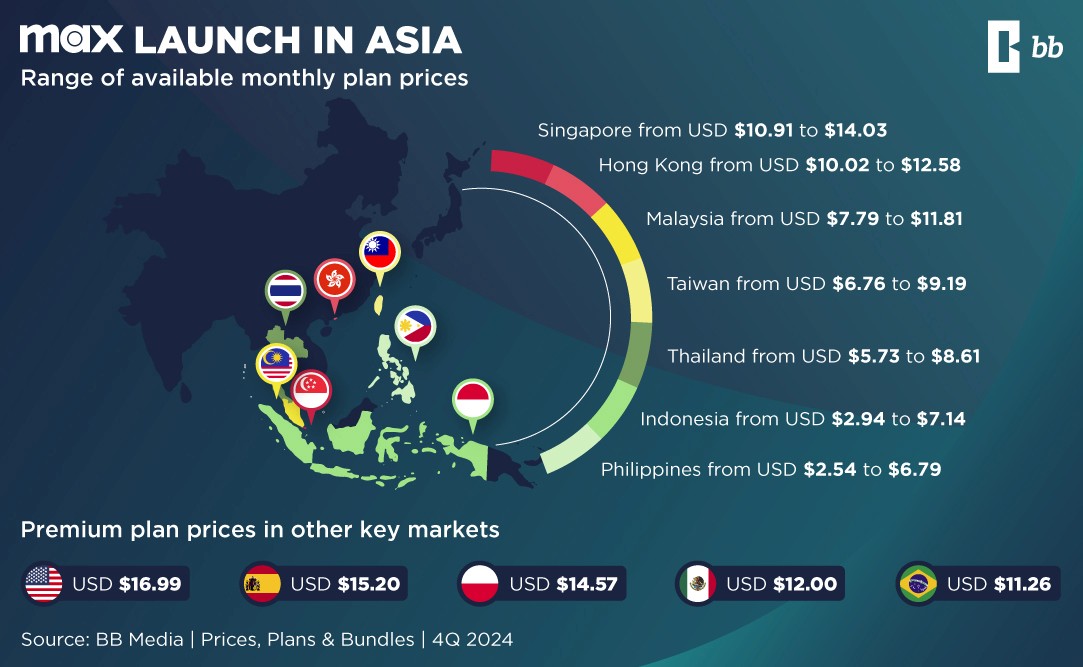
Max’s expansion in Asia marks a significant move in the global streaming market, reinforcing its availability in 69 countries. Since its launch in the U.S. in May 2023, followed by Latin America and the Caribbean in February, and Europe in May 2024, Max now strengthens its presence in Southeast Asia, covering Indonesia, Malaysia, the Philippines, Singapore, Thailand, Taiwan, and Hong Kong

Competing with Local Giants in Asia

With its arrival in Asia, Max demonstrates a keen adaptation to local market demands. Unlike its strategy in Europe, the U.S., and LATAM, it has not yet introduced an ad-supported plan. Instead, Max offers mobile-exclusive plans in Indonesia and the Philippines, aligning with the 71% of APAC households that consume content via mobile devices.

Max’s Standard plan, priced at an average of USD 7.22, allows two simultaneous streams, Full HD quality, and 30 downloads, while the Ultimate plan, averaging USD 10.06, supports four streams, 4K quality, and up to 100 downloads. Both plans include annual options to entice long-term subscribers.

Strategically, Max’s Standard plan positions itself in the mid-range pricing tier, competing with more expensive platforms like Netflix (USD 9.09) and Disney+ (USD 8.28) while remaining pricier than local options like iQIYI (USD 3.99) and Viu (USD 6.74). This pricing mirrors its strategy in Latin America, where the Standard plan costs USD 7.67.

Notably, Max lacks sports content in APAC and LATAM, a feature present in Europe and the U.S., where prices are significantly higher (USD 9.33 and USD 16.99, respectively).

The Role of Local Content in Asia

Max’s expansion in Asia comes with a robust international catalog, but it faces a significant challenge: capturing audiences that overwhelmingly prefer local content. In APAC, 82.6% of viewers consume local productions, giving platforms like iQIYI (10,601 total titles) and Viu (4,623 total titles) a competitive edge due to their regional focus. 

Netflix’s Stronghold in Asia

Competitors like Netflix are intensifying efforts to dominate the Asian market. Since August, Netflix has announced 13 new regional productions, with six set to premiere between December 2024 and early 2025. In 2024 alone, Netflix has distributed over 400 Asian-origin titles, showcasing a strong commitment to local content.

What Max Needs to Succeed in Asia

To achieve success in Asia, Max must invest in producing content that resonates with local audiences. The ability to deliver regional stories and culturally relevant narratives will be crucial in establishing a competitive foothold against entrenched platforms like iQIYI, Viu, and Netflix.Want to learn more about the local platforms? Dive into BB Media’s Streaming Services Directory, select “Asia” on the region filter and get free data of the local players!

Powered by BB Media, a Fabric Data company

Read More Articles

We're constantly pushing the boundaries of what's possible and seeking new ways to improve our services.

Origin Nexus Entertainment Search API with StartDateStart and StartDateEnd date range filters applied, returning a list of movies and TV titles with upcoming streaming availability dates across major U.S. platforms.

May 11, 2026

Filter Content by Streaming Availability Dates with the Origin Nexus API

Developers can now filter movies and TV titles by the date they become available on streaming platforms, using two new Origin Nexus API parameters. Here is what you can build with them and why availability-date filtering changes how audiences discover content before it starts trending.

Illustration showing three separate department systems, distribution, marketing, and rights management, each holding a different version of the same content record, contrasted with a single unified metadata platform feeding all downstream systems from one authoritative source.

May 7, 2026

Your Metadata Has More Than One Version of the Truth. That's the Problem.

When three departments each maintain their own record for the same title, none of them wrong but none of them the same, the real cost isn't the occasional incident. It's the permanent overhead of a metadata environment nobody fully trusts. Here's what a genuine source of truth looks like and what it takes to build one.

Illustration showing a media operations workflow moving from fragmented manual coordination across email, spreadsheets, and verbal handoffs to a structured, automated system with centralized job tracking and task progression.

May 6, 2026

Media Workflow Automation: How Modern Facilities Are Eliminating Manual Handoffs

Manual handoffs are not just an inconvenience in media operations — they are a structural cost that scales with every job, every team member, and every new client. Here's how modern facilities are replacing coordination overhead with automated workflows, and what that shift looks like in practice.

World map highlighting global streaming platform developments for April 2026, including new launches in Argentina, Brazil, Germany, India, and the United States, HBO Max's European and Indian expansion, AVOD updates across North America, and sports rights shifts in Central America and Europe.

May 5, 2026

The Streaming Moves That Mattered in April 2026

April 2026 reshaped the global streaming map in ways that matter beyond the headlines. HBO Max completed its European rollout, AVOD platforms consolidated around clear winners, sports rights redrew regional competition in Central America and Europe, and niche platforms continued carving out specific audiences. Here's what the month's moves mean for content strategy and distribution planning.

Xytech X2 benefits

May 4, 2026

What ScheduALL Got Right About Transmission — and Where Xytech’s X2 Goes Further

ScheduALL built its reputation in broadcast by solving a genuinely hard problem: transmission scheduling that understands how resources relate, not just whether they are individually available. Xytech's X2 Transmission replicates that relational foundation and goes further, adding a cloud-native architecture, a Network Visualizer, and an AI scheduling layer that changes what experienced transmission teams can accomplish in a day.

A layered pyramid or stacked diagram showing the five metadata types from bottom to top

Apr 30, 2026

Metadata: The Hidden Engine Behind Every Streaming Recommendation

Metadata is the hidden engine behind every streaming recommendation. For platforms competing on content discovery, the quality, depth, and normalization of movie and TV metadata — from genre tags and contributor records to thematic enrichment and availability windows — determines whether recommendation engines surface the right title or settle for a generic list. This post breaks down the layers of entertainment metadata that matter most, why sparse or inconsistent data produces shallow discovery experiences, and how continuous enrichment pipelines are the only scalable answer to keeping a catalog current. If your platform's engagement metrics aren't where they should be, your metadata infrastructure is worth examining.

Ready to take your data to the next level?

Copyright © 2026 Fabric. All Rights Reserved

Powered by AWS

Ready to take your data to the next level?

Copyright © 2026 Fabric. All Rights Reserved

Powered by AWS

Ready to take your data to the next level?

Copyright © 2025 Fabric. All Rights Reserved

Powered by AWS

Ready to take your data to the next level?

Copyright © 2025 Fabric. All Rights Reserved

Powered by AWS