
Learn More
LGBTQ+ Content in the US Streaming Market
The United States is the world's most developed streaming market, and the breadth of LGBTQ+ content available across its platforms reflects that maturity. Fabric's Origin Insights database tracks LGBTQ+ titles across more than 50 streaming services in the US market, covering everything from the largest subscription video-on-demand platforms to free ad-supported services, pay TV operators, and niche community platforms. The figures below reflect titles carrying LGBTQ+ classification in Fabric's metadata taxonomy. What emerges from it is a picture that challenges several common assumptions about how and where LGBTQ+ content is distributed.
Where the volume lives, and where the identity does
The most immediate finding from the platform availability insights data is the scale at which mainstream streaming services carry LGBTQ+ content, relative to the platforms specifically built for LGBTQ+ audiences.
Amazon Prime Video leads the US market with over 2,400 LGBTQ+ titles, of which approximately 79% are movies and 21% series. Apple TV follows with over 1,700 titles at a similar ratio (81% movies, 19% series). Fandango at Home, Google Play Movies and TV, YouTube, The Roku Channel, and Tubi each carry over 990 titles, all skewing heavily toward movies, with YouTube at 92% movies and Tubi at 90%.
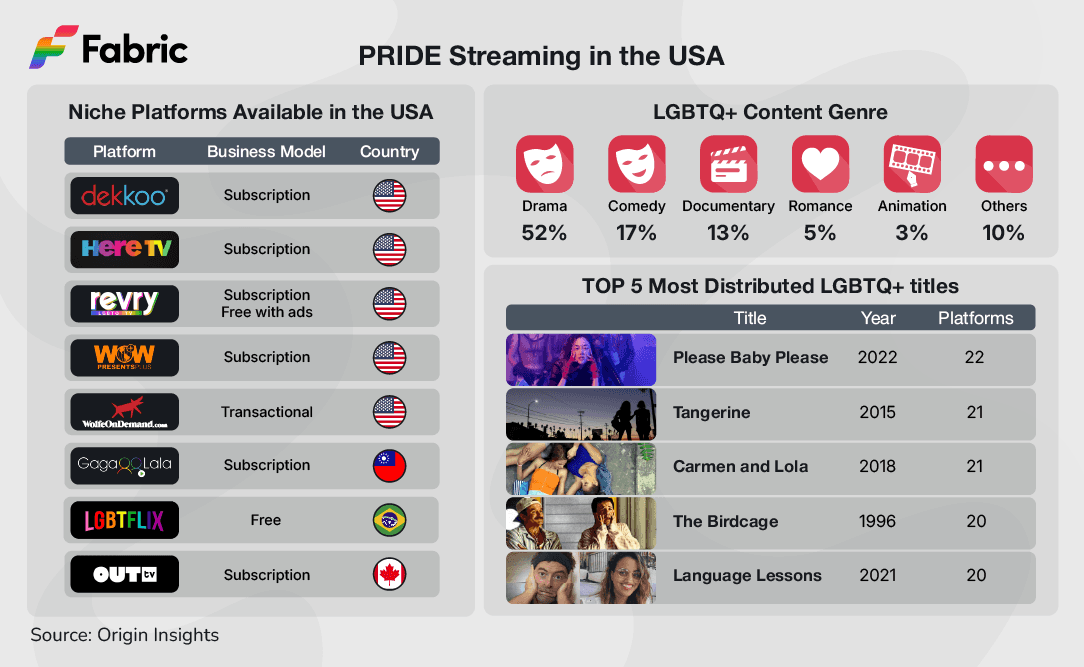
Dedicated LGBTQ+ platforms carry significantly smaller catalogs in the US market: Dekkoo carries almost 500 titles, Here TV over 430, WOW Presents Plus over 300, and Revry around 225.
This gap is not a sign of failure for dedicated platforms. It reflects a structural reality about how these two types of services operate. Mainstream platforms aggregate broadly, acquiring LGBTQ+ content as part of general catalog licensing across genres and territories. Dedicated platforms curate specifically, building identity-aligned catalogs where LGBTQ+ content is not incidental but central. For content owners and distributors, the strategic question is not which type of platform to prioritize but how to think about the different audience relationships each one creates. This is the kind of tv distribution insights that informs smarter windowing and licensing decisions.
The data also surfaces a catalog expansion opportunity for the platforms most commonly associated with prestige content. Netflix US carries over 330 LGBTQ+ titles, with around 60% being series rather than movies. Hulu shows a similar composition at roughly two-thirds series. Disney+ and HBO Max each carry over 120 titles, both closer to an even split. Compared to the volume that transactional and free ad-supported services carry, there is meaningful room for these platforms to deepen their LGBTQ+ movie catalogs specifically, a gap that becomes more visible when set against the demonstrated audience demand trends for LGBTQ+ drama and documentary content that the genre distribution data shows.
Drama dominates, but the catalog has range
The genre distribution of LGBTQ+ content available in the US follows a pattern consistent with global data, but with notable specifics at the margins.
Drama accounts for 1,984 titles, representing roughly half of all tracked LGBTQ+ content in the US market. Comedy follows at 706 titles (18%), and Documentary at 530 (13%). Romance accounts for 159 titles, Animation for 106, and Reality-TV for 95. Horror, Thriller, Crime, and Action each fall below 80 titles individually.
The Documentary proportion is worth noting in context. At 13%, it is meaningfully higher than Documentary's share in general US streaming catalogs, reflecting the significant role that non-fiction storytelling has historically played in LGBTQ+ media, from community history to advocacy narratives to personal testimony. For platforms and distributors building LGBTQ+ programming strategies, Documentary is not a niche within this category; it is a core pillar.
The relative scarcity of Horror, Action, Sci-fi, and Thriller content also stands out. Each of these genres carries fewer than 80 titles in the tracked dataset. For content developers and acquisition teams, this represents an identifiable supply gap rather than a demand gap. Content discovery data at the genre level is what makes these gaps visible and actionable before competitors close them.
The most distributed titles reveal something about catalog strategy
The most widely distributed LGBTQ+ titles in the US market, measured by the number of platforms each title appears on, are instructive in ways that go beyond simple popularity metrics.
Please Baby Please (2022) appears on 22 platforms, making it the single most distributed LGBTQ+ title in the US market tracked by Fabric. Tangerine (2015) and Carmen and Lola (2018) each appear on 21. The Birdcage (1996) and Language Lessons (2021) appear on 20. Further down, titles including Blue Is the Warmest Color, Portrait of a Lady on Fire, Moonlight, Schitt's Creek, RuPaul's Drag Race, and Killing Eve all appear on 13 to 18 platforms each.
Several things stand out in this list. Catalog depth matters more than recency: titles from 1959, 1971, and 1978 remain among the most widely distributed, reflecting both their cultural significance and their availability for broad licensing. The list also spans a more diverse range of genres than the overall catalog distribution would suggest, including Comedy, Drama, Documentary, Horror, Animation, and Reality-TV. And 2025 titles already appear in the list, indicating that newly released content is achieving rapid cross-platform availability in the current market.
One pattern worth noting is how heavily the most widely distributed titles skew toward independent productions. Films like Please Baby Please, Tangerine, Language Lessons, Carmen and Lola, The Miseducation of Cameron Post, and Welcome to Chechnya are all independently produced and distributed, without the exclusive platform arrangements that typically come with major studio ownership. The structural logic is straightforward: an independently licensed title can be placed on as many platforms as the rights allow, while a studio title often defaults to the platform ecosystem of its parent company. For LGBTQ+ content specifically, where independent production has historically been the primary vehicle for community storytelling, this creates a distribution dynamic where the most broadly accessible titles are also the ones made furthest from the studio system.
The US business model shift is sharper than the global average
When Fabric tracks how LGBTQ+ content is distributed across streaming platforms, one of the dimensions measured is the business model of the platforms carrying it: whether the service operates on a subscription basis, a transactional per-title model, a TV Everywhere bundle arrangement, or a free ad-supported model. Mapping this over time shows how the platform landscape available to LGBTQ+ audiences has changed structurally, and the US picture between Q2 2020 and Q2 2026 tells a more dramatic story than the global average.
In Q2 2020, the majority of LGBTQ+ content available in the US was accessible through transactional platforms, accounting for 59% of all tracked availability. Subscription platforms carried 38%, and TV Everywhere bundle services accounted for just 3%. By Q2 2026, transactional platforms had fallen to 35% of availability, a decline of more than 24 percentage points over six years. Subscription platforms held relatively steady at 40%. TV Everywhere grew from 3% to 20%, reflecting the significant expansion of LGBTQ+ content into cable and telco bundle environments. A subscription with ads tier entered the data at 5%.
This streaming evolution analysis is the kind of longitudinal market intelligence that informs rights strategy and windowing decisions across the full content lifecycle. Understanding how media pricing and plan data has shifted over six years, and where it is heading, is what allows distribution teams to position content ahead of the market rather than reacting to it.
The dedicated LGBTQ+ platforms: where they come from and where they operate
Alongside the mainstream platforms carrying LGBTQ+ content at scale, ten dedicated LGBTQ+ streaming services make up the specialist layer of this market. Their geographic origins, US availability, and business models tell an interesting story about how this category has developed globally.
Six of the ten platforms are headquartered in the United States: Dekkoo, Here TV, Revry, WOW Presents Plus, and WolfeOnDemand, all US-founded, alongside GagaOOLala which was founded in Taiwan and LGBTFlix in Brazil. OUTtv and OUTflix originate from Canada. OUTFILM is based in Poland.
Of the ten, eight are available in the US market. OUTFILM and OUTflix are not currently available in the US, with OUTFILM operating exclusively in Poland and OUTflix serving a small number of markets.
What is particularly striking is the business model diversity across these ten platforms. No two operate identically. Dekkoo, Here TV, OUTtv, OUTflix, and WOW Presents Plus are subscription-only. Revry operates on a hybrid free-with-ads and subscription model. GagaOOLala combines subscription with a free tier. LGBTFlix is entirely free, which helps explain its 250-country reach. WolfeOnDemand operates on a purely transactional model, making it an outlier at a time when the broader data shows transactional access declining sharply across the market. OUTFILM offers both transactional and subscription access.
The geographic spread of origins is worth noting alongside this. While the majority of dedicated LGBTQ+ platforms are US-founded, the presence of GagaOOLala and LGBTFlix reflects the global appetite for identity-specific streaming that extends well beyond English-language markets. That both of these non-US platforms have chosen free or partially free models to achieve their global reach is consistent with the distribution logic of serving audiences in markets where willingness or ability to pay for niche subscription services varies significantly. Streaming market research at this level of granularity is what makes those structural differences visible rather than assumed.
What this means for content and distribution strategy
The US LGBTQ+ streaming market in 2026 is considerably more complex than a simple narrative about dedicated versus mainstream platforms would suggest. Content volume is heavily concentrated on mainstream services, but community reach and editorial identity remain the province of dedicated platforms. Transactional access has declined sharply as a primary access model, while TV Everywhere has emerged as a significant distribution channel that many content owners have not yet fully integrated into their rights and windowing strategy. Genre supply gaps in Horror, Action, and Sci-fi exist against demonstrated general audience demand for all three. And the most widely distributed titles span decades of catalog history, confirming that well-licensed older content continues to generate meaningful platform presence alongside newly released titles.
For teams making decisions about content acquisition, licensing windows, platform partnerships, or distribution strategy in the US LGBTQ+ market, the data points above are the kind of entertainment market intelligence that Origin Insights is built to surface: primary-sourced, human-verified, and updated continuously so that the picture reflects the market as it is today rather than as it was six months ago.
Stay ahead of the curve
We publish regular insights on streaming market data, content strategy, and platform intelligence. Follow Fabric on LinkedIn for new analysis as soon as it drops.
Fabric is a global media data company. Origin Insights delivers primary-sourced, human-verified entertainment market intelligence covering 1,000+ streaming platforms across 249 countries. Real data. Verified by humans. Trusted by the industry.
FAQ
Similar Articles
We're constantly pushing the boundaries of what's possible and seeking new ways to improve our services. Search your topic of interest.


