Learn More
/
Key Pricing Strategies and Partnerships
Disney+ is reshaping its pricing strategies and partnerships to adapt to an ever-changing streaming market. By introducing new subscription plans, adjusting prices, and forming strategic alliances, Disney+ aims to enhance user accessibility while maintaining its leadership in the industry.
Disney+ Pricing Strategies and Partnerships
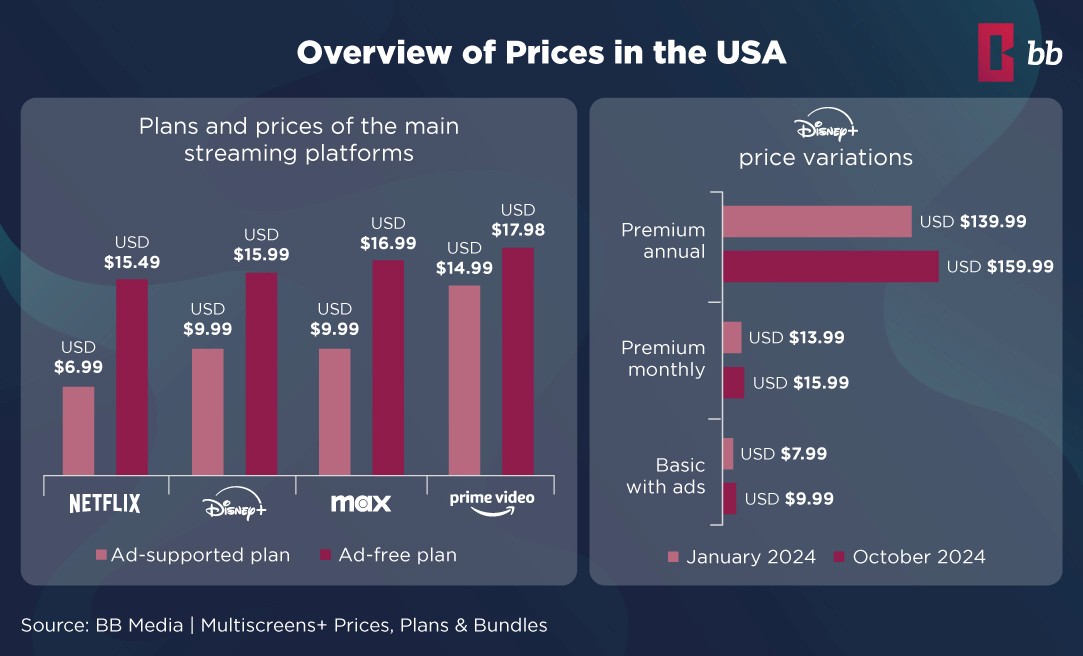
Price Adjustments in the U.S.In October, Disney+ increased its U.S. subscription rates. The ad-supported plan, which had remained at $7.99 since January, rose to $9.99 per month. The ad-free plan increased from $13.99 to $15.99, while the annual subscription went from $139.99 to $159.99. These adjustments align Disney+’s ad-supported plan with Max, although it remains below Prime Video’s price. Meanwhile, the ad-free plan is now slightly higher than Netflix’s Standard plan but continues to trail Prime Video and Max in overall cost.
Diversification Through Bundling
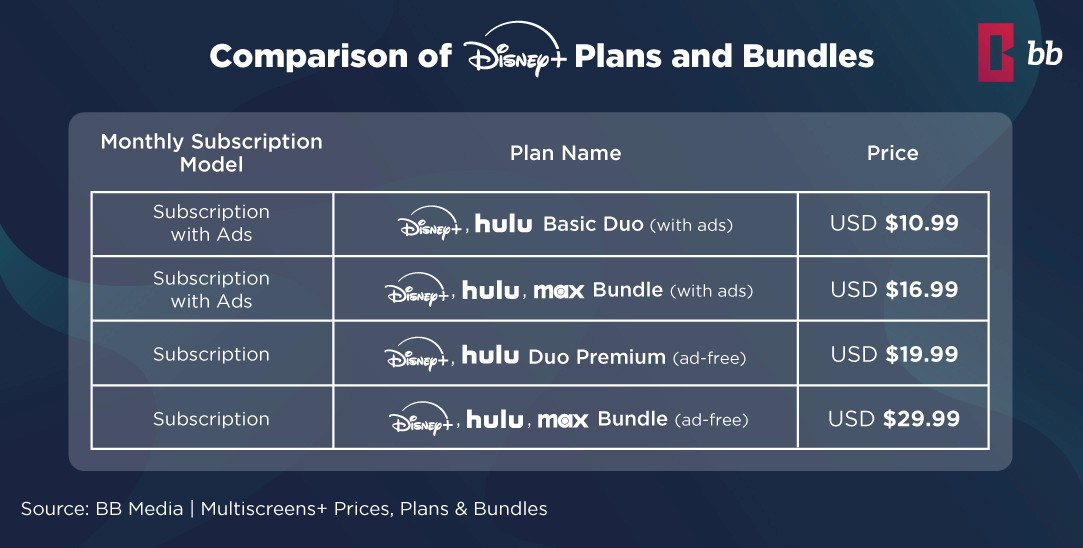
Disney+ employs bundling as a key strategy to attract users. By combining its platforms—Disney+, Hulu, and ESPN+—into a single subscription at a reduced cost, Disney+ simplifies subscription management while encouraging customers to explore more of The Walt Disney Company’s content.
Collaborative Moves with Competitors
An innovative partnership between Walt Disney and Warner Bros. Discovery has led to a joint bundle featuring Disney+, Hulu, and Max. This groundbreaking collaboration offers users access to all three platforms on a single bill at a lower cost than individual subscriptions, highlighting the importance of strategic alliances in a competitive market.
Expanding in Europe with Tiered Plans
New Pricing Models in Europe Disney+ has expanded its subscription offerings in Europe, catering to a wide range of budgets. Countries like Portugal, Poland, and the Netherlands now have “Standard” and “Premium” plans, priced at approximately $10.38 and $14.22, respectively. This model mirrors HBO Max’s strategy in Europe, where tiered plans provide users with more flexible choices.
Competitive Pricing Landscape
In Spain, Disney+’s new pricing aligns its Standard and Premium plans with Max. However, Netflix remains the most expensive platform, while Prime Video continues to offer the most affordable option.
Future Growth and Regional Expansion
New Subscription Models on the HorizonDisney+ plans to expand its pricing strategies and subscription models in regions like Latin America and APAC. Flexible options will allow the platform to cater to diverse audiences in emerging markets.
Strategic Partnerships Globally
Building on its success in the U.S., Canada, Italy, France, and Germany, Disney+ is likely to replicate its bundling and partnership strategies in other countries. These efforts are expected to solidify its global footprint and enhance its adaptability to regional needs.
The dynamic streaming landscape continues to challenge platforms like Disney+ to innovate and adapt. From pricing adjustments to groundbreaking collaborations, Disney+ remains a trailblazer in providing flexible and accessible options for its global audience. The question remains: how will other platforms respond, and what lies ahead in this competitive market?
Check out the Disney+ and the Disney+ Hotstar overview on BB Media’s Streaming Services Directory and get global data for free!
Powered by BB Media, a Fabric Data company
Similar Articles
We're constantly pushing the boundaries of what's possible and seeking new ways to improve our services. Search your topic of interest.