/

Insights

Global Strategies for Christmas Advertising and Streaming Trends

Global Strategies for Christmas Advertising and Streaming Trends

Christmas advertising

Christmas transforms how brands and streaming services connect with audiences, tailoring content and interfaces to regional traditions. This analysis reveals global advertising and streaming trends for the festive season. 

UCAN and LATAM: USA Leads Christmas Advertising

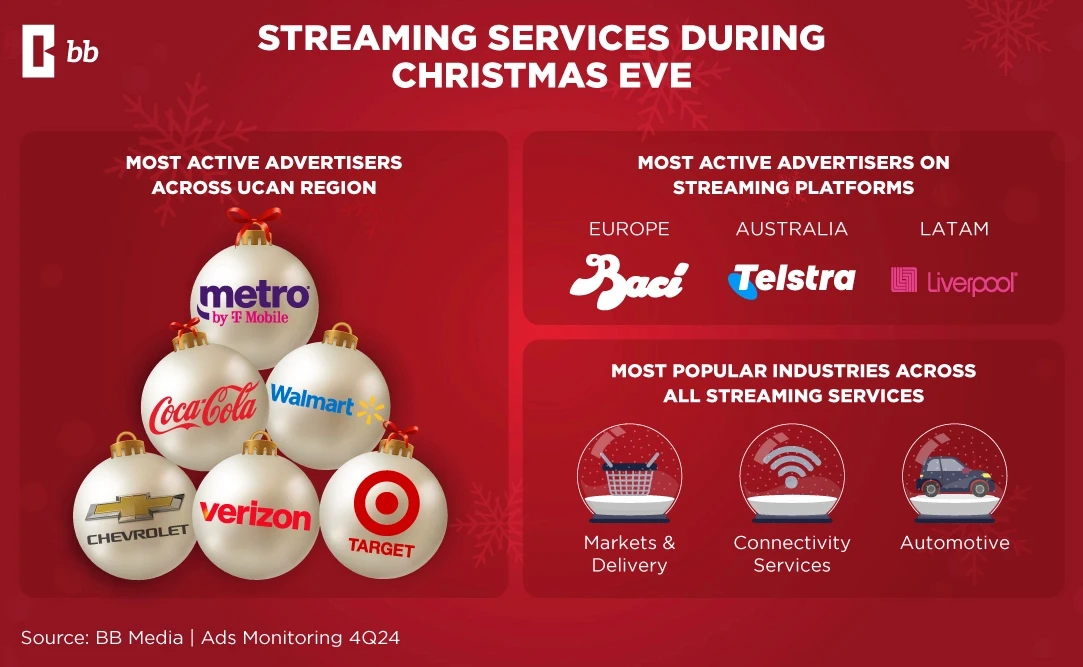
The UCAN region stands out for adapting both interfaces and ad campaigns to the holiday season. At least two Christmas-themed ads per content were recorded, with 26 unique advertisers. Metro by T-Mobile stood out as the brand that appeared most frequently across different platforms, including Hulu, Amazon Prime Video, Max, and Peacock. Their campaigns focused on electronics like cell phones and smartwatches, occupying prime ad slots and creating high visibility as the first brand viewers encounter during content interruptions.

In Latin America, the landscape varies. Liverpool dominated Christmas advertising in Mexico, becoming the most visible brand on streaming platforms. In contrast, Argentina did not feature any Christmas ads across the analyzed platforms, highlighting significant regional differences in advertising strategies.

EMEA and Asia-Pacific: Contrasts and Singularities

In EMEA, the UK led in holiday advertising, while campaigns for the Champions League and Black Friday dominated the region. Furthermore, in the UK and Spain Disney+ promoted its own Christmas content, reflecting a focus on local audiences. However, this strategy was not replicated globally, emphasizing regional uniqueness.

Australia spearheaded holiday advertising in Oceania with market and connectivity-focused campaigns in mid-roll ad slots. Conversely, Japan and South Korea lacked Christmas advertising, showcasing cultural differences shaping advertising strategies.

Advertising in Christmas and Non-Christmas Content

Among all advertisers with themed campaigns, 72% focused on non-Christmas titles, 18% targeted exclusively Christmas content, and 10% appeared in both. These insights reveal how advertisers adapt strategies based on context and festive alignment.

In the US, Dove leveraged dual advertising tactics in “Meet Me at Christmas,” using pre-roll ads and pause ads. Both campaigns reinforced the festive connection, enhancing the brand’s alignment with holiday content.

In Chile, Ralph Lauren’s Christmas campaigns exclusively targeted films, using personalized pre-roll messages. This approach underscores how festive elements can foster meaningful audience connections.

Streaming Interfaces Embrace the Festive Spirit

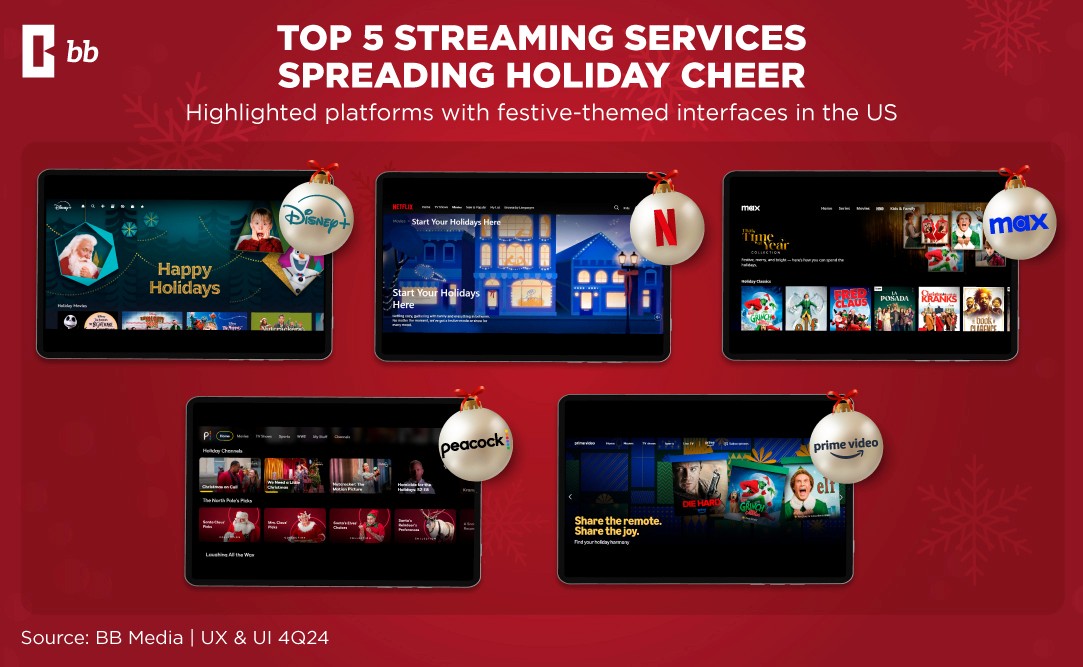
Streaming services transformed its interfaces to immerse users in the holiday season. Among the changes appear:

  • Netflix integrates an animated video as a special banner for the holiday’s collection and includes thematic categories beginning with “In the mood for…”

  • Disney+ curates’ collections “Holiday Seasons”, “Santa Clausula” and “Home Alone”.

Other platforms follow suit.

  • Max adds festive visual touches like Christmas lights in its kids’ section filters, that light up when users hover, and categories like “Fireplace Atmosphere”, with scenes of fireplaces from titles to play as background.

  • Peacock presents “Santa Claus’ Picks” category, with different holiday filters, and the special section “Find Your Seat at the Table”, that includes holiday episodes of popular sitcoms like New Girl and Brooklyn Nine-Nine.

  • Amazon Prime Video diversifies with categories like “Under the Mistletoe” and features less-represented holidays such as Hanukkah, creating a globally inclusive festive atmosphere.
Regional differences define Christmas advertising strategies. Some regions excel in festive campaigns, while others see limited impact. However, streaming platforms universally adopt festive interfaces, ensuring the holiday spirit is represented across markets. This highlights their commitment to creating engaging user experiences during key moments of the year.

Powered by BB Media, a Fabric Data company

Read More Articles

We're constantly pushing the boundaries of what's possible and seeking new ways to improve our services.

Origin Nexus Entertainment Search API with StartDateStart and StartDateEnd date range filters applied, returning a list of movies and TV titles with upcoming streaming availability dates across major U.S. platforms.

May 11, 2026

Filter Content by Streaming Availability Dates with the Origin Nexus API

Developers can now filter movies and TV titles by the date they become available on streaming platforms, using two new Origin Nexus API parameters. Here is what you can build with them and why availability-date filtering changes how audiences discover content before it starts trending.

Illustration showing three separate department systems, distribution, marketing, and rights management, each holding a different version of the same content record, contrasted with a single unified metadata platform feeding all downstream systems from one authoritative source.

May 7, 2026

Your Metadata Has More Than One Version of the Truth. That's the Problem.

When three departments each maintain their own record for the same title, none of them wrong but none of them the same, the real cost isn't the occasional incident. It's the permanent overhead of a metadata environment nobody fully trusts. Here's what a genuine source of truth looks like and what it takes to build one.

Illustration showing a media operations workflow moving from fragmented manual coordination across email, spreadsheets, and verbal handoffs to a structured, automated system with centralized job tracking and task progression.

May 6, 2026

Media Workflow Automation: How Modern Facilities Are Eliminating Manual Handoffs

Manual handoffs are not just an inconvenience in media operations — they are a structural cost that scales with every job, every team member, and every new client. Here's how modern facilities are replacing coordination overhead with automated workflows, and what that shift looks like in practice.

World map highlighting global streaming platform developments for April 2026, including new launches in Argentina, Brazil, Germany, India, and the United States, HBO Max's European and Indian expansion, AVOD updates across North America, and sports rights shifts in Central America and Europe.

May 5, 2026

The Streaming Moves That Mattered in April 2026

April 2026 reshaped the global streaming map in ways that matter beyond the headlines. HBO Max completed its European rollout, AVOD platforms consolidated around clear winners, sports rights redrew regional competition in Central America and Europe, and niche platforms continued carving out specific audiences. Here's what the month's moves mean for content strategy and distribution planning.

Xytech X2 benefits

May 4, 2026

What ScheduALL Got Right About Transmission — and Where Xytech’s X2 Goes Further

ScheduALL built its reputation in broadcast by solving a genuinely hard problem: transmission scheduling that understands how resources relate, not just whether they are individually available. Xytech's X2 Transmission replicates that relational foundation and goes further, adding a cloud-native architecture, a Network Visualizer, and an AI scheduling layer that changes what experienced transmission teams can accomplish in a day.

A layered pyramid or stacked diagram showing the five metadata types from bottom to top

Apr 30, 2026

Metadata: The Hidden Engine Behind Every Streaming Recommendation

Metadata is the hidden engine behind every streaming recommendation. For platforms competing on content discovery, the quality, depth, and normalization of movie and TV metadata — from genre tags and contributor records to thematic enrichment and availability windows — determines whether recommendation engines surface the right title or settle for a generic list. This post breaks down the layers of entertainment metadata that matter most, why sparse or inconsistent data produces shallow discovery experiences, and how continuous enrichment pipelines are the only scalable answer to keeping a catalog current. If your platform's engagement metrics aren't where they should be, your metadata infrastructure is worth examining.

Ready to take your data to the next level?

Copyright © 2026 Fabric. All Rights Reserved

Powered by AWS

Ready to take your data to the next level?

Copyright © 2026 Fabric. All Rights Reserved

Powered by AWS

Ready to take your data to the next level?

Copyright © 2025 Fabric. All Rights Reserved

Powered by AWS

Ready to take your data to the next level?

Copyright © 2025 Fabric. All Rights Reserved

Powered by AWS