Learn More
Streaming keeps evolving, and the latest disruption comes from a format that fits perfectly into today’s mobile-first lifestyle: the microdrama. These are ultra-short episodes, typically between 1 and 5 minutes long, produced in vertical format and designed for smartphones. With stories built around constant cliffhangers, and genres ranging from romance to revenge and fantasy, microdramas deliver fast-paced narratives that keep audiences hooked.
The trend has seen an early adoption across APAC, especially in Singapore, and has since expanded to global markets. Much of its momentum might be traced back to platforms like TikTok, which normalized short-form storytelling and taught audiences to view fragmented content in quick bursts.
Viewership Trends Across Regions
Perfect Timing
The current rise of the micro-drama market didn’t happen in a vacuum. It was built on the foundation of previous attempts. Most notably Quibi, which showed that while the concept was visionary, it arrived too early. The platform struggled not only because of unfortunate timing—launching in the middle of lockdowns—but also because the market wasn’t yet primed for that kind of short-form storytelling. What Quibi couldn’t establish on its own has since flourished, as audience habits and industry models have finally caught up.
Regional Viewing Patterns
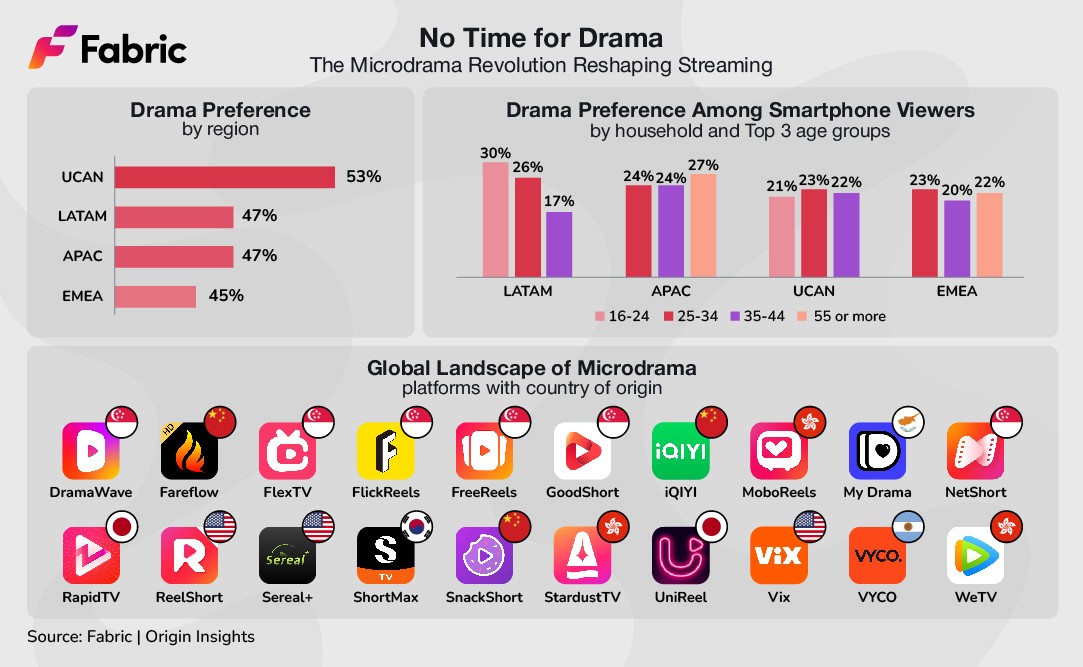
The evolution of microdramas reflects more than just a stylistic shift — it mirrors broader behavioral changes in streaming. According to Fabric Data, smartphone drama preference shows distinct regional variations.
In UCAN, drama preference among smartphone viewers accounts for 53% of streaming, with the 25–34 demographic emerging with the highest preference. In APAC, where microdramas originated, dramas represent 47% of preference among mobile audiences, and unexpectedly, the most significant uptake comes from audiences over 55. LATAM records 47% preference, where younger audiences between 16-24 lead the trend. Meanwhile, in EMEA, dramas capture 45%, with the 25–34 segment once again at the forefront.
These data points confirm that microdramas are not confined to a single market or age group. Instead, they highlight how mobile-first habits are reshaping viewing preferences across generations and continents.
Established Platforms Embracing the Format
Mainstream streaming platforms have started integrating microdramas into their ecosystems to diversify their catalogs and capture new audiences. The strategy often begins on social media, where short teasers on TikTok or Instagram drive interest, before funneling users into apps for the full series.
ViX MicrO from TelevisaUnivision has opted for a completely free distribution model to maximize reach. Meanwhile, APAC pioneers like iQIYI and WeTV integrate microdramas into their premium VIP packages. These platforms typically release the first few episodes at no cost to spark engagement, then encourage upgrades to unlock the rest of the storyline.
Specialized Platforms Competing for Attention
While established services are adapting, dedicated platforms built exclusively for microdramas are leading the charge. Reel Short, for instance, already features +450 series in Mexico and +440 in Brazil. DramaBox and GoodShort have both surpassed one million downloads, while other challengers such as ShortMax, FlickReels, and RapidTV are building strong catalogs.
In Latin America, VYCO has emerged as a significant player. Beyond distribution, it invests in original productions with regional talent, tapping into local audiences and creating content that resonates with cultural nuances.
User Experience: Fast, Addictive, Mobile-First
The unique appeal of microdramas lies not only in their length but also in the immersive experience they provide. Platforms are engineered for instant gratification, replicating the addictive flow of social media feeds. Navigation is designed for vertical viewing and single-hand use, while transitions between episodes are seamless, creating a binge-worthy flow similar to infinite scrolling.
Monetization strategies also distinguish the format from traditional subscriptions. Most platforms adopt a freemium model, where the first episodes are free and later episodes are locked behind in-app purchases with coins or credits. Others rely on advertising or hybrid models, allowing users to remove ads with a one-time payment per title or per month. This gamified approach monetizes attention in new ways, proving particularly effective with mobile-native audiences.
More Than a Passing Trend
The question now is whether microdramas represent a short-lived experiment or a new frontier in streaming. While it may be too early to declare them the definitive future of entertainment, they also might be more than a temporary fad. With data showing global adoption, addictive narrative design, and monetization models tailored to modern viewership habits, microdramas are an interesting step in digital storytelling.
For streaming services and content producers, the opportunity lies in embracing the format strategically, leveraging its immediacy and appeal to audiences who no longer have time for traditional drama.
FAQ
Similar Articles
We're constantly pushing the boundaries of what's possible and seeking new ways to improve our services. Search your topic of interest.