Learn More
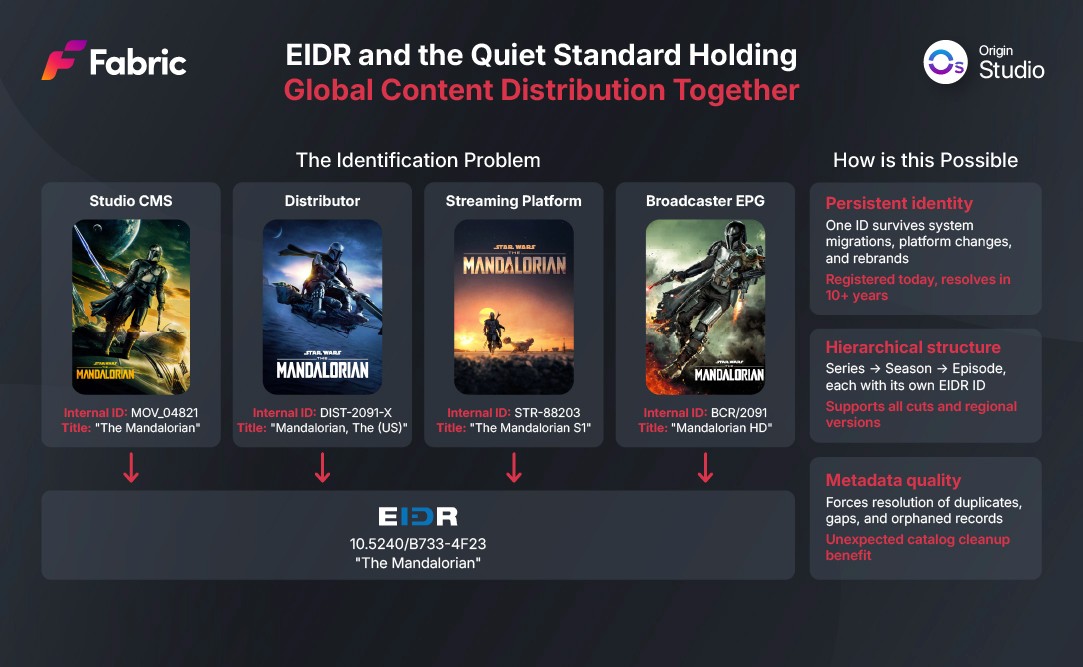
Behind every piece of content that moves across the global media supply chain, from a studio's internal systems to a streaming platform's catalog, from a distributor's records to a broadcaster's EPG, there is an identification problem. A film might be called one thing in production, something slightly different in distribution, and something different again in the platform's CMS. An episode might carry three different internal IDs depending on which system is referencing it. At small scale, this is an inconvenience. At the scale of a modern content business, it is a significant operational liability.
EIDR, the Entertainment Identifier Registry, exists to solve this. It is an industry-standard identification system that assigns unique, persistent identifiers to films, television series, seasons, episodes, and other audiovisual content. The simplest way to understand it is as the ISBN system for content: a universal reference point that allows different organizations, systems, and platforms to refer to the same title unambiguously, regardless of what they call it internally.
It sounds straightforward. In practice, making EIDR work well inside a media organization requires more than registering IDs. It requires a metadata management infrastructure that is built to accommodate it.
Why unique identifiers matter more than they used to
The proliferation of distribution channels over the past decade has made content identification exponentially more complex. A title released in the 1990s might have had one theatrical version, one home video release, and a television broadcast. The same title today might exist across a dozen streaming platforms, multiple regional versions, multiple language dubs, an edited broadcast cut, and a 4K remaster, each potentially with its own platform-specific metadata requirements, rights windows, and availability data.
Without a persistent, universal identifier attached to each of these versions and their parent title, tracking what exists, where it is, and what has been done to it becomes an exercise in manual reconciliation. Studios spend significant operational effort resolving what are essentially identification ambiguities: figuring out whether the record in one system refers to the same content as the record in another, and which version of the metadata should be treated as authoritative. This is precisely the problem that a proper metadata source of truth is designed to eliminate.
EIDR short-circuits this by providing a stable reference point that survives system migrations, platform changes, and organizational restructuring. An EIDR identifier registered today for a title will still resolve correctly in ten years and beyond, regardless of what happens to the internal systems that originally created it.
What EIDR compatibility actually requires
Registering content with EIDR is a relatively straightforward technical process. The harder part is building the organizational workflow around it, and that is where the choice of metadata management platform becomes consequential.
An EIDR-compatible records metadata management platform needs to handle several things that simpler content databases do not. It needs to model the hierarchical relationship between a series, its seasons, and its individual episodes, because EIDR identifiers exist at each level of that hierarchy and the relationships between them matter for both identification and distribution. It needs to manage multiple versions of the same title, covering different cuts, language versions, and regional releases, without collapsing them into a single undifferentiated record. It needs to maintain the EIDR identifier as a persistent, governed attribute that does not get overwritten or lost when records are updated. And it needs to support the workflows by which new content is registered, identifiers are validated, and changes are propagated to downstream systems.
For organizations managing large catalogs across multiple territories and platforms, this is not a trivial infrastructure requirement. It is the reason why content businesses that take EIDR seriously tend to also invest in studio metadata solutions rather than adapting general-purpose databases or spreadsheet workflows to the task.
The connection between EIDR and metadata quality
One of the underappreciated benefits of adopting EIDR properly is what it does to metadata management quality more broadly. The discipline required to maintain clean, hierarchical, version-aware records for EIDR compliance tends to surface and force resolution of metadata problems that existed long before EIDR was in the picture: duplicate records, orphaned episodes, inconsistent versioning conventions, missing contributor data.
Organizations that go through a serious EIDR implementation often describe it as an unexpected media catalog management cleanup project. The identifier registration process requires that records be complete and accurate enough to register in the first place, which means that gaps and inconsistencies that were previously invisible become visible and actionable. The long-term metadata scalability improvement from this process frequently exceeds the direct operational benefit of having the identifiers themselves.
How Origin Studio supports EIDR-compatible workflows
When Fabric designed Origin Studio, EIDR support was not bolted on as an afterthought. The entire system data model was built from day one to align with EIDR's data structure and support EIDR workflows and use cases natively. Series, seasons, episodes, and compilations are each managed as distinct record types with explicit relationships between them, mirroring how EIDR organizes content hierarchically. EIDR identifiers are supported as governed, persistent attributes within the record structure, maintained through updates and enrichment workflows without risk of being overwritten or lost.
The platform's governance layer, covering configurable metadata models, role-based permissions, and stage-based workflows from draft through publication, provides the organizational infrastructure that EIDR compliance requires. New titles can be registered, identifiers validated, and changes propagated to downstream systems through structured workflows rather than manual processes, reducing both the effort and the error rate associated with managing identifiers at scale. This is what API-first records metadata management looks like when it is built for the specific demands of the content industry.
Origin Studio integrates directly with Origin Nexus for metadata enrichment, which means that records created and governed within the platform are continuously enriched with normalized metadata from authoritative sources, including cast and crew, synopses, imagery, and availability, without requiring manual data entry at each update cycle. For studios and distributors managing hundreds or thousands of titles across multiple territories, this automated metadata enrichment approach is what makes maintaining EIDR-compliant records at scale operationally realistic rather than aspirational.
Thinking about media data strategy?
Content identification is foundational infrastructure: the kind that becomes invisible when it works and very visible when it does not. Follow Fabric on LinkedIn for regular insights on metadata strategy and the technology behind modern content operations.
Fabric is a global media data company. The Origin product family, including Origin Nexus, Origin Studio, and Origin Insights, powers metadata enrichment, governance, and market intelligence for entertainment companies worldwide.
FAQ
Similar Articles
We're constantly pushing the boundaries of what's possible and seeking new ways to improve our services. Search your topic of interest.