
Learn More
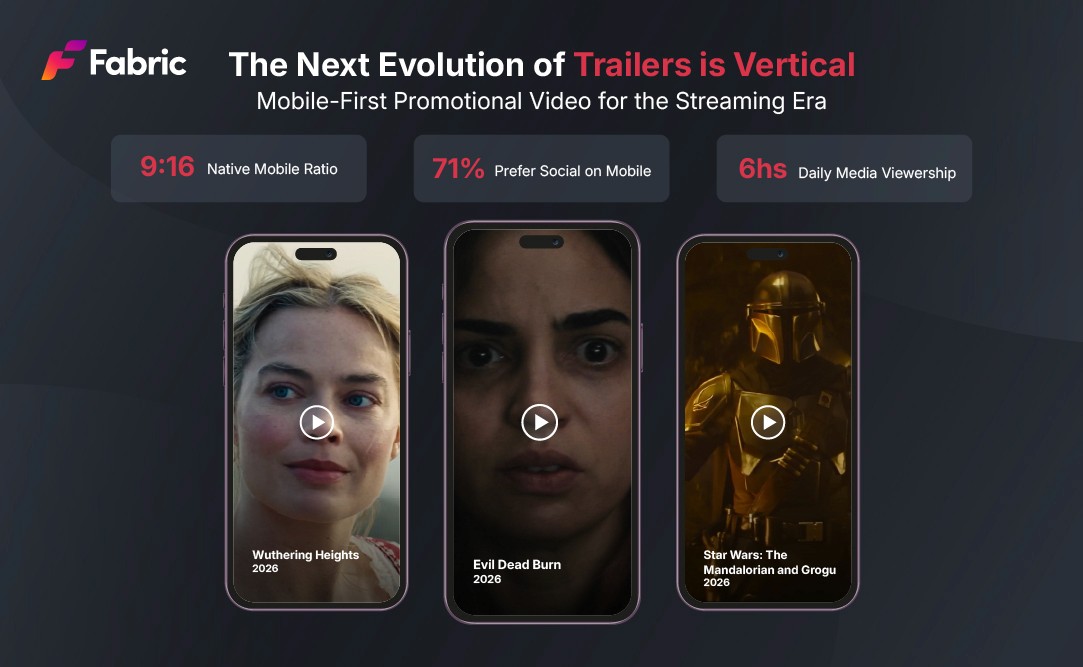
Fabric is pleased to announce the addition of vertical video support to its promotional video services, helping entertainment marketers expand audience reach on mobile devices through its distribution partners. Clients using Origin Nexus can now include vertical video assets directly within their mobile applications and streaming experiences.
As vertical video emerges as the next major evolution of movie and television trailers, it is worth examining the history of trailers and how they have continuously adapted to changing audience behaviors, viewing platforms, and methods of engagement over the past century.
A Century of Adaptation: How Trailers Have Always Found Their Audience
For over 100 years, trailers have been the entertainment industry's most powerful audience building tool. They create anticipation, shape cultural conversation, and drive tune in and purchase intent. Today, that same function is evolving into vertical, mobile native experiences that align with the TikTok era's familiar patterns of discovery and engagement.
From Theaters to Television to Mobile
In the 1920s, trailers literally trailed films after the feature presentation in theaters. Theater owners used them to encourage audiences to return and watch upcoming releases. With the rise of television, trailers evolved into 15 and 30 second advertising spots that could be distributed through traditional media buys. Today, trailers are evolving once again to meet audiences where they spend most of their time, on personal mobile devices. As video consumption increasingly shifts toward the 9:16 aspect ratio, the entertainment industry must adapt and produce content promotional data designed specifically for that experience.
Trailers as Cultural Events, Not Just Advertisements
At their core, trailers are advertisements. Their primary purpose is to persuade audiences to purchase tickets, rent or buy a title, or subscribe to a streaming service. Yet trailers have become something much larger than traditional advertising. A major trailer release can now become a cultural event shared by millions around the world. For example, the trailer for Spider-Man: Brand New Day reportedly generated more than 718 million views last March within its first 24 hours, making it one of the most viewed trailer launches in entertainment history. Few forms of advertising generate that level of audience engagement.
The Psychology of Anticipation
The most effective trailers are the ones that create what psychologists and marketers often call an open loop. The trailer for Spider-Man: Brand New Day was engineered to create suspense by emotionally priming fans to want to know what happens next. As Lynn Zubernis, Ph.D., wrote in the Psychology Today article "Anticipation Is Part of Being a Fan, and That's a Good Thing":
"Being a fan is, for many people, a source of repeated positive experiences. Becoming a fan has often been compared to falling in love, because it can produce similar emotions of euphoria and a strong desire to see or interact with the celebrity or media or activity in some way."
The anticipation surrounding a major release can trigger dopamine responses in audiences who want to resolve the emotional and narrative questions that the trailer leaves unanswered.
Fan Communities and the Trailer Breakdown Economy
Fans immediately begin searching for answers after viewing the new Spider-Man trailer. Will Peter Parker reunite with his love interest? How does Spider Man know the Punisher? Will the Hulk battle Spider Man? Will Daredevil help Spider Man fight members of The Hand? Who is the mysterious hooded figure? Could Peter become "Man Spider"? Entire communities of creators now specialize in trailer breakdowns, analyzing individual frames and developing theories that extend audience anticipation long after the trailer has ended. Trailers are clearly more than advertisements. They are engines for fandom and conversation.
The Mobile Imperative: Why Vertical Video Can No Longer Be Optional
For movie and television marketers, video remains the dominant medium for audience engagement. Consumers now spend an average of six hours per day with media and entertainment, including nearly one hour on social media platforms. According to Deloitte's 2025 Digital Media Trends report, audiences strongly prefer scrolling social media on mobile devices rather than smart TVs, with usage rates of 71 percent versus 3 percent. The report also found that audiences overwhelmingly prefer watching short form video on mobile devices. Reaching audiences on mobile devices is no longer optional, and providing vertical video experiences is becoming increasingly important for any content discovery strategy.
How Major Studios Are Responding
This year, companies such as The Walt Disney Company, Netflix, and Amazon have all expanded efforts to capitalize on scrolling video behavior across platforms such as TikTok, Instagram, Facebook, and YouTube, where billions of video plays occur daily. Because most of this viewing happens in vertical format, creating movie trailers and promotional assets in a 9:16 aspect ratio should become a core part of every movie and television marketing strategy. The platforms that win on audience demand trends will be the ones that meet audiences in the formats they already use, not just the formats that are easiest to produce.
Back to the Beginning: The Original Purpose of Trailers
In many ways, the trailer industry is returning to its original purpose. One hundred years ago, trailers were designed to bring audiences back to theaters for the next experience. Today, they are designed to pull audiences deeper into streaming platforms, social feeds, and entertainment ecosystems. The platforms have changed, but the goal remains the same: build anticipation strong enough that audiences feel compelled to return. Understanding streaming user habits and preferences at the territory and platform level is what allows marketers to time and target that anticipation effectively.
Best Practices for Modern Trailer Marketing
For marketers, several best practices are becoming clear. Create trailers that establish compelling open loops and unanswered questions. Continuously release supporting video and imagery metadata such as featurettes, clips, behind the scenes footage, and cast moments to sustain audience anticipation. Produce vertical video versions of promotional assets specifically designed for mobile first viewing experiences.
Vertical Video Support in Origin Nexus
Fabric Nexus clients will need to request that vertical videos be added to their account. Please contact originsupport@fabricdata.com to make a request. Identifying vertical videos by resolution is easy: the aspect ratio shows width being smaller than height (such as 1080 x 1920 vs 1920 x 1080).
Fabric helps studios, distributors, and streaming services extend the reach of their trailers metadata and promotional content. Our platform supports large scale distribution of promotional videos, including vertical video formats, at no cost. To learn more, contact us at acquisitions@fabricdata.com or visit the Fabric Origin Upload Portal.
Stay Ahead of the Curve
We publish regular insights on content distribution, promotional video strategy, and the metadata infrastructure powering entertainment marketing. Follow Fabric on LinkedIn for new articles as soon as they drop.
Fabric is a global media data company. The Origin product family, including Origin Nexus, Origin Studio, and Origin Insights, powers metadata enrichment, governance, and market intelligence for entertainment companies worldwide.
Similar Articles
We're constantly pushing the boundaries of what's possible and seeking new ways to improve our services. Search your topic of interest.


